Finn Lassen wrote:
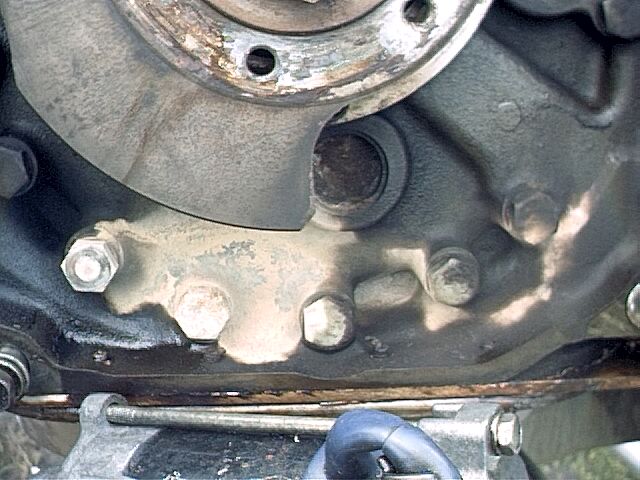
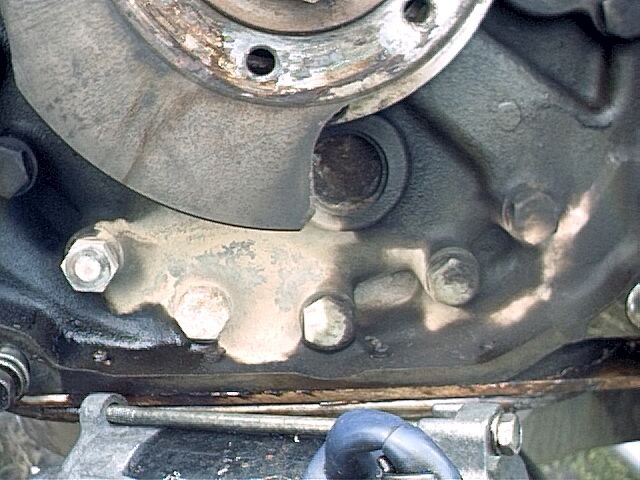
I would never have believed it but... (see picture).

Fortunately my Ross flywheel doesn't have anything sticking out that
could bend the head. The bolt head simply scraped on it. You can see how
the counterweight blew the leaking coolant towards the right.

Here's some data points:
1) Coolant system holds pressure (18 psi or more).
2) After pumping up the coolant system to 18 psi, after a few minutes
the bolt got slightly  moist (coolant).
3) While running engine under normal load and operation  after about an
hour about 1 quart of coolant has been replaced with air (coolant forced
out into overflow bottle).
4) After shutdown the coolant system retains pressure for many hours
(compressible air as opposed to incompressible coolant) preventing the
coolant from being sucked back into the engine.

Here are some questions:
1) How come it holds pressure and only slowly dribbles moisture into the
bolt hole even at 18 psi? After all the bolt hole is inside the water
jacket (between outer and inner big o-rings). Is the rotor housing to
side housing metal-to-metal contact really so tight?
2) Does this broken bolt explain the air in coolant situation. If so,
how?

There's no way I can put in a new bolt without taking the engine apart
(need to remove the broken end). Someone suggested I thread the hole and
cap it with a bolt. How important is that (one) tension bolt anyway?

If I should decide to take the engine apart (now that I'm anyway 1/2 way
there with the re-drive off) - what's the cheapest source of the needed
parts:
Tension bolt
Thrust bearing (beaten up by Ross re-drive)
Water jacket o-rings
Dowel pin o-rings
Not sure if I need oil scraper o-rings.
Anything else?

I'm not keen on trying the non-standard o-rings after seeing the picture
of what a wrong-sized expanding silicone o-ring can do to the grooves in
the housings, so I tend towards ordering the standard overhaul gasket
kit from one of the sources recently posted here.

I also need to replace at least one of the 4 sets of conical engine
mount bushings (set of 8 is #28.50 from Wag-Aero). I thought of
replacing these with plain donuts but didn't see what I'd need in the
recent tables posted here: 1"OD, 3/8" ID, 7/16" thick. 1.5" OD, 3/8" ID,
maybe 3/4" to 1" thick. Any ideas?

Finn
Ah ha!!! I told you so!!! You did not take those bolts out one at a time
and coat them with RTV, like I suggested, did you? :-)> Do I need to dig
up that message? You know I can.  Right after it happened to Perry.

All you new guys. Buy a new set of tension bolts. It is impossible to
inspect used bolts for cracks at the root of the threads. Take your old
tension bolts out one at time. Coat the new ones with RTV and replace
the one removed. Re-torque the bolt.  Then take the next one out in
the order recommended by Mazda in the shop manual. This is done to damp
a resonant condition at certain high power continuos RPMs causing the
bolts to fail from fatigue. We do not yet know what that RPM is but
we do know it is less than 5500 RPM as that is Perry's direct drive max RPM.
Since Finn cruises at low RPM is could be as low as 4000 RPM.

The O-ring failure was an anomaly. We now have a handle on the correct size
to use. Bad idea to save a few bucks and not use teflon encapsulated O-rings.
One coolant leak and an engine overheat can destroy the stock coolant O-rings.
Besides that the TES  oil o-rings are cheaper than the stock Mazda oil O-rings.

Paul Lamar

The AirCraft Rotary Engine NewsLetter.              Powered by Linux.
ACRE NL web site.
http://home.earthlink.net/~rotaryeng/            http://www.linux.org