No reasom why not! The V Max Probe was a sound Idea that suffered a
few
but tragic details in execution. The primary problems were: a bit
too
agressive
in wing and airfoil, too large a pilot for ease of control operation
and
prudent
safety gear, and a pilot with pretty much unavoidable lack of time
in
type.
A tragic set of circumstances, and a loss to all of us - Vance
A loss Indeed. I was in graduate school at the time and corresponded via
email with Lars. Unfortunately I never got to meet him in person. He
wrote
me an email the day before he made the first test flight. When I did not
get
a first flight report the next day, I knew something was wrong. The news
hit
me like a ton of bricks. I also learned a lot. The design that I posted
has
room for the pilot to wear full protective gear: helmet, parachute,
flight
suit, boots, and gloves. I  am not going for ultimate performance. The
aircraft (If I can ever get time to build it) will be designed to stall
and
land at a reasonable speed, with reasonable stall behavior. This will be
the
first goal with top speed as the second. Safety first. There is no need
to
push the envelope too much. At 300 mph aeroelastic effects and flutter
become a problem. Plus a prop spinning at 6000 rpm is dangerous enough.
Loose a blade at 300 mph and you may not have a chance to shut things
down
before parts come off the plane or G forces knock you out. They don't
call
it the bleeding edge for nothing.

Monty
Yah all be careful out there! Actually flutter can rear it's ugly head at a
lot
lower speeds than 300. A Duster sailplane suffered a nasty crash after
losing the vertical at less than 90mph. Also, if you lose a blade at
virtually
any time, you do not have enough time to shut down the engine before it
is ripped from it's mounts. The good side to this is that well designed
composite construction has better flutter resistance than almost all
other systems,

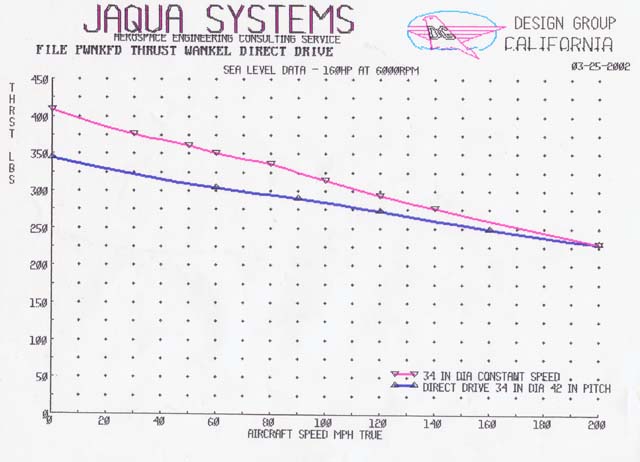
Speaking of 6000 rpm props, I promised to look at the difference between
constant speed and fixed props in this range, and the results should be
below. this was for a near stock Mazda with 160 bhp at 6000 rpm for
a 200mph capable plane on that power. The fixed prop was 34 inch
dia with about 42 in pitch. The constant speed was simulated by the
same blade area with the pitch changed to match speed. This is for a
clean installation, with free flow - interference from the fuselage
can severely degrade these predictions. The results are not half bad
for this little prop, and the gain from varible pitch appears less than
what one would expect at a lower disk loading.
Vance J
The AirCraft Rotary Engine NewsLetter.              Powered by Linux.
ACRE NL web site.
http://home.earthlink.net/~rotaryeng/            http://www.linux.org