Joseph Berki wrote:
Hi,
        Does anyone have a source for A/C evaporators for use as
a radiator? I
have searched the web and found that everything is keyed to make
and model
of the auto it goes in.  That does not help with dimensions and cubic
inches.  If you take one from a salvage yard to determine size
then order a
new one from a supplier, seems like there should be an easier
way. I know
the salvage yards could probably come up with several but how
does one
test the integrity of a component that has questionable
history. Like mom
use to say "Don't put that in your airplane, you don't know where
it's
been".  Thanks for any help.

Joe Berki
Limo EZ
Working out details for exhaust augmented cooling
Why don't you just use a new rad under the engine? Get a free
Summit Racing catalog
and there are a bunch of different sizes of all aluminum rads to
choose from.
Admittedly evaporator cores work pretty good as Tracy has been
flying around for
seven years with only one out of the two he has in there actually
working well:-)
(Mazdas are half as hard to cool as we thought :-))

Paul Lamar
Joe here is some background info on why automotive rads are better
than evaporator
cores. I suggest you buy the Kays and London book. This is a serious
and extensive study.
The Navy spent millions on this heat exchanger study over a period of
years and the
book is a compilation of that data. Here are a few excerpts from that
book.
You need a thin rad to get the air to go through
at takeoff speeds. Tracy had a lot of trouble with his evaporator cores
and he was not entirely satisfied with the results. Two of these
might work
with 150 HP but you will need to put plenty of vents and cooling flaps
to encourage the air to go through the thicker cores.

BTW Tracy is using a thin oblique mounted automotive rad on his new RV8.

If you want to experiment with augmented cooling all well and good but
it should be done on the ground. The airport pattern is not the place
to experiment with new cooling schemes. If your engine over heats on
takeoff
it can pump the coolant over board in a matter of minutes. You then
risk very
expensive repairs to your engine. It is not like a car. You cannot just
pull over to the side of the road and stop. At a minimum you can fry
the water seal O-rings.

Paul Lamar
I'm getting by with an incredibly small radiator.  I forget the exact
dimensions now, it's only about 14 x 18 x 2 overall including tanks.
But I think it is about the minimum, and would probably not be
sufficient if you are turning more than 5500 RPM or using a
super/turbocharger.  But it's difficult to fit anything larger on a LEZ.

--
Perry Mick
Duckt N7XR
http://www.ductedfan.com
Perry did not mention that his prop also turns at 5500 RPM and sucks air
out of the rad like mad.

Paul Lamar
Joseph Berki wrote:
Paul, Perry,

The reason that I was considering evaporator cores was that I intended to
use exhaust augmentation to assist pumping air through the radiator.  The
inlet in my proposed design has a direct shot at the radiator, which is in
optimum orientation to the air flow, after 41" it expands to the dimension
of the radiator and then  converges into a 6.5" augmenter tube 24" long
after the radiator.  There is a slight bend just after the radiator .  I
have no intention of flying this until it is proven on the ground.  I may
also get a radiator built if I can't get the packaging with the evaporators
right.  Thank you for the information.

Joe Berki
I think having the air go straight through the rad is overrated.
If the duct is done right the velocity should be low. The other important
thing is turbulence in the core itself. Forcing the air to make
a right angle going into the core could enhance turbulence in the core.

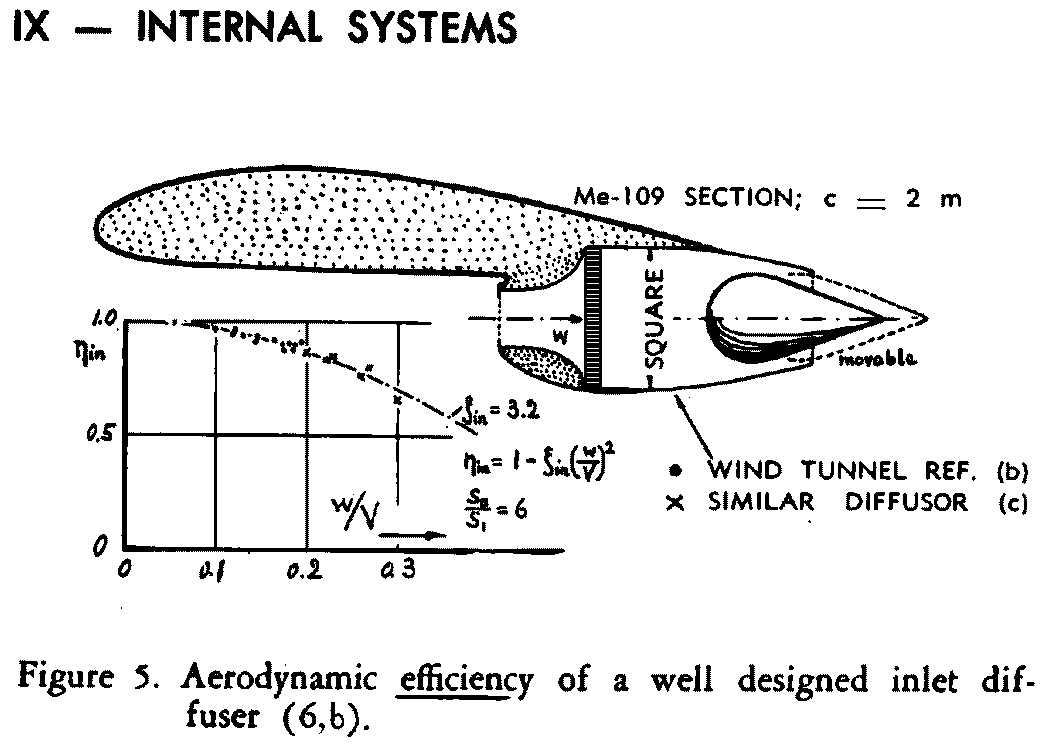
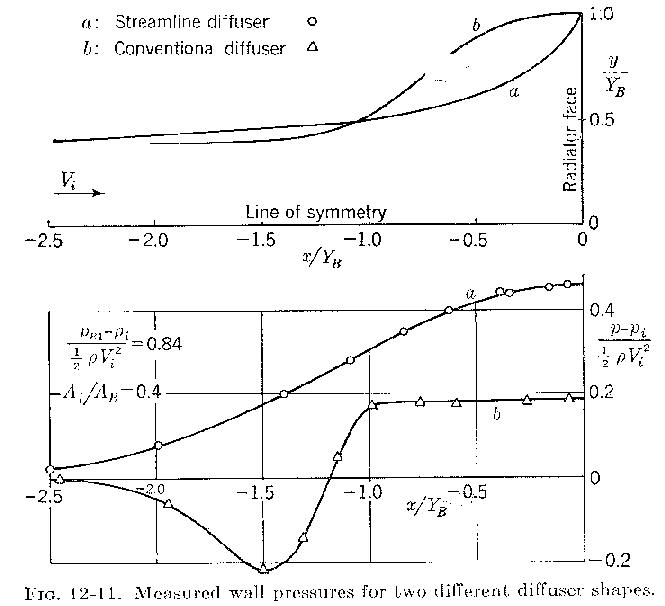
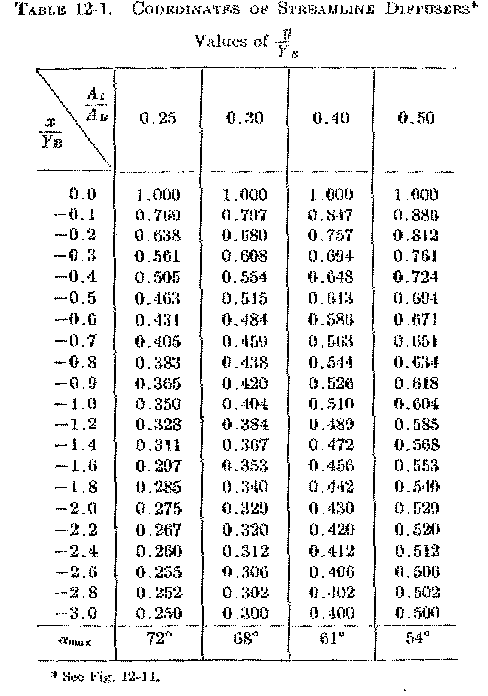
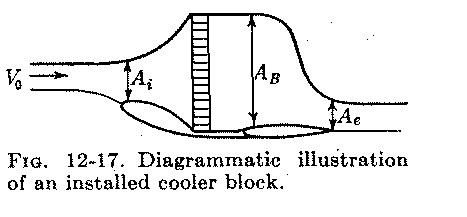
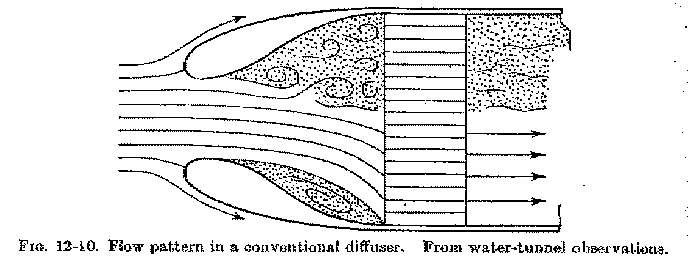
Here are some coordinates & charts for a straight in duct Joe.
This data is post WW II.

Paul Lamar

The AirCraft Rotary Engine NewsLetter.              Powered by Linux.
ACRE NL web site. Copyright 1998-2002 All world wide rights reserved.
http://home.earthlink.net/~rotaryeng/            http://www.linux.org