Fred Osborn wrote:
<snip>
In the past I?ve given some thought to the problems involved in an
in-flight prop pitch adjustment and concluded that a electromagnetic
coupling would be the best approach. Something along the lines of a
pancake 2 phase or stepper motor generator with its rotor on the prop
shaft directly driving a 2 phase or stepper motor and gear train in the
hub. A switch would control the generator stator DC excitation (+ off -)
to determine the status and phase (direction) of the motor drive. It
seemed to me that this could resolve all of the wear and contamination
problems at a minimal weight penalty.
<snip>
Fred Osborn
I would love to see a design for that. Can you get power to the motor
without contacts? I have no knowledge or experience in that area.
Can you do a schematic for us and upload it? Can we get the motor off the
shelf?

Paul Lamar
Yes, yes, YES!!!  Fred is on to something there.  We do this on the big
generators at work: brushless exciters.  I'm not sure just how to make a
small, light one for the LAEV, but I'm sure it could be done.  Basically,
use a static electromagnet mounted on the PSRU to create a field.  The field
can switched on or off, and polarity reversed manually or by the controller.

Mount a coil in the LAEV hub that "cuts through" the magnetic field of the
electromagnet.  This creates an AC voltage in the coil.  The voltage is a
function of the turns ratio, prop RPM, and field strength.  Now rectify it
into DC right in the hub, maybe use a zener diode to clip peaks, a capacitor
to remove ripple, and Voila!  You got a DC drive for the pitch motor.  No
physical contact, and the voltage & direction are all controlled by a fixed
coil.

On second thought, I think I can get direct DC in the hub.  The coil needs
to be wound in a torus, with the torus co-axial and encircling the prop
shaft.  Uni-directional "cutting" of the magnetic field gives DC.  No
rectifier needed.  Hmmmm.... I'm just a flange-head.  You sparkies out there
wanna chime in?

Tom Kendall
**********************************************************

I was thinking along the same lines.  The basic principle is to 1) move
a coil of wire through a magnetic field to generate electricity (your
basic, everyday generator), and then 2) use that current to drive your
prop pitch adjustment motor.  The advantage over rings, contacts,
brushes, etc. is that there are no mechanical parts to wear out, other
than the prop pitch adjustment motor assembly.

To generate the electrical current in the hub/spinner, you can:

1) Use a MECHANICAL approach.  Place a "generator coil" in the spinner.
This coil would rotate with the spinner, cutting across electromagnetic
fields from a permanent magnet (or magnets) mounted to the stationary
engine/PSRU.  The magnets can be mechanically adjusted/rotated to
introduce variable amounts of current in the spinner coil, even
reversing polarity to drive it in opposite directions.  Pros: No
aircraft current required to control system.  Cons: Permanent magnet
adjuster could be complex, and possible weight concerns.

2) Use an ELECTRICAL approach.  Again, place the "generator coil" in the
spinner.  This coil would cut across electromagnetic fields generated by
an "electromagnet coil" mounted to the stationary engine/PSRU.  The
stationary electromagnet can be electrically powered to introduce
variable amounts of current in the spinner coil, even reversing polarity
to drive it in opposite directions. Pros: Can be entirely an electrical
solution, mininal moving parts.  Cons: Draws upon aircraft electrical
sources.

3) Use another ELECTRICAL approach.  Similar to (2), but use stepper
motors and many electrical fields to control, in steps, how far the prop
pitch adjustment motor moves in either direction.  I think this is what
Fred Osborn was getting at above.  Sounds too complex for me.

There are several issues that would need to be worked out.  Here's a few
thoughts on the matter:
1) Can this "generator" generate enough current to drive a prop pitch
adjustment motor?
        a) how much force/torque is required to adjust and hold the props?
        b) how much current is required for this control motor?
        c) can this be generated at ~1000-2800 RPM prop speeds?
        d) without a heavy, bulky coil and/or magnet setup?
2) Can the motor be geared such that the prop shaft torque cannot
"reverse drive" the motor?  This would mean that a) loss of electrical
power results in a fixed pitch prop (it's last setting), and b) that no
current would be required to maintain a given pitch setting.
3) For efficiency reasons, the two coils (or coil/magnet) would have to
be very close - the closer the better.  We may even adopt an irregular
or protruding shape for the back of the spinner (under the cowl) to
maximize the interaction between the spinner's generating coil and the
stationary magnetic fields.
4) The prop cannot be adjusted without the engine running (I think this
is a non-issue).
5) The more current that can be generated, the faster the prop pitch can
change.
6) What does all this weigh - it's way out there at the prop, remember.
7) Generator coils/magnets need to be out at the radial edge of the
spinner to maximize linear speed, and increase generator efficiency.
8) The horsepower required to run this generator-come-prop-govenor would
be negligible.
9) The control system to determine prop pitch could be just about
anything
        a) Manual switch, pilot controlled (+ off -)
        b) Electrical circuit, constant speed (set RPM)
        c) Computer controlled, whatever-you-want

As Chrissi mentioned (I think) - rings & contacts DO wear ... but
they're also CHEAP.

Personally, I think the "Electromagnetic-Induction Controlled Prop" idea
has merit, and should be explored further.

One last question:  What does LAEV stand for?

Vince Orton
Starting RV-7 soon ...
Butch attached that name and despite my best efforts it stuck. :-)
It stands for LAmar Electric Variable I think as I had some of the initial
ideas. It evolved into something far better with input from a lot
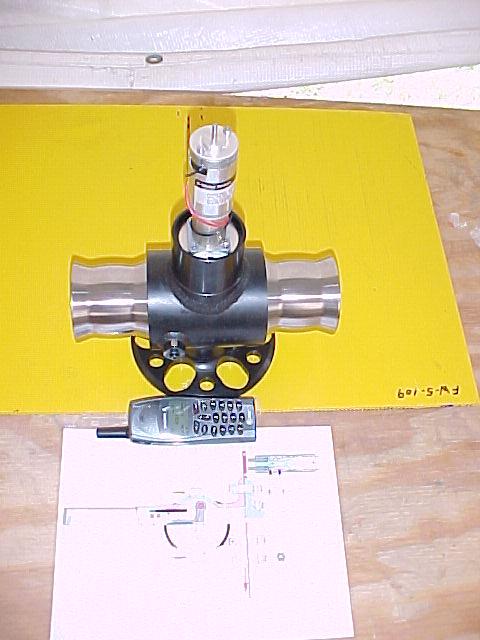
of people on this list. Here is the picture again for all the new guys.

Paul Lamar


The AirCraft Rotary Engine NewsLetter.              Powered by Linux.
ACRE NL web site. Copyright 1998-2002 All world wide rights reserved.
http://home.earthlink.net/~rotaryeng/            http://www.linux.org