Mark Waldron wrote:
Paul,

    I've been concentrating on the NA version of the 13B for my
eventual
project (due to cost and weight), but it seems worth at least
considering a
turbo.   I don't need more HP for sea level conditions, but the
extra
power
at alt (especialy for low density altitude takeoffs) might be
useful.

    So, some questions for those in the know:
    - If I recall, many have written that with the turbo they
believe
they
can get by with no muffler. If so, what's the approx weight diff
(turbo+no
muffler vs. NA and swiss or tangential muffler)
I would say it is on the order of ten or twenty pounds in favor of
no
turbo.
- Pluses/minuses of the stock turbos
Low cost.
Could over speed due to the small size of the turbine. Strict
attention
to the turbine inlet temp as the material may not be Inconel
as is available with certain after market turbo's from Garrett.
- Cost, recommendations in the aftermarket turbos
$750 and up for the turbo. $250 and up for a manifold. Then you will
need a intercooler and piping. You might get away with a stock Mazda
intercooler if you have room.
- Set-up considerations (waste gate, etc).
We are rapidly coming to the conclusion that a waste gate is not
essential with a Mazda as the engine is very robust indeed.
Fly it by the boost gage. No cylinders heads to blow off through
the sides of the cowling. The stock second gen 89-91 (best years to
use)
has a built in waste gate.
    - Reliability issues:
        -- What are the typical turbo failure modes, esp relative
to
safe
continued flight under power.
The big thing to avoid is knock. That can crack an apex seal.
Other than blowing them up from over speed turbo's have a benign
failure mode. The blades slowly melt or erode off the turbine wheel
reducing
the boost and the power and the heat energy applied to the turbine
wheel.
        -- Just how often do they fail (If used primarily for turbo
normalizing vs boost above SL/standard day conditions)
If you limit the power they could last thousands of hours.
On the other hand we have no hard and fast data. It will take 20
years to get enough turbo rotaries flying to come up with some
average life. No question about it. You will be in the experimental
stage in every sense of the word. PL
Thanks to you or any who care to reply.

Mark Waldron
Mark,
I keep wondering along the same lines and come back to KISS. From
what I
have seen here a two rotor should reliably produce 200 hp. My a/c
only
needs
150, so if I build a 200  hp 2 rotor I can use the extra power
lifting
floats out of the water and I can maintain 150 to 5000'-6000' ( a
guess ).
The rest of the time I fly it with lower power and fuel burn. No
turbo,
inter-cooler etc. and still lighter. Build light.
Cheers,
John
I'm not an expert on engine performance. Having said that,    I think
200 hp from the n/a 13-B is just a dream unless  you go to P. Porting.
That is the real answer to more  power in an aircraft installation
because it is light and simple.  And, by  keeping the tiny footprint of
the 13-B,   the PP engine will fit easily inside any cowl.  Jerry
You might also get it with careful porting and a 2.85 to one gear box
good
for another 1000 RPM or so.

Paul Lamar
Yes, but remembering those bearing load graphs that showed that the 13B
runs with the least stress in the 6000 rpm range, why not just design
for that rpm.  PowerSport has proven that the POWER is available  in the
5000 to 6000 rpm range through peripheral porting.  We need to do the
same, but with a much less expensive, do it yourself, modification.
Maybe I am missing something, but it does not seem that difficult to
do.    Jerry
Well you can take off at 7000 and cruise at 6000.

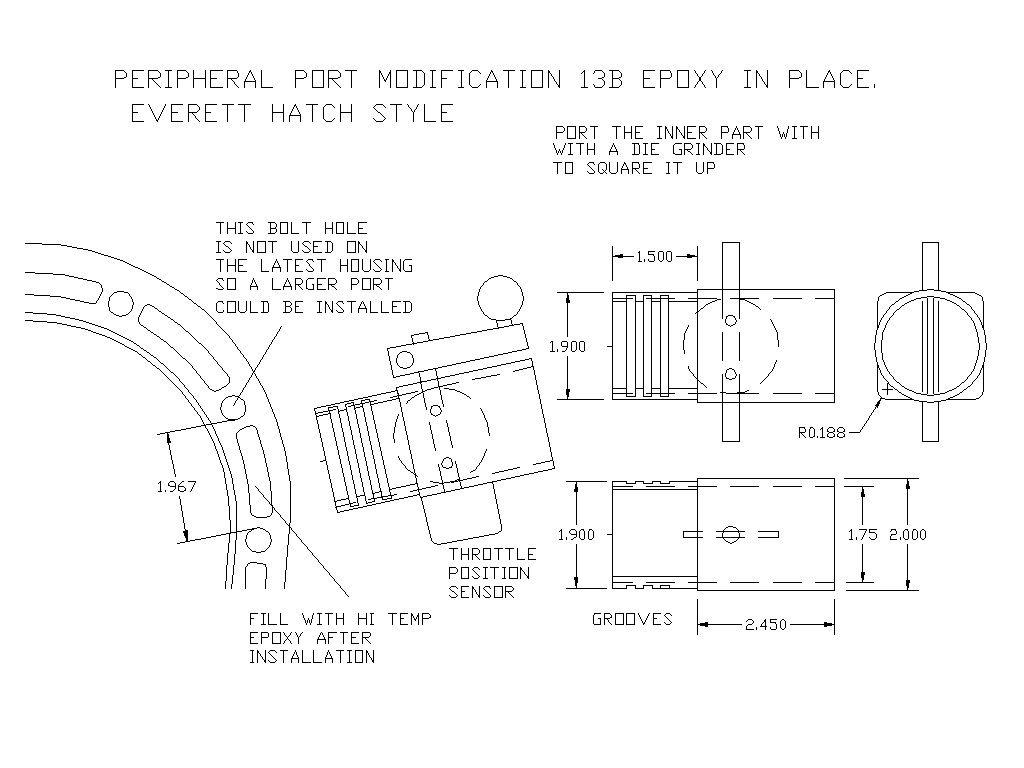
I am all for peripheral ports. Especially if you can set up
and bore rotor housings at low cost. Also provide a butterfly throttle port
insert that people can bond in. How is that project coming?

Here is a drawing. The throttle position sensor is not needed with
Tracy Crook's EFI system.

Paul Lamar

The AirCraft Rotary Engine NewsLetter.              Powered by Linux.
ACRE NL web site. Copyright 1998-2002 All world wide rights reserved.
http://home.earthlink.net/~rotaryeng/            http://www.linux.org