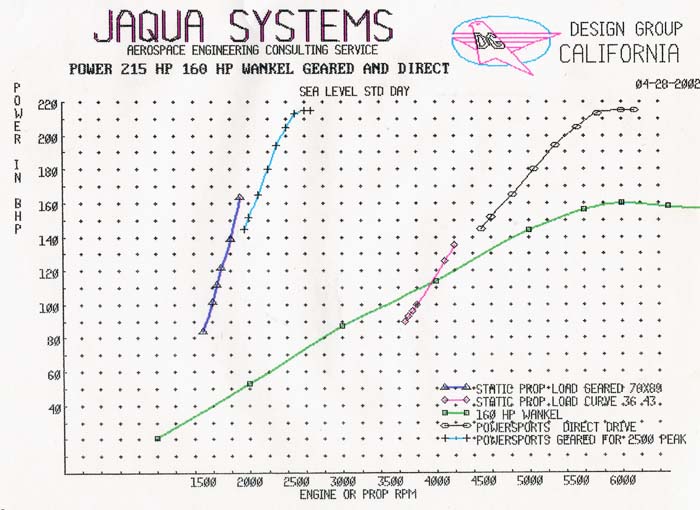
Which one was that Vance? I forgot. Perhaps it was a prop load curve.
Here is a Lyc prop load curve verses a rotary dyno load curve for a
215 HP
at 6000 RPM peripheral port rotary engine built by Power Sport.

Paul Lamar
Paul - this curve is almost as bad. The low rpm fall off is so fast that
it
almost matches the 3rd power prop load curve at static for a no valid
cross over point. An engine this peaky would be almost impossible to
idle. The top also rounds over with a "breathing limt" around what is
probably
6000 engine rpm - kinda shoots your high reduction ratio to extend the
power
concept in the foot. I suspect that this might be data "corrected" past
the
limits of believability.

If we want to explore direct drive in the 200 hp range, we still have a
need
for a VALID power curve - Vance
These are "VALID" power curves.
The peripheral ports and runner diameters in this Power Sport engine were
limited.
You want high RPM power with a p port look at this Leman engine curve
with variable length intake runner. The longest intake runner length
was about 2 feet.
The 13B is a 80 cubic inch two stroke equivalent engine despite what you
say
it is equivalent to. Your hang up is you think it is a bigger engine than
it is :-)
It will never equal a 320 cubic inch four cylinder four stroke thumper
aircraft
engine for 3000 RPM torque without a gear box. There is no replacement for
displacement when it comes to low speed torque.
That is not what the rotary is all about. It is a high RPM engine that
requires
a gear box for low RPM torque. Nobody has tuned one to my knowledge
for low RPM torque.
To get the most out of it at low spped it would probably require a dynamic
chamber intake manifold with 3 foot runners.
Here is a dynamic chamber curve from Mazda with about 2 foot runners.
Mazda has been struggling with this for years. They should give up and
put a 2:1 planetary between the engine and the gear box :-) GM built a
relatively large wankel for the Vega but never persevered long
enough to get it to work.

Perhaps a turbo optimized for 3000 RPM would get you partially there.
Frankly forget using a Mazda 13B for direct drive unless you are willing
to have a 5500 RPM prop diameter and I guess that would be 30 inches
in diameter or thereabouts.

Do you mind if I publish this? You can change your part if you wish.
Might save some people from going down the wrong road.

Paul
Yes you may make this public, I was concerned about the contreversy

I am convinced that direct drive is quite practical for a clean aircraft
with a clean
installation like the direct drive Subaru, or Perry's (without the duct).
With extreme
port as suggested by the Powersport curve you can destroy all the low end
performance to the point where any fixed pitch prop (regardless of gearing)
becomes almost a total loss at take off power.
That is a wrong impression Vance. Not much low end torque is sacrificed by the
P port itself, if any. We have no direct comparisons HP curves with a P-port tuned
for low end power. I drove a P-port NSU RO 80 in Germany and it had
just as much low speed punch as any Mazda six or four port engine.
ALL wankel engines have low displacement for their power so none of
them have the low RPM torque that a high displacement piston engine
would have.
Yes a controllible prop
is the answer to that, but I fear, in spite of your good works, that your
low cost
variable prop is at least 3 years away from flying in a customer airplane..
The 160 hp curve that you supplied is quite valid (and I used it in my
comparison with direct and geared props). The LeMans curve is also
valid, and very much what one might expect with race porting and
controlled inlet length. It also would be a loser with a fixed pitch
prop, because you would probably fall right off the "pipe" and
into that powe valley at take off.
Again this is not so much to do with the P-port as it has to do
with the longest length of the  intake runners chosen. Choose longer
runners or a dynamic chamber and you will get more low speed torque.
You will never get much more low speed torque than what you would get out of a piston
engine of equivalent displacement. A four rotor Leman engine generating
690 HP NA at 9500 RPM is equivalent to a 160 cubic inch two cycle piston
engine in displacement. The big reason a small displacement rotary generates so much
power at high RPM is breathing. The high speed volumetric efficiency is much
much higher than any engine with poppet valves that get in the way. PL
I have still not seen a usable power curve for a 200hp normally
aspirated 13b , and if the peripheral porting that you suggests, gives a
curve like the Power sport, you are doing a diservice in suggesting it.
When was the last time I suggested  it for direct drive? I don't
recall ever doing that but you could maybe search the CD and find
my slip up :-) PL
Also all these
curves seem to show a breathing limited fall off above 6000 rpm, so high
ratio
reduction drives are going to penalize efficient airframes with steeply
pitched props stalled at take off.
Wait a minute! The Leman P-port engine does not fall off in power above 6000 RPM.
If you made those movable intake trumpets even longer you could extend
the power curve way down below 4000 RPM. PL
I am enclosing some curves replotted to the same scale, including "half" of
a LeMans engine for comparison of curve shapes - Vance
The AirCraft Rotary Engine NewsLetter.              Powered by Linux.
ACRE NL web site. Copyright 1998-2002 All world wide rights reserved.
http://home.earthlink.net/~rotaryeng/            http://www.linux.org