If you can predict the pressure then you have predicted the power(less
friction
if you use IMEP) normally the equation is reversed using stated power to
compute the BMEP (Brake meam effective pressure) . This is often used
as a reality check on advertised power of normally aspirated engines
(with boosted or nitro'd engines you can dial any amount of power
you want - right up to distruction) - I once wrote an article for
Contact
magazine titled "Seperating the BS from BHP with BMEP"
Wankels are pressure/area/volume expansion engines like all the
rest, and the same rules apply - Vance
Norman DeBoer writes:
Thank you Vance for your response.  Yes, all that you say is correct.
The first item P = 146 is the predicted pressure (IMEP) for the Zoche
Aero
Diesel engine.  All the rest of the parameters are given or are claimed
(300 HP). Could something like the PLANK/33000 formula be developed for
the
Rotary Engine?
As inferred above, all the same basic rules apply to any form of
positive
displacement expansion engine. Since we do not have classic bore and
stroke, the
equivalent is the swept volume of an individual cylinder/chamber cubic
inches, divided
by 12 (this is our LA) NK then becomes the number of expansion
completions (power
strokes) per turn of a reference shaft times the rpm of that shaft. The
Wankel output shaft
turns 3 times for each turn of the trochoid rotor, and each of those
turns makes 3 complete 4 stroke cycles (3 power" strokes") for each of
the two rotors in
a Mazda 13B. so there are 2 power expansions per each turn of the output
shaft.
Each expansion displacement is half the "rated "1.3 liter displacement,
or 39.65 cubic inches
thus with 133 psig bmep (typical normally aspirated value for a
production automobile engine
and 6000 rpm we have:

133 psig * (39.65/12 ) * 2 per rev * 6000  rpm  /   33000 = 159.8 hp
Which is about what a late model stock RX7  engine will do.
Vance
========================================================
RPM PSIG 13B HP
800 133 21.3
900 133 24.0
1000 133 26.6
1100 133 29.3
1200 133 32.0
1300 133 34.6
1400 133 37.3
1500 133 40.0
1600 133 42.6
1700 133 45.3
1800 133 47.9
1900 133 50.6
2000 133 53.3
2100 133 55.9
2200 133 58.6
2300 133 61.3
2400 133 63.9
2500 133 66.6
2600 133 69.2
2700 133 71.9
2800 133 74.6
2900 133 77.2
3000 133 79.9
3100 133 82.6
3200 133 85.2
3300 133 87.9
3400 133 90.6
3500 133 93.2
3600 133 95.9
3700 133 98.5
3800 133 101.2
3900 133 103.9
4000 133 106.5
4100 133 109.2
4200 133 111.9
4300 133 114.5
4400 133 117.2
4500 133 119.9
4600 133 122.5
4700 133 125.2
4800 133 127.8
4900 133 130.5
5000 133 133.2
5100 133 135.8
5200 133 138.5
5300 133 141.2
5400 133 143.8
5500 133 146.5
5600 133 149.1
5700 133 151.8
5800 133 154.5
5900 133 157.1
6000 133 159.8
6100 133 162.5
6200 133 165.1
6300 133 167.8
6400 133 170.5
6500 133 173.1
6600 133 175.8
6700 133 178.4
6800 133 181.1
6900 133 183.8
7000 133 186.4
7100 133 189.1
7200 133 191.8
7300 133 194.4
7400 133 197.1
7500 133 199.8
7600 133 202.4
7700 133 205.1
7800 133 207.7
7900 133 210.4
8000 133 213.1
8100 133 215.7
8200 133 218.4
8300 133 221.1
8400 133 223.7
8500 133 226.4
8600 133 229.0
8700 133 231.7
8800 133 234.4
8900 133 237.0
9000 133 239.7
9100 133 242.4
9200 133 245.0
9300 133 247.7
9400 133 250.4
9500 133 253.0
9600 133 255.7
9700 133 258.3
9800 133 261.0
9900 133 263.7
10000 133 266.3

Vance:
Am I correct in my thinking here, using your formula for the stock 13B
800-10000 RPM HP figures? I'm lost where you get this 133 number.
Also what does PSIG stand for? What numbers would we change in your
formula to compare a mild/full ported 13B to a stock 13B for example?
Rich
The 133 psig was based on the highest factory rating for a normally
aspirated
rx7 engine. Psig is psi gage, or referenced to ambient rather than absolute
since it is a working pressure acroos the piston area (average during a
power stroke)
 and relates to the 160 hp rating. As I said PLANK is not a prediction
device, since it
requires you to know the pressure (which actually follows the torque
curve, and is highest at torque MAX. The actual realized value is a fuction
of breathing (volumetric efficiency) and compression ratio (assuming smooth
combustion) The stock Wankel is really not a very good breather, 133 is
along
the bottom  line for rather mundane passenger car engines, and most
"Lycosauras"
engines are in the 145 to 150 range at rated power with low compression
ratios. The torque/bmep is falling rapidly at 6000 rpm for all of the
production
Wankel curves that I have seen documented (the Le Mans engine is FAR from
a production engine, or any engine you are likely to put in an airplane) so
extrapolating that pressure  to the higher rpm values is not valid.
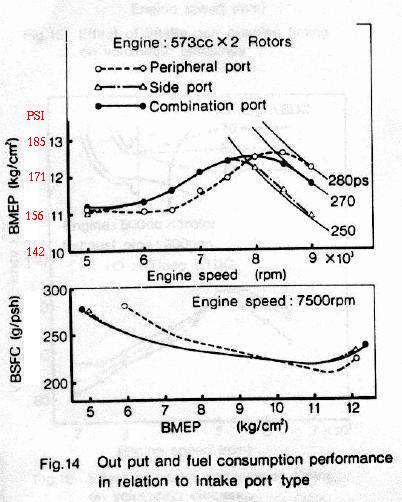
Most porting operations will actually reduce the max bmep, but  flatten
out the fall off to provide more power at higher rpm. Tuned intake porting
will increase the bmep in the affected range, since this is a form of
resonant superchargeing. Vance
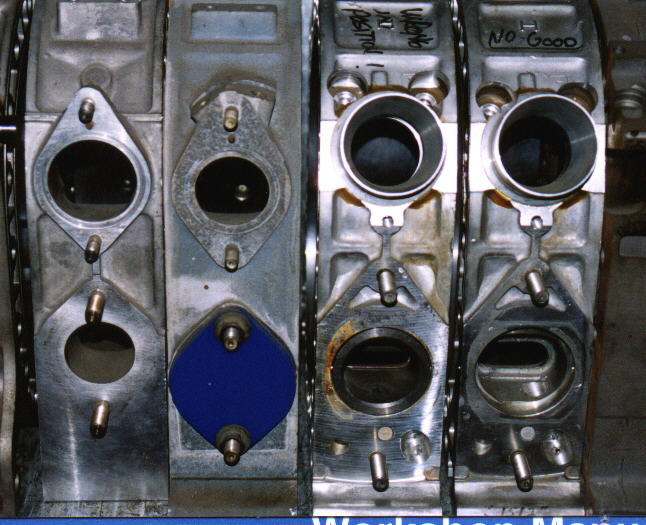
There are moves afoot to put the Leman engine porting in a rotary.
In fact you can buy modified rotor housings from Racing Beat that
duplicate the Leman porting. In that case the volumetric efficiency is
well over 120% over a wide RPM range.

This data from Mazda disputes your claims Vance. I think you are over
estimating the displacement again in your calculations of BMEP.

Paul Lamar

The AirCraft Rotary Engine NewsLetter.              Powered by Linux.
ACRE NL web site. Copyright 1998-2002 All world wide rights reserved.
http://home.earthlink.net/~rotaryeng/            http://www.linux.org