snips...
The 133 psig was based on the highest factory rating for a normally
aspirated
rx7 engine. Psig is psi gage, or referenced to ambient rather than
absolute
since it is a working pressure acroos the piston area (average during a
power stroke)
 and relates to the 160 hp rating. As I said PLANK is not a prediction
device, since it
requires you to know the pressure (which actually follows the torque
curve, and is highest at torque MAX. The actual realized value is a
fuction
of breathing (volumetric efficiency) and compression ratio (assuming
smooth
combustion) The stock Wankel is really not a very good breather, 133 is
along
the bottom  line for rather mundane passenger car engines, and most
"Lycosauras"
engines are in the 145 to 150 range at rated power with low compression
ratios. The torque/bmep is falling rapidly at 6000 rpm for all of the
production
Wankel curves that I have seen documented (the Le Mans engine is FAR
from
a production engine, or any engine you are likely to put in an airplane)
so
extrapolating that pressure  to the higher rpm values is not valid.
Most porting operations will actually reduce the max bmep, but  flatten
out the fall off to provide more power at higher rpm. Tuned intake
porting
will increase the bmep in the affected range, since this is a form of
resonant superchargeing. Vance
There are moves afoot to put the Leman engine porting in a rotary.
In fact you can buy modified rotor housings from Racing Beat that
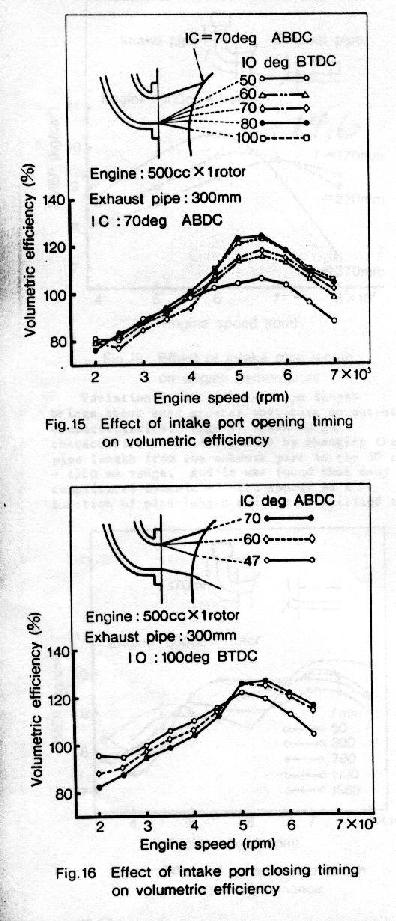
duplicate the Leman porting. In that case the volumetric efficiency is
well over 120% over a wide RPM range.

This data from Mazda disputes your claims Vance. I think you are over
estimating the displacement again in your calculations of BMEP.

Paul Lamar
Those are intersting curves - probably from a race tuned lab engine, and it
shows that
a Wankel is possible with high BMEP . The Le Mans engine shows that also,
particularly
with resonant supercharging, altho, even when it is "off the pipe" the bmep
is pretty
darn good. At 5000 rpm it is still showing 167 psig and at peak torque it is
213, a very
credible value, peak horsepower is 191, slightly above production high bucks
sport cars.
I did not "cheat" on displacement. With the calculation of BMEP you do not
need to know
the output rpm, nor the number of cylinders/chambers. You can just look at a
horsepower
values - multiply by 33000 to get ft lbs minute and the determine the number
of power/expansion
events per minute, and the expansion volume of each of those events. It
matters not if it is
1/2 per turn, as in a single cylinder 4 stroke or 12 per turn as in a V12
Detroit Diesel, or that
some part of the engine is turning at 25,000 rpm, while another shaft is
running 2rpm nor
which one the power is taken from.

No porting in the world is going to give you greater than 100 percent
volumetric eff.
without some "boost" applied upstream of the valving. - period! don't send
any
money to people that make those kind of claims. The Wankel is a good engine
but magic is in short supply and won't lift you over the trees at the end of
the
runway. - Vance
P-Porting combined with resonant supercharging on the rotary can give volumetric
efficiency well over 120% over a wide RPM range from 4000 RPM to 7000 RPM.
Here is some more data on the subject from Mazda.
The rotary is no Rube Goldberg piston engine with silly poppet
valves getting in the way :-)

Come on Vance, jump on the wankel rotary band wagon :-)

Paul Lamar

The AirCraft Rotary Engine NewsLetter.              Powered by Linux.
ACRE NL web site. Copyright 1998-2002 All world wide rights reserved.
http://home.earthlink.net/~rotaryeng/            http://www.linux.org