John Gibbons wrote:
 >
 > Okay, am I just dim or what?  These measures are quite precise (1
 > degree ), so when you have your rotor housing on the bench, how do find
TDC
 > within 1 degree ? When you answer I'm sure I'll say yeah, duh.
 Check Paul Yaw's web site. He has some pictures on there on how to
 do it within one degree. He uses a degree wheel on the nose of the
 e-shaft.  http://personal.riverusers.com/~yawpower/

 Paul Lamar
    It isn't quite that easy. If you have a fixture that holds the tip of the
dial indicator at a precise location that replicates the exact center of the
rotor housing it is easy.
Also if you get that far, you actually rock the shaft back and forth over TDC
to the same place on the dial indicator. Say .100". Then move the degree
wheel to put the TDC mark on the wheel to null between these two locations.
This because the bearing surface is so large in diameter that the dwell
around TDC will give a wide range of locations that can pass as TDC. So turn
the assembly until the indicator moves .100" one way and make a mark on the
degree wheel under your new pointer.
 Then move the assembly the other way, back passed zero (suspected location
of TDC) until you see .100" again and make another mark on the degree wheel.
Now TDC is exactly half way between these two marks. During this measuring
trauma, just pretend that the degree wheel is blank. It has no degree marks
at all. In fact, you could use a blank disc for this. Finding half way
between the marks is easy with a child's compass. If you use a degree wheel
to find TDC you can just count off the number of degrees between the two
marks.  Once you have the TDC mark on the degree wheel or a blank disc, you
rotate the crank to put the TDC mark under the new sheet metal pointer you
made. Now loosen the degree wheel to crank connection, and rotate the degree
wheel until the TDC mark on the degree wheel is under the pointer. Now mark
the pulley under the pointer to record TDC. Tighten the degree wheel to crank
connection. Now turn the engine backwards until 24 degrees (or whatever you
want to use for spark lead) is under the pointer and mark the pulley again
with a different color paint. That mark will be you max spark advance. Piece
of cake.
 Also the stock pointer (if there is one) is very hard to use. One must sight
along one of the water pump studs across the pointer to get anything like an
accurate read. Better to make up a sheet stock pointer that is held on by the
front cover bolts. This is since that once installed you may not be able to
do the sighting trick with all of the junk back on the engine and without a
ladder if its in the airplane. The fluid system is easier to get the TDC
right on than anything else I can think of. The only problem is that unless
the engine is on the bench and plugs up, you must overfill the chamber with
oil. Put in the modified spark plug in the trailing hole, with the brake line
tubing installed and a vertical plastic tube attached (old spark plug in the
leading hole) , and turn the engine back to the point where the oil column is
the tallest, so as to get most of the extra air out of the chamber. If it was
as hard to do as it sounds, nobody would have found TDC on a rotary yet. Mail
me off the list if you don't get. Or call me while the list is off the air.

Lynn E. Hanover
lehanover@aol.com
614 837 3047
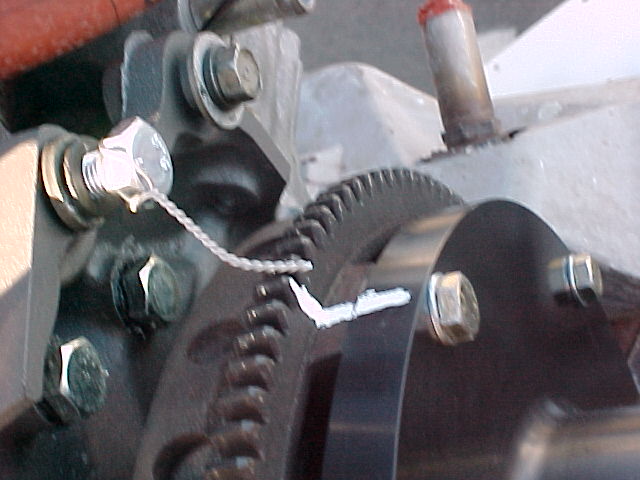
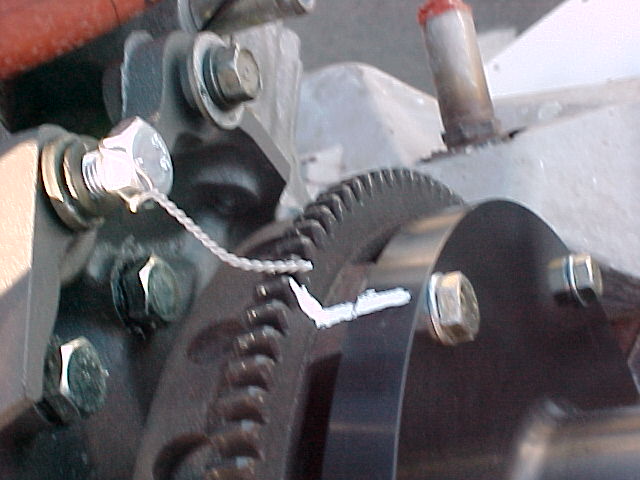
This works well in an airplane. Easy to see. Especially with a Tracy Crook  motor plate as the
ring gear is readily accessible. With a bell housing you will need a hole somewhere
to see the marker. It matters not where the marker is on the ring gear. It does
not have to be at the exact top.

Paul Lamar

The AirCraft Rotary Engine NewsLetter.              Powered by Linux.
ACRE NL web site. Copyright 1998-2002 All world wide rights reserved.
http://home.earthlink.net/~rotaryeng/            http://www.linux.org