Old message:

Jeff Spitzer wrote:
I recieved a brochure in the mail for a company that does metallurgical
analysis.  They are SMTS in Riverside.  909-689-6144.  No endorsement.

Jeff Spitzer
Funny you should mention that.
I just got Hurleys apex seal done at UCLA. 3% Si, 92% Fe, 1% S, 1% Cu trace elements
make up the rest. Don't know the percentage of carbon yet. Electron microscope.
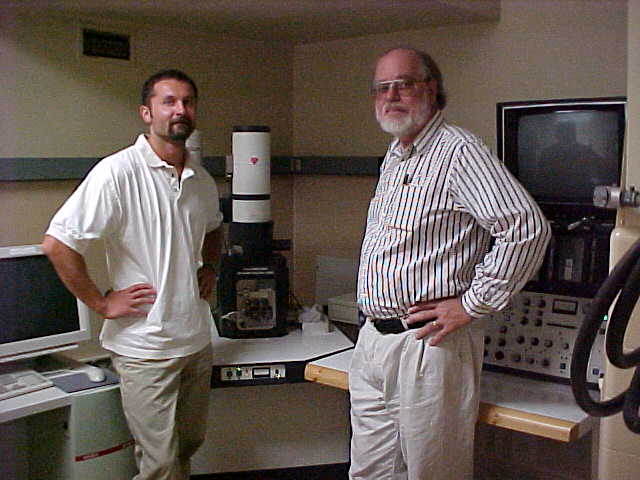
That is Doctor Sergey Prikhodko with me in front of the EM.
Anyone recognize that alloy?

Paul Lamar
---------------------------------------------------------------------
Recent message from Bruce with my reply.

BruceTurrentine@aol.com wrote:
Thanks Paul,
I've heard that the alloy may have to be imported.
Bruce
That is a possibilty.

Paul Lamar


Old messages on the subject:
-----------------------------------------------------------------------
I just found out what kind of cast iron is used in the Mazda apex
seals. "The base metal of the apex seal is accicular cast iron with
bainitic structure."

Check with your local cast iron foundry.

"The top surface of the seal..... is melted by electron beam and
rapid[ly]
solidified to provide an approxmately 3 mm chilled layer."

Check with your local heat treater.

The quotes are from SAE paper 860560 Material Technology Development
Applied to Rotary Engine at Mazda. Muroki, Miyata

I highly recommend this paper as there is lots of other good information
including the amount of lubrication necessary to keep the apex seal
temperatures
down. The apex seal can run at 240 degrees C at wide open throttle.
Again ceramic seals should excell in this regard.

Looks like it may be cheaper to buy the 3 mm ceramic seals and forget it
:-)

Paul

-----------------------------------------------------------------------------------
Jeff Spitzer wrote:
"Simple cast iron" will probably not make a suitable apex seal.  The oil
film between the apex seal and trochoid is practically non-existent.  That
is why your quoted text refers to a hardening process for the wear surface.
 The apex seals that were in the OMC engines were made from M2 tool steel.
They are fairly expensive to make because they must be ground on three to
five sides (one of them a radius as you mentioned) after heat treat.
Another issue that must be addressed is the combined friction/stiffness
effects at the trochoid boundary.  It was found by OMC (which used a
sprayed on carbide trochoid surface) that the heavy steel tip seals were
needed to dampen chatter just after the major axis.  Lighter seals seemed
like a good idea until this problem was discovered.  If you change
materials (e.g. ceramic, carbon) and reduce the friction then you can
reduce mass and still not experience chatter.  My only point here being
that it ain't as easy as "x is better 'cause y" really this is a
challenging area to delve into.

Jeff Spitzer
Yes, I finally realized that after running across that SAE paper on
the subject.

BTW In rotary drag circles this chatter phenomena is refered to
as "jump-off the hump" :-)

Paul

---------------------------------------------------------------------------------------
Jeff Spitzer wrote:
 >
Paul Wrote:
I guess the major axis is where the apex seals change angle from drag to
push.

Is that right?
Yes, IIRC this is where the apex seal begins to push.  The chatter is
caused by the drag of the tip seal pushing the seal back up into the rotor
groove hence lifting it slightly from the surface.  This, of course,
reduces the drag and the seal recontacts the surface.  If this phenomenon
is resonant you have excessive chatter.  The exact location where this will
occur is usually somewhat after the major axis on the combustion side
leading up almost to the exhaust port. (The intake side has more oil, less
drag)  The factors that determine this location are seal angle (push), tip
speed, friction, seal mass, seal spring rate, etc.  Note that the seal is
slowing down throughout this region causing a change in the normal
force/friction among other things.  This is one of those cases where if
everything is just right it will go wrong :)

Jeff Spitzer
So it is real important to match the spring rate of the apex seal with
the weight of the apex seal itself. Two mm cast iron verses three mm
cast iron for one example.

Higher spring stiffness and lower apex
seal weight would increase the resonent frequency of course.

Another good argument for light weight ceramic apex seals.

Paul

--------------------------------------------------------------------------------
 Jeff Spitzer wrote:
At 10:29 AM 9/10/98 -0700, you wrote:
So it is real important to match the spring rate of the apex seal with
the weight of the apex seal itself. Two mm cast iron verses three mm
cast iron for one example.

Higher spring stiffness and lower apex
seal weight would increase the resonent frequency of course.

Another good argument for light weight ceramic apex seals.

Paul
Yes, in general I think lighter seals are better.  Don't forget that there
are really two springs here.  One is the apex seal spring.  The seal spring
is really secondary in importance to the trochoid surface "spring."  The
frequency of the spring mass system when just the seal and leaf spring are
considered is probably so low that the seal would be off the housing for a
major part of the cycle for resonance.  This just can't happen. That's why
I made the point originally that compatability of seals and trochoid
surfaces must account for all factors (seal mass, friction, surface "spring
rate" etc).

Jeff Spitzer
I don't want to give the impression that this is a major problem.

Nobody has complained in decades. The only problem Abel mentioned with
his 700 HP Mazda two rotor is jump off the hump at 10,000 RPM and not
chatter.

Paul

----------------------------------------------------------------------------


The AirCraft Rotary Engine NewsLetter.              Powered by Linux.
ACRE NL web site. Copyright 1998-2002 All world wide rights reserved.
http://home.earthlink.net/~rotaryeng/            http://www.linux.org