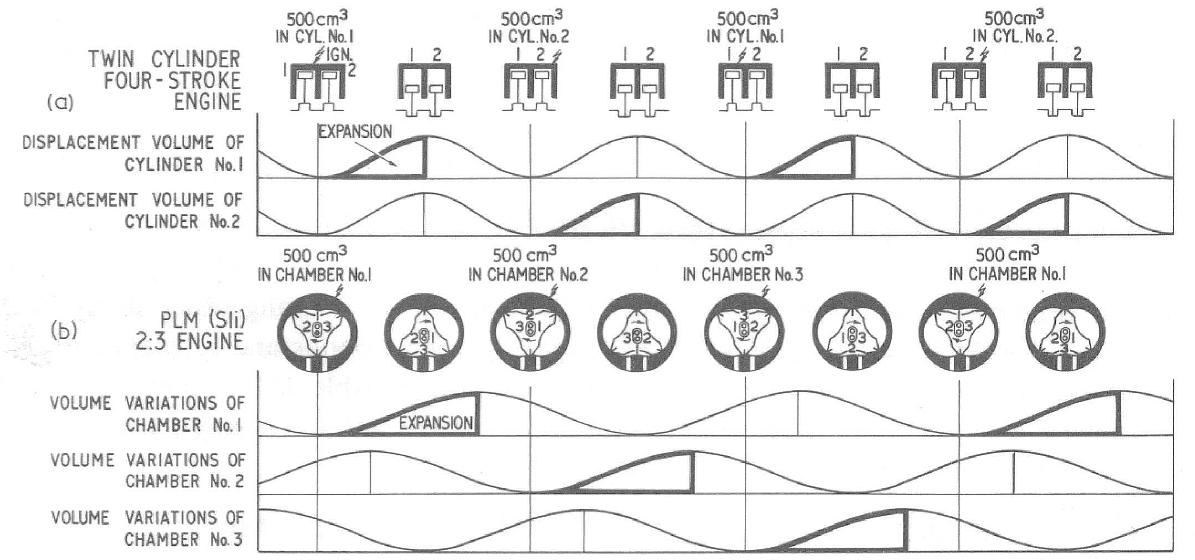
Rotary displacement verses piston engine displacement:

Here is a chart from the R.F. Ansdale book that says it all.

What is a bit controversial about this is the area under the
displacement verses shaft angle curves. As Ansdale said
on page 53:

"it ought to be reiterated that the displacement volume
of any positive displacement engine has no direct bearing
upon power output."

The rotary changes its displacement 0 to max over 270 degrees while
the piston engine changes it displacement in only 180 degrees.
However this has absolutely nothing to do with the equivalent
displacements. Displacement is displacement. Displacement is defined as
max volume of the working chamber.

If the bureaucrats and racing officials are dumb enough to tax or handicap
engines based on displacement there is always the possibility someone will
figure out how to get more power out of a given displacement. It can be
done in many ways. Up the compression ratio is one way. Improve the
volumetric efficiency is another. Power of course is a product of
torque times RPM of the output shaft.

The previous unheard of way was to change the mechanical way displacement
is varied. That is exactly what Felix Wankel did. In other words he did
not use a crankshaft to vary the displacement and Vance is crying foul
or unfair.

This, I think, is where Vance is going wrong.

The 13B is indeed equivalent, displacement wise, to a four cylinder 2.6 L four
cycle piston engine or a 1.3 L two cylinder two cycle piston engine with 2 power
pules per output shaft rotation. Just because it can generate up to 800 HP
has nothing to do with its exact displacement :-)

This is my version of Ansdale's style rebuttal Vance.

Paul Lamar

The AirCraft Rotary Engine NewsLetter.              Powered by Linux.
ACRE NL web site. Copyright 1998-2002 All world wide rights reserved.
http://home.earthlink.net/~rotaryeng/            http://www.linux.org