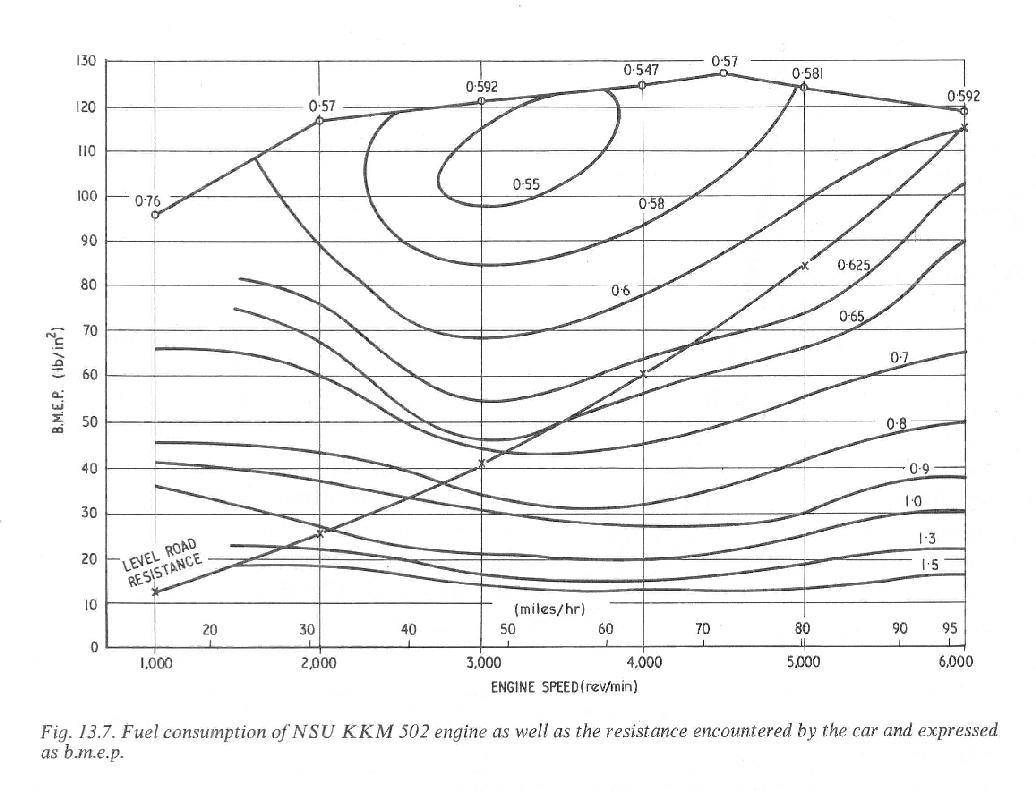
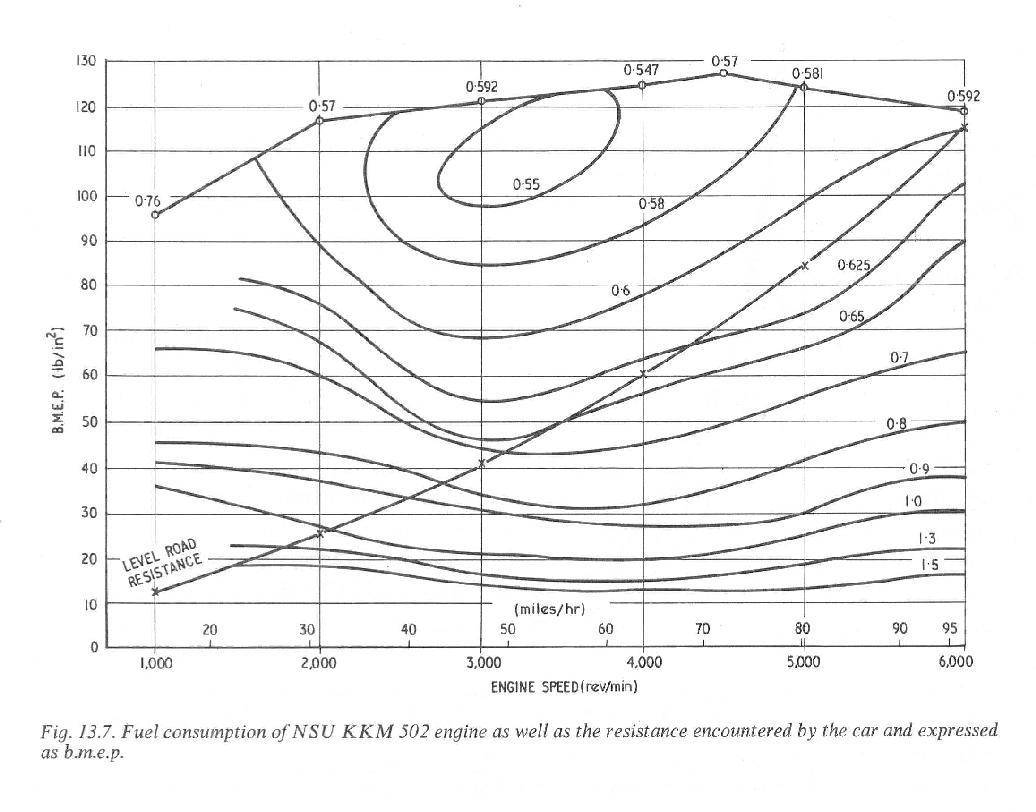
It is extremely rare to find one of these charts on a Wankel engine.
I found it by rereading R.F. Ansdale's 1969 book The Wankel RC Engine.
It is either for an NSU Wankel Spider or an NSU RO80.
Unfortunately we don't have one of these charts for a late model 13B.
The absolute numbers are not all that important however as large strides
have been made in Wankel rotary BSFC (pounds of fuel burned per HP per hour).
It is the relationships that are important and they have not changed
much in the last 30 years.

This says it all and a tremendous amount of knowledge can be gained
about a lot of things if you study this chart.

The left vertical side of the chart can be thought of as torque,
manifold pressure or throttle opening. The product of this number
and the RPM is HP.  As you can see the level road load for a car
is plotted on the chart. As you can tell with this kind of overall
gearing the Wankel rotary characteristics do not lend themselves to good
gas mileage in a car. To a large extent the piston engine suffers
from the same problem. Recent transmission developments in the last thirty
years has led to lower and lower over all gear ratios. My 1994 Cougar
with over drive cruises at less than 1900 RPM at 60 MPH. The gearing
in this chart is  3800 RPM at 60 MPH. This is roughly the same as my 1983
RX7. This also puts the throttle opening well south of optimum.
The engine is operating well out of the sweet spot.

If the gearing was decreased the road load curve would shift to
the left better matching road load with the best BSFC island.
No wonder the rotary gets bad gas mileage in a car.
The low gearing in the modern car has more to do with the improved
gas mileage than any other factor IMHO. That is not to say that
much work as not been done improving the part throttle BSFC on piston
engines as well as Mazda rotary engines.

The ideal scenario is to operate the engine at near wide open throttle
and at 2800 to 3800 RPM. This could be better done by Mazda with the proper
over drive transmission.  In an airplane that would be a good cruising speed
but you will need a variable pitch prop to load the engine down at
the speed you would like to cruise. If you are using a fixed pitch
prop and you reduced the RPM to 3800 you would probably be operating
at a manifold pressure way less than optimum and well south of the best
BSFC island.

Think about this and understand it as this is the key to a lot of
things about any I.C.E..

Paul Lamar

The AirCraft Rotary Engine NewsLetter.              Powered by Linux.
ACRE NL web site. Copyright 1998-2002 All world wide rights reserved.
http://home.earthlink.net/~rotaryeng/            http://www.linux.org