Paul - Ansdale's own curves show that a Wankel has three working
chambers/cylinders.
Output shaft rotation is not a valid way to rate displacement, Other
engines
have an
indirect relationship, usually in the opposite direction, since lower
output
shaft rpm
is generally desired, Most cam driven engines , such as the dynacam have
one
turn
of the output shaft for the entire 4 stroke cycle - much like a 2:1
reduction without
gears. A simple way to rate displacement, for any form of positive
displacement
engine is to take the charge volume of a single chamber/cylinder, and
multiply by the
number of power expansions that occur during that cylinder/chamber being
taken through it's
complete cycle. This method will work with geared engines, two stroke
engines,
and even with engines that have no output shaft, (free piston)  and if
you
insist that it
does not apply to a Wankel engine, you are atributing magic powers which
it
does not posess.
The Wankel develops 800 hp in 3.9 liters, the same way a top fuel engine
makes
3000 hp out of 400 cubic engines, and a 0.15 cu inch F1 model airplane
engine
makes almost 7 hp per cubic inch  (normally aspirated) by turning 30,000
true rpm
 on nitrated fuel. As we both agree - displacement is not an issue for
our
airplane
application, but I tend to be adament about engineering integrity.
Vance
Up until Vance Jaqua nobody has accused Ansdale of lacking integrity :-)
VJ - Ansdale was in the business of  "selling" rotary designs, and could
hardly  be considered neutral
I don't think so. All he was selling was his book.
There are sixteen cylinder engines with the same displacement
as two cylinder engines. If you don't take into consideration
output shaft rotations the concept of displacement is meaningless.
VJ - As you said displacement is displacement, There is no perfect way of
describing
engine size- but displacement is the closest. As you increase piston area,
you derive benifits
in breathing, which permits higher rpm while still filling the chamber. RPM
enters the
power, and power per cubic inch factor, but does not change displacement.
This why
many racing classes limit the number of cylinders as well as displacement,
Remember the Hondas with oval cylinders,?
Another point you are missing is ignition intervals.
With out ignition there are no expansions.
VJ- No I did not miss ignition, as you sy it is part of the power strokes
that I
told yo to count.
You are also still thinking crankshafts. As I said before:
"The previous unheard of way [to increase power per cubic inch] was to
change
the mechanical way displacement is varied."
VJ - Again NO! I included cams, and free pistons, and the expression would
work
equally as well for true rotary engines such as vanes.
Yes but cams, as in the dyno cam engine, work exactly like a crankshaft.
with only one motion control element. A better analogy to the wankel perhaps
would be something like a four bar linkage.
The combination of eccentric shaft and phasing gear is a whole
new way of changing I.C.E. volume. This is the key difference.
VJ - So it might be new, but it does not change any rules of thermodynamic
nor Physics
True but as you admit the chamber expands over 270 degrees while both
the dyno-cam and a crankshaft piston engine  expand over 180 degrees.
BTW the tooth contact is not a fulcrum as the pressure on the face
of the rotor is considered perpendicular, uniform and centered over the
eccentric.
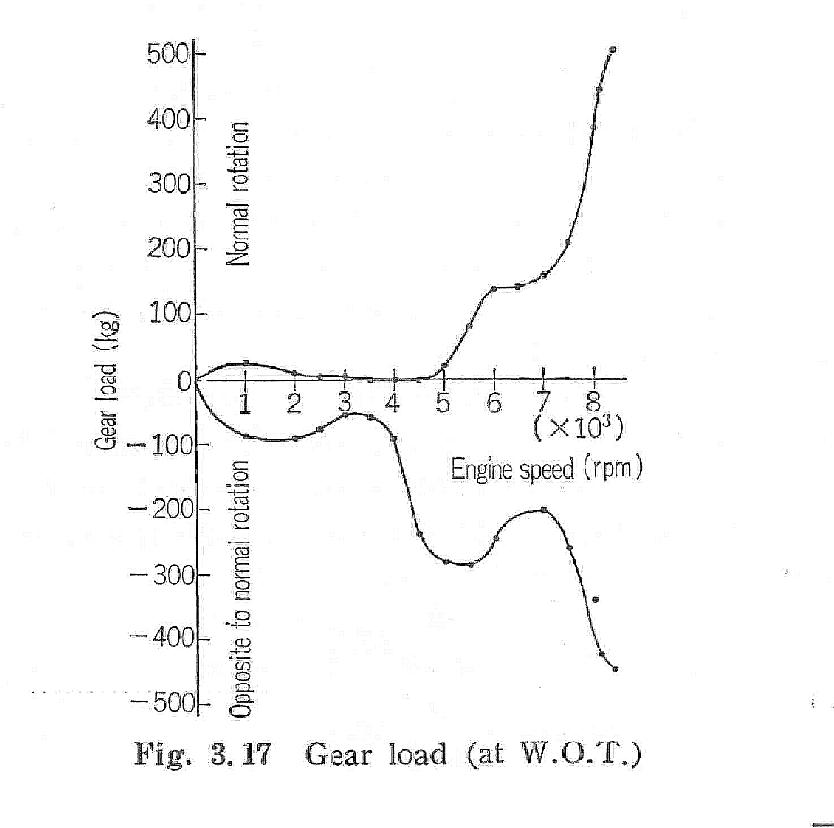
The measured tooth loads confirm that tooth load is totally unrelated
to anything but RPM. I have some charts of tooth loads in case you
are interested.
VJ - OK, I give you that - it is mostly a timing and anti tipping device -
but the engine will  self destruct if one breaks.
Yes of course. See the chart below. Improvements in gear mounting
technology have been made since this chart was published.
The 800 hp rotary is not running on nitro methane which
has it own fuel and oxidizer. Nitro methane is more like liquid dynamite.
The top fuel 400 cubic inch 3000 HP engines are running on nitro methane.
There is a huge difference between nitrous oxide the 800 HP rotary is
running
and nitro methane. I am sure Archie can fill us in on the differences.
VJ- Though different in chemistry, the effects and  limitations are very
similar.
Both are oxygen bearing, and while the nitromethane has both oxidizer and
fuel, the nitrous oxide requires that you add fuel.  Nitro methane is fuel
rich
so you have to add oxygen(air) nitrous is oxidizer rich so you add fuel.
Dragsters also played with hydrazine but that has been outlawed with good
reason
with that you would need neither fuel nor air - but it can go "high order"
(like nitro glycerine).
As Archie would be quick to explain you can get far more power out of nitromethane
than you can get out of gasoline or alcohol and nitrous oxide.

Paul Lamar

The AirCraft Rotary Engine NewsLetter.              Powered by Linux.
ACRE NL web site. Copyright 1998-2002 All world wide rights reserved.
http://home.earthlink.net/~rotaryeng/            http://www.linux.org