VJ & Paul wrote: Snip...Snip
BTW the tooth contact is not a fulcrum as the pressure on the face
of the rotor is considered perpendicular, uniform and centered
over the
eccentric.
The measured tooth loads confirm that tooth load is totally
unrelated
to anything but RPM. I have some charts of tooth loads in case you
are interested.
VJ - OK, I give you that - it is mostly a timing and anti tipping
device -
but the engine will self destruct if one breaks.
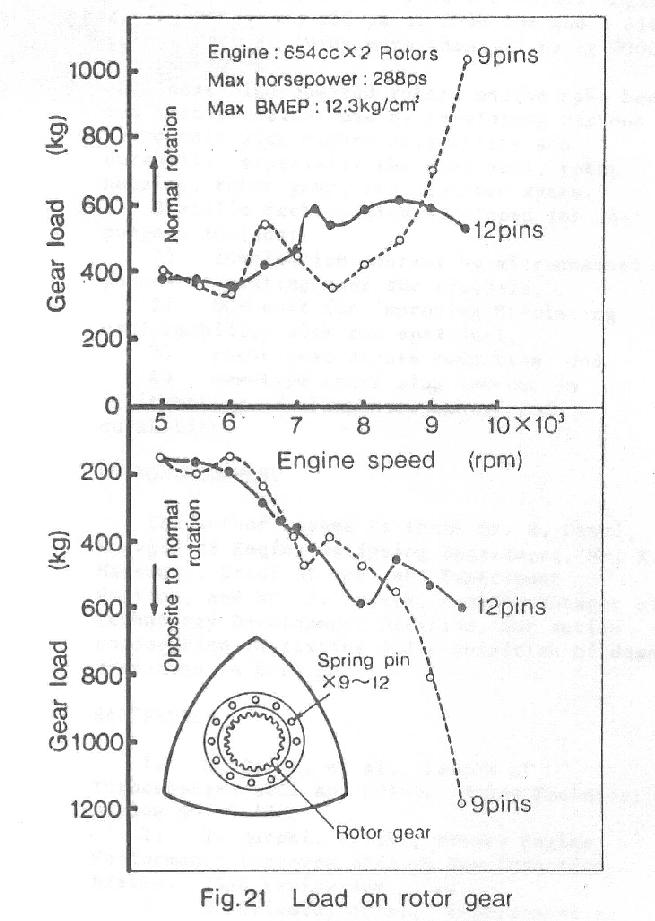
Yes of course. See the chart below. Improvements in gear mounting
technology have been made since this chart was published.

 [Image]
Paul,

I have been following this discussion fairly well but the "Reverse
Rotation"
in the chart threw me. Could we have an explanation ? BTW that chart
gave
me a much better appreciation for a 6,500 rpm redline for aircraft
applications !!

Fred O.
It throws me too. I have no idea what they are talking about.
It my have something to do with the over run. When you let up
on the gas and the inertia of the car drives the engine this
could be the case. I say this because the loads on the phasing
gears are also a function of what kind of transmission is in use.

Paul Lamar
Yep, it's pretty complex.  The main point is that the gear force has nothing
to do with the torque delivered to the crank, i.e. it is not a fulcrum
point.  I think the 'reverse rotation' just refers to which face of the
tooth is under load.

Also note that the forces on the gear tooth changed a lot (for the better)
when the 2nd gen RX-7 came out (1986) due to the change in the number of
spring pins retaining the rotor gear.  Was 9,  changed to 12.

Tracy Crook
tcrook@rotaryaviation.com
www.rotaryaviation.com
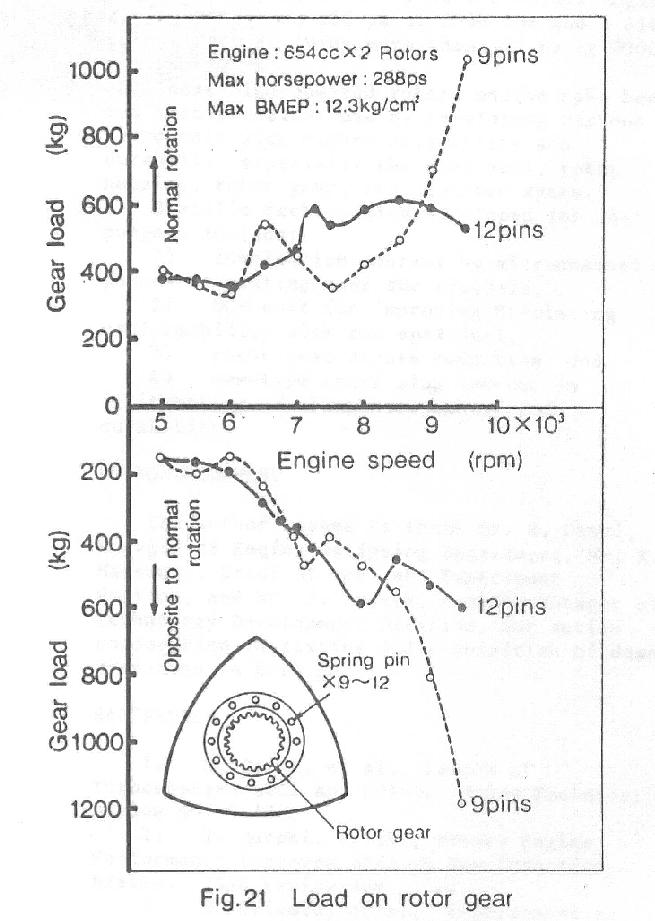
Here is a later chart to illustrate what Tracy is talking about. The limit
now looks to be around 10,000 RPM. I am sure Mazda has done additional work
on this subject since 1986 particularly for the much lighter weight rotors used
on the new RX8 engine.

We are in no danger of exceeding the limit because nobody is running
more than about 7500 RPM in aircraft use. Drag racers on the other hand
use 10,000 RPM and they only occasional have trouble with the phasing
gears. I suspect it happens on the over run. When you let up on
the gas while still in gear. Not something we have to worry about
in an aircraft. Even if the prop was wind milling the possibility of
the dead engine being driven over 5000 RPM is rather remote.

Paul Lamar

The AirCraft Rotary Engine NewsLetter.              Powered by Linux.
ACRE NL web site. Copyright 1998-2002 All world wide rights reserved.
http://home.earthlink.net/~rotaryeng/            http://www.linux.org