VJ - So it might be new, but it does not change any rules of
thermodynamic
nor Physics
True but as you admit the chamber expands over 270 degrees while both
the dyno-cam and a crankshaft piston engine  expand over 180 degrees.
No - the dyna cam expands over 90 degrees, and it could be 180 degrees
or
45 degrees  by reshaping the cam, so long as it works in integers of the
four stroke
cycle, and none of those answers would negate the system I stated for
computing true displacement.
As I recall I thought it was a skewed flat wobble plate last time I looked
at it in Torrance. That would make it 180 degrees. 45 degrees is
possible however but not practical. There is line contact between
the connecting rod rollers and the cam which limits the RPM presently
to about 1800 RPM due to high line contact stresses. This is why it is not
practical to retrofit the Dynacam in existing airplanes as the
landing gear is too short for the required  seven foot diameter props.
Are they still in business and still pushing worthless stock paper?
Dyna Cam uses a circular 2 cycle sine wave cam, ie the pistons on opposite
sides
are travelling in the same direction which makes good balance, and in effect
is
like a 2:1 reduction. Out put rated speed is 2000 rpm, good for big constant
speed
low noise props, but not much use in an RV6 or similar.  The stock is a
loser, but
not because it is a bad engine - wrong size (too small for twins) , no
market,
and no sign of sufficient funds to put it in, or create a market, and not
enough
advantage over existing established designs. -Vance J
The fact that the Wankel expands over 270 degrees is
actually de facto evidence that you should not use that rotation for
displacement calculations. No one chamber completes the thermodynamic
cycle in one rotation, nor even two rotations. It takes three full turns
for
one face to complete the four stroke cycle, and the other three then
also
complete their cycles   EXACTLY AS AN EVEN FIRING THREE
CYLINDER FOUR STROKE ENGINE OF ANY OTHER
CONFIGURATION that would have 3:2 stepup of the output shaft).
The common P V diagram for the four stroke cycle makes no mention of
angles, nor even of stroke, but only volume changes that go from minimum
to maximum in four excursions (called "strokes" for convenience) The
integrated area within the curves can be equated to foot pounds of work
per cycle. The angular travel  some output shaft has no direct bearing
on this volume - it could even be a rack and pinion with 100 turns per
stroke and the displacement would be the same.
The rather high output rpm of the output shaft is an artifact of how
the cycle is mechanized, and I am sure that Herr Wankel would
have made it slower if he could.
Vance you are replacing the world wide acceptance of the defacto standard
definition of piston engine displacement by the over simplified
dictionary definition. The piston engine world assumes 180 degree
output crankshaft expansion. The over simplified dictionary definition
states
"The volume displaced by the stroke of a piston." You are trying to relate
the Wankel rotor motion to a piston and crankshaft and it is apples and
oranges.
It is not a short stroke crankshaft and large rectangular piston. Accept
that
fact.

Why would Felix Wankel want to slow it down? The HP generated per pound of
weight  in internal combustion engine is strongly related to the RPM at
which
max HP is generated. You yourself tout the power to weight ratio
of model aircraft engines that run up to 25,000 RPM or so. The only reason
geared large aircraft engines were limited to about 3500 RPM was because
of the
inertia loads of the connecting rod and piston jerking up and down and
dead
stopping at top and bottom. Large aircraft piston engines evolved to
more and more cylinders and high RPM when they were superseded
by gas turbines.
The Wankel is not really a high rpm engine - only the output shaft is high
rpm.
The part of the engine that is harnessing the expanding gases is turning
relatively slowly, The Wankel's beauty is that it is emulating a rather
large 6 cylinder engine in a very compact package, The fact that it
has to be coupled to a  high revving short stroke crankshaft with a short
lever arm to get the power out of the engine is a disadvantage.

I do not think you can mention any possible positive displacement engine
that cannot have the displacement computed by the method that
I have stated. Vance J
Face it! Piston engines are obsolete for aircraft. The Wankel engine is
the current engine of choice for light aircraft and possibly for cars if
Mazda
perseveres. You are fighting a losing battle. Particularly on here.
This is the choir. To have owned one and understand it is to love it.
Yes! I am preaching to the choir.  I might claim to have a little bit of
how
Martin Luther (not King) must have felt. Also I should probably stop,
because
if the truth gets out the upper staff at Mazda would have to flee Japan to
avoid government expectation of a ritual public self embowelment to
preserve "Honor".  So as they say "let lying dogs sleep"

As for "the current choice for light aircraft" I cannot think of a single
manufacturer, nor even serious designer that is currently working on
a program to employ a Wankel engine as the primary powerplant. Vance J
There is no need to redesign the airplane so that is irrelevant.

I give up Vance. Have it your way. It is a six cylinder 3.9 L engine that
just happens to be half the size and weight and that can run at twice the RPM.

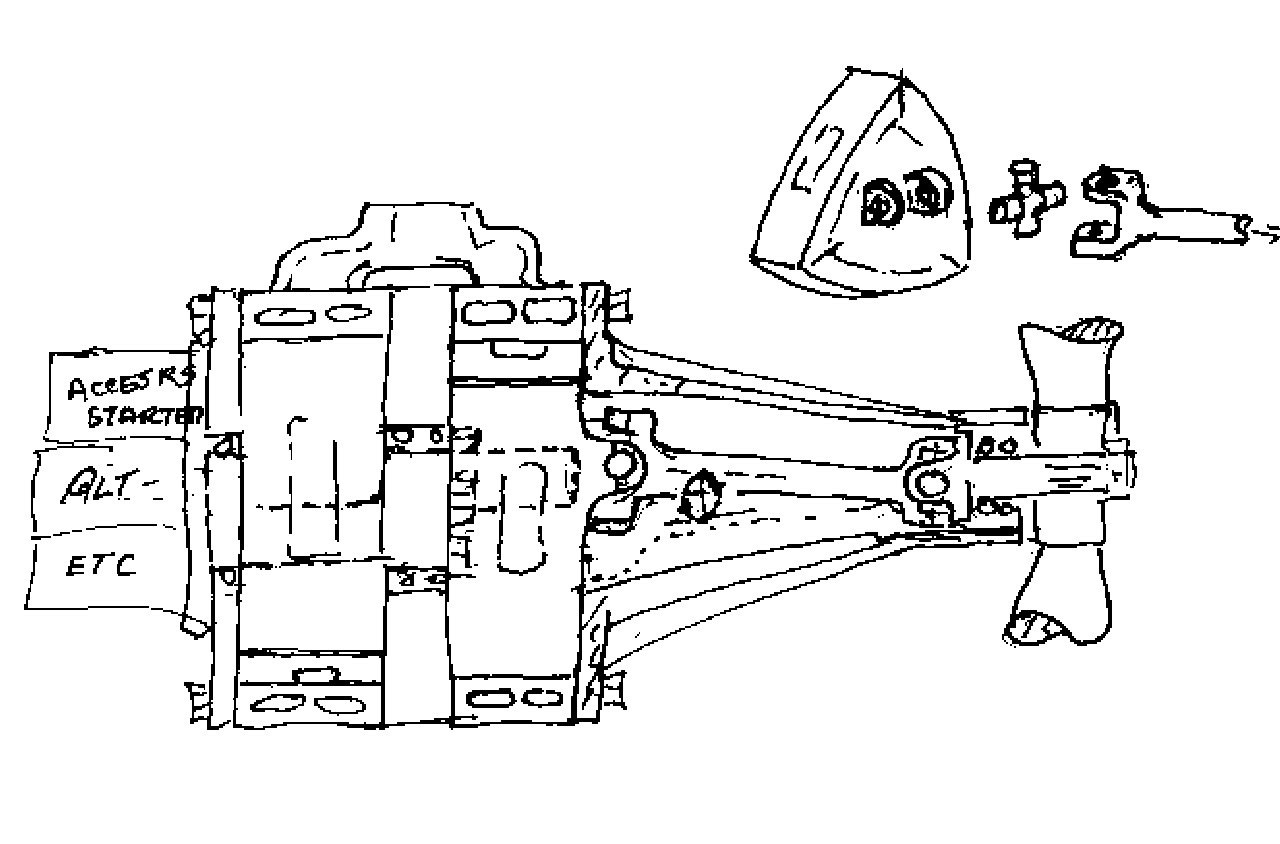
And for the new guys here is your suggestion again for getting the power
out of the six cylinders :-) If this don't slow it down nothing will :-)

Paul Lamar

The AirCraft Rotary Engine NewsLetter.              Powered by Linux.
ACRE NL web site. Copyright 1998-2002 All world wide rights reserved.
http://home.earthlink.net/~rotaryeng/            http://www.linux.org