Perry Mick wrote:
I thought my oil temp was too marginal for the horrid temperatures
back east.  At 70F ambient, I can climb full throttle power about
2000 feet, before I have to throttle back and climb at a lower rate.
That's when oil temp hits 210-220.

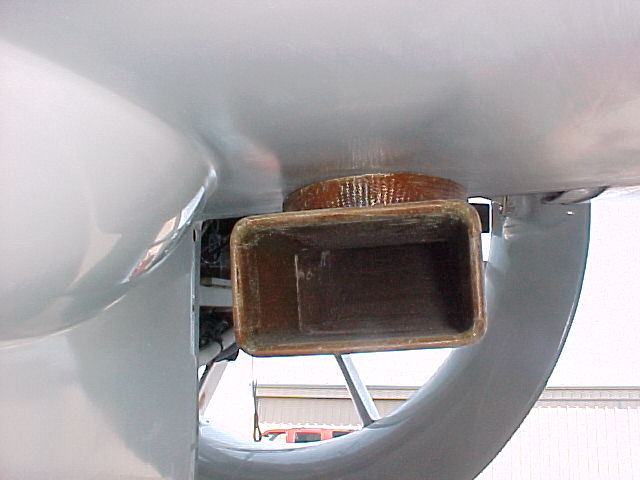
So I opened up the inlet to my oil cooler.  Increased the opening
from 5 x 2.5 inches to 5 x 4.5 inches.  Oil temp got worse.
This seems to say the pressure data I took awhile back
with an airspeed indicator was correct, and for some reason I
actually had reverse airflow in the oil cooler.  Doesn't make sense
to me, but that's what the data seems to say.  The cowl is already
about "60 mph" of vacuum as compared to ambient, and the inlet
was even lower, even though it is a ram air inlet facing forward.
So by opening up the inlet, I probably stopped all airflow through
the oil cooler, thus the higher temps.

So I took an idea I read about on the Cozy list, and cut a bunch
of 1/4 by 5 inch wide slots in the top cowl above the oil cooler.
This brought the temps back down.  Blocked off the big exit hole
in the left cowl right in front of the fan: no difference.  Closed off
the
TE hole in the cowl with a nice trailing edge in front of the fan,
like on the right side.

First takeoff with that configuration, I could hardly believe it.
I gained 100 RPM for takeoff.  From 5050 @ 80 knots to 5150.
It can now climb very well at 75 knots for best angle climbout.
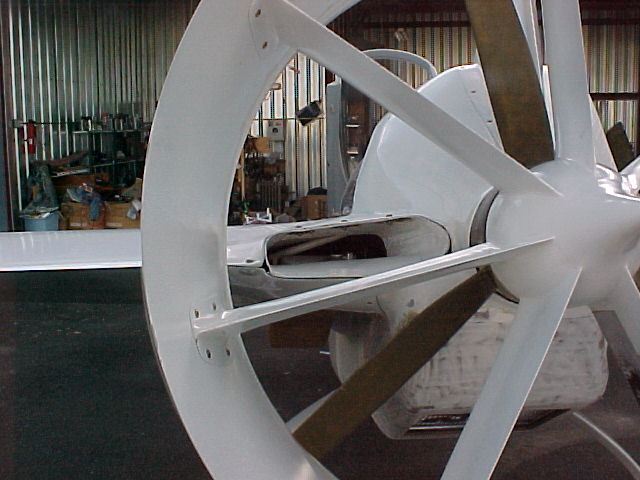
That big hole, about 2.5 x 8 (guess) about 3" in front of the fan was
disrupting airflow into the fan enough to sap some RPM.  Now it
looks and performs better. No noticable effect on speed. I've heard
you want clean airflow into the fan/prop, now I have firsthand
experience of the effects of not obeying that rule.  I've also nearly
completed a new intake manfold that will allow me to remove the
bumps on my cowl, that might help more too, but that won't be ready
before OSH.

I'm also going to try a bolt-on piece that will partially convert
the fuselage belly NACA inlet to the radiator into a scoop, see
what that does. If it works, it would only be required when ambient
temps are above 70 F.

Anyway, I'm feeling pretty good about heading to OSH in 3 weeks.
Will limit my departures to the cool morning hours.  I have enough
rad squeezed into a Long-EZ for 70F, but I don't think it will work
at 90-100F.  The temperatures here in Oregon are more moderate
year around, so I rarely have a chance to fly with ambient temps
above 80F.

I also did a 4000 foot density altitude takeoff recently, used
2600-2800 feet of runway according to the tower.  This is better
than I expected.
--
Perry Mick
Duckt N7XR
http://www.ductedfan.com
Good work Perry. I still think you would be better off with a
water manometer as you could check several pressures at the same time.
Or a data acquisition system and a bunch of pressure sensors.
I agree with reducing the bump on the engine cowl as pressure
vectors on this cowl point up and back. The back components are
drag and reduce the dynamic pressure the prop sees.

Louvers on those oil cooler slots might work even better.

Here are some pictures I took up at Perry's hangar of the
old oil cooler set up. We need new pictures Perry.

Paul Lamar

The AirCraft Rotary Engine NewsLetter.              Powered by Linux.
ACRE NL web site. Copyright 1998-2002 All world wide rights reserved.
http://home.earthlink.net/~rotaryeng/            http://www.linux.org