Jerry Hey wrote:
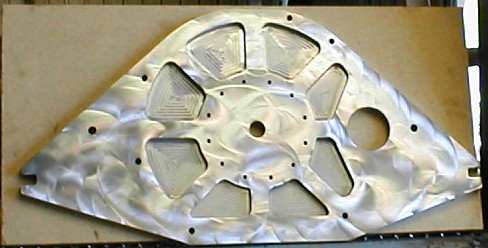
Paul, I completed the deflection tests. The MMP deflected
.174"
measured at 24 inches. Tracy's adaptor plate deflected .137
inches
measured at 24 inches. I'm dying to find out what this
signifies.
You need not worry about the test stand deflecting at all. It
was
very rigid and heavily braced. The steel plate is .375 thick
with a
piece of 3" channel as stiffener from top to bottom. This was
tied
into the stand frame and welded to the 3" plate. During the
test we
kept bubble levels on the stand and saw no movement. The two
foot
tube is 4.188 o.d.  Wall thickness is .188"

Jerry
Excellent work Jerry. Thanks a bunch.
This is 600 ft pounds of torque applied to the motor plate
and 300 pounds of shear load applied to the 10 mm bolts and
3.050 long 1/2 inch thick spacers. 600 ft pounds is the gyroscopic
torque you would get from a metal prop rotating at 2500 RPM and
pitching at 60 degrees per second. A worst case scenario
as we mostly run wood or carbon fiber props.

That includes the deflection in the two foot long,   4" dia.  188
wall,
steel pipe, the steel flange and the 10 mm bolts and spacers. Not
bad.
.174 in 24 inches is only an angle of .44 degrees. So Tracy's
stock
plate deflected about .42 degrees or so. Hardly any difference. I
think
if we tested his super light weight plate version it would
probably
deflect more than our pocketed plate.

I here bye sign it off for production :-)

You might unload the 300 pounds  and put the dial indicator under
the plate and reload the weight to see how much the 10 mm bolts
and
spacer are deflecting due to the 300 pound shear load. We will
need
to do that to prove to Tracy that our spool and our 360 degree
1/4"
plate spacer scheme is as stiff as his 1/2 plate spacers.

Paul Lamar
I hate to have to point this out, but you'll have to repeat this in
5 or 10
degree increments (rotating the engine mount plate). Not sure how
you can do
this with your existing fixture.

Finn
No we won't Finn. The plate is symmetrical enough and the angle
numbers
are small enough that we will not bother. As far as the shear loads
are
concerned they are only in the vertical direction.

Not only that nobody runs a metal prop and the test loads are for
a metal prop. This is a conservative and severe test. The angles
would probably be half for a wood or carbon fiber prop.

In the lateral plain our motor mount/PSRU plate scheme
is far more stiff as the prop gyro torque reactions are ultimately
reacted by the motor mounts. In our case that is a direct load
path while the other configurations must go through the spacers,
into the engine and then into the motor mounts.

There is way more slop in the gears than these tiny angle numbers
we are seeing.

Besides all this one could brace the plate
with 1/2 inch square 4130 diagonal tubing to the nose of the PSRU
as in this drawing. That would allow a much thinner plate with
some real PSRU weight savings.

Paul Lamar
Ok, my concern is that some if the milled pockets are directly in the
patch from
mounting bolt to re-drive - exactly where you want to have the strongest
paths.
BTW, I now have a vested interest in these results, as I'm now the proud
owner of
an ROWS redrive.

Finn
It is not that simple. All parts of the plate add to the panel stiffness.
Even the un-milled area around the periphery. That is why it is way too
hard to calculate the stiffness with out a high buck finite element
analysis
computer program. Consequently that is also why we had to test it.

BTW if you want to sell your Ross PSRU let me know.

Paul Lamar
Do you have a CAD or DXF file of your plate?  I do have Cosmos FEA analysis
with Solidworks.  Please also indicate or drawo some more details about the
spool mounts and I will see what I can do.

Marc Pedings
Thanks Marc. Here it is. We have not made the final decision on
the spool mounts. I think Jerry is still thinking about the casting.
This is to scale so you can dimension it off the ACAD R12 drawing.

Paul Lamar

The AirCraft Rotary Engine NewsLetter.              Powered by Linux.
ACRE NL web site. Copyright 1998-2002 All world wide rights reserved.
http://home.earthlink.net/~rotaryeng/            http://www.linux.org