"Webre, Steven P." wrote:
Ed and John,

My only experience w/ O2 sensors is in automotive applications where
I've
"killed" several.  One intentional, one accidental.  In both cases, the
computer yelled they had "died" after a small amount of leaded fuel.

Never thought about them still working as you've described, just not up
to
the automotive program standards. From your, and Tracy's experience,
that
is obviously the case.

Another "Cool Fact" for the day!

Likely discussed before but how did you calibrate the sensor output to
air/fuel ratio?

Steve Webre
Broussard, LA
Your experience (and many stories I've heard) indicates that for automobile
computer sensor trying to maintain 14.7 A/R from millisecond to millisecond
that indeed the lead apparently renders the sensor usless for that function.
As I understand it kills the responsivness of the sensor to respond very
quickly (milliseconds) to the changes in air/fuel mixture, but since my
response time is somewhat slower (used to be on the order of 300-500
milliseconds in my younger days - longer now) me and the lead 02 sensor
match up quite nicely {:>).

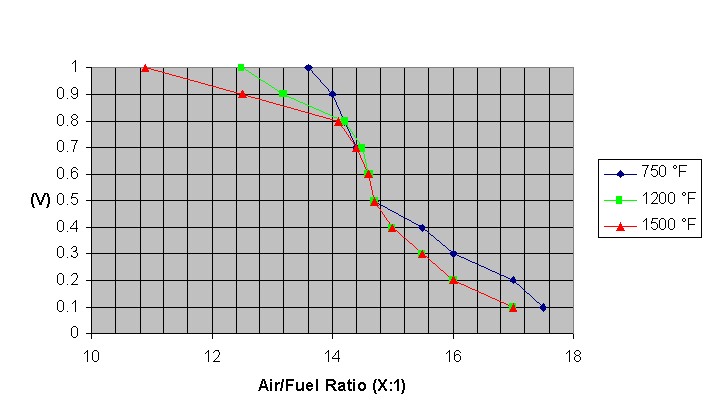
Bascially, I took the voltage curve for my sensor (see attached) which plots
its output voltage vs air/fuel ratio (at a specified temperature) which
range from 0.0 - 1.1 volts and from like 24:1 to 10:1 air/fuel ratio (this
is from memory so it may be slightly different)  and knowing that 12.62 Air
Fuel Ration is considered "Best Power" and 15.7 is considered "Best Economy"
(got this from the auto boy crowd) I set up my LEDs to light up beginning at
around 0.15 volts  and the last (richest LED) lights at around 0.96 volts
that gives me my air fuel ratio range for the meter.  You could hook up  a
voltmeter and get the numbers, but I only need a relative reference for my
tunning purposes.

The multicolored lines on the sensor curve of the second drawing were my
color code for different colored LEDs (when I used 20 of them to get finer
resolution - I found that unnecessary for my needs so now only use 10 leds)
and at voltage at which they turned on.

Some folks have used a PIC (Microcomputer) to get really down to the nat's
a__ on the 02 sensor readings but that kind of approach is unnecessary for
our needs (in my humbled opinion). The parts I used cost around $15 (not
counting the sensor and the boss to weld to the exhaust pipe).
The AirCraft Rotary Engine NewsLetter.              Powered by Linux.
ACRE NL web site. Copyright 1998-2002 All world wide rights reserved.
http://home.earthlink.net/~rotaryeng/            http://www.linux.org