Thanks...Look forward to seeing the continued development.
Would you have a photo of the other side of the engine showing how the
mount
attaches to the block?
Dean
Same as the right side. The motor plate takes all the loads and
incorporates
the rubber bushing motor mounts. It also directly takes
the thrust load as well as roughly an 800 ft pound peak torque pulse
applied to the prop from the gear box. I am not exactly sure the exact
peak
value as it is mitigated somewhat by the rubber bushings in Tracy's
torque
isolator plate. Peak torque is roughly twice average engine torque and
average
torque at the prop is up to 400 ft pounds. Two times engine average
torque
because of the 2.17:1 gear box. Since the rubber bushing are about three
feet
apart they see only a 266 pound vertical pulse. If they were only
one foot apart they would see the full 800 pound vertical pulse and
would
need to have roughly three times the travel for the same pulse
absorption.

This is the main reason the Questair Venture is one of the smoothest
airplanes flying. I copied that design. It was designed by Jim Griswold
of Piper Malibu fame and Ed McDonald.

IMHO a major breakthrough in aircraft engine motor mounts.

Paul Lamar


[Todd Carrico]
How would this compare to having the rubber bushings in the firewall?
Also, how is the fore of the engine supported (I am building a pusher
<g>)?

tc
It all depends on how far apart the mounts are. Might work real
well on a Cozy or Velocity if you can get those mounts spread
far apart on the firewall.
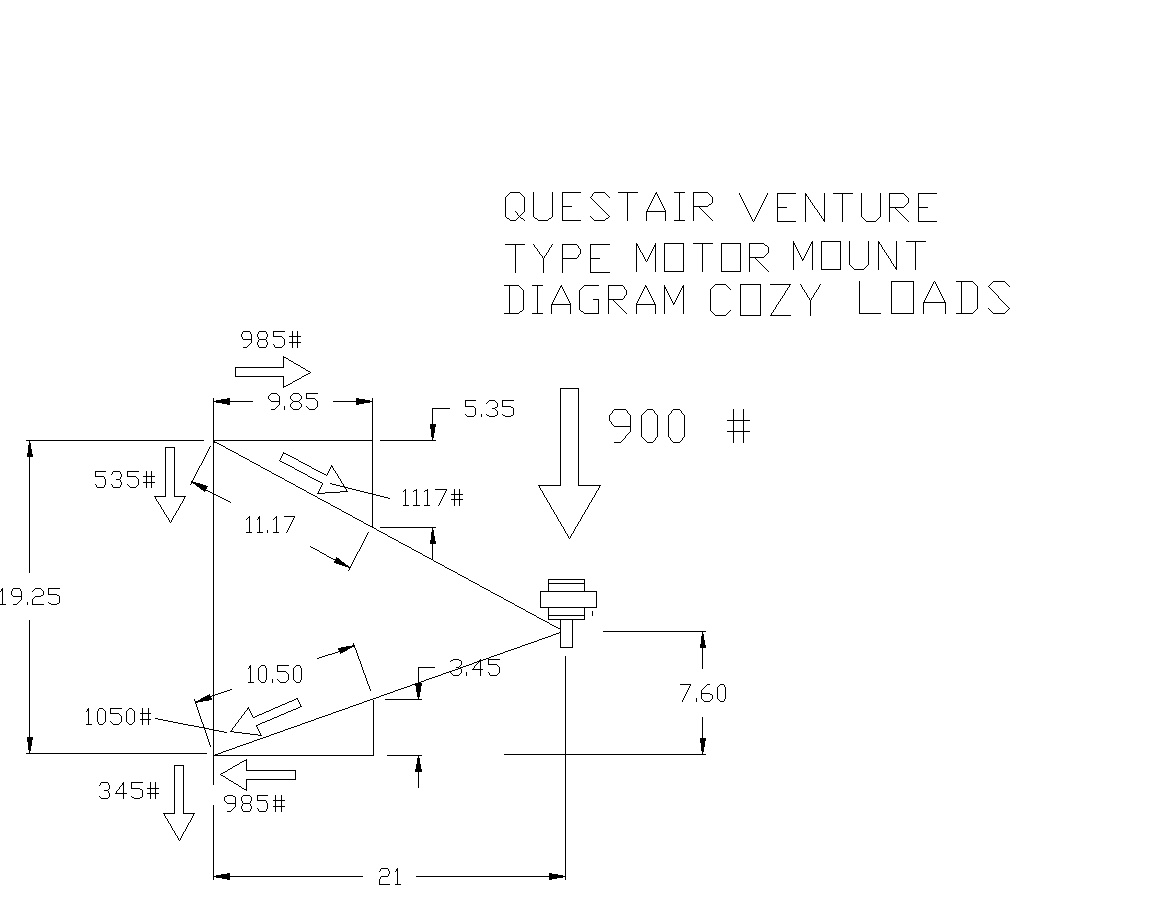
The vertical distance between the mounting points on a Cozy MK-IV is 19"
and 28" horizontal.
Bulent
Be nice if you could move the lower mounts down and use this scheme
to feed the loads directly into the landing gear bolts.

I also think you could move the upper mounts up to near the top of
the fuse with a little firewall beef up in that area.

Paul Lamar

The AirCraft Rotary Engine NewsLetter.              Powered by Linux.
ACRE NL web site. Copyright 1998-2002 All world wide rights reserved.
http://home.earthlink.net/~rotaryeng/            http://www.linux.org