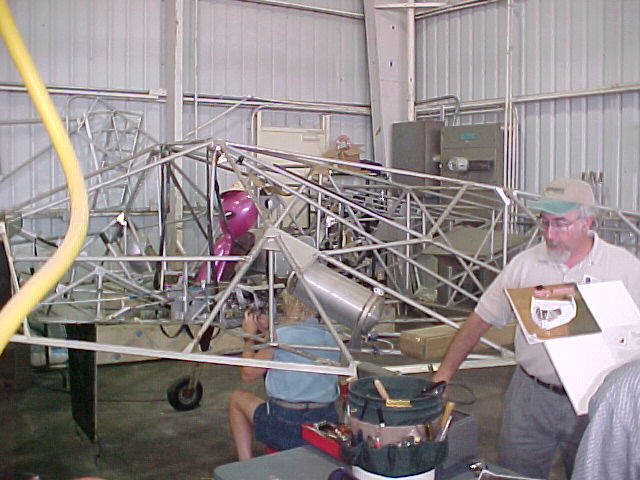
The Compton airport flyin is a short drive from my house so what
the heck. Had a long talk with Barnaby Wainfan about a lot
of things. Here is a shot of his Facet Mobile with Lynne his
wife rewiring it. Made from pop riveted aluminum tubing
and fabric covered.

http://members.aol.com/slicklynne/wainfan.htm

Barnaby says a scaled up Facet Mobile would make a great flying motor
home.

These pages from his site says it all.


FACETMOBILE FMX-5 PROJECT


A MULTI-FACETED OPPORTUNITY!
We are interested in talking to individuals or groups who want to help make the FMX-5 a reality
faster than we can do it ourselves. Up to
now the project has proceeded as a homebuilt project, happening only as fast our available time and
money will allow. Although we will
continue this effort, we are receptive to other approaches to moving the FMX-5 ahead. A focussed,
well financed effort can have a
prototype flying much sooner, and lead to early kit production.
If you have the resources to help make FMX-5 a reality, and want to be a part of a whole new facet
of aviation please contact us.
You can reach us by e-mail at: Slicklynne@aol.com
Facetmobile FMX-5 Models

FMX-5 DESCRIPTION
The FMX-5 is a new aircraft design based on the Facetmobile FMX-4 (N117WD. The FMX-5 design is a
2-seater projected to use engines
in the 100 to 150 horsepower class. The design is not simply a scaled-up Facetmobile, but
incorporates many improvements based on what
we have learned in 130 hours of flying N117WD. The prototype will be powered by either a Lycoming
O-235 or the new Jabiru 6-cylinder
engine, and the structure has been stressed to handle engines up to 150 hp, including the Lycoming
0-320. The structure of the FMX-5 is a
mix of steel tube, aluminum tube, and sheet aluminum. The airframe will be fabric covered. It is
intended to offer FMX-5 as a kit once the
prototype has satisfactorily complete flight testing. A major advantage of the low aspect ratio
lifting body configuration is the large useful
volume inside the airplane. In conventional airplanes, the cabin is kept as small as possible to
minimize drag. This restriction does not
apply to the FMX-5, which carries two people in a cockpit which measures 80 inches between the
window sills. Each seat is 20 inches wide,
and they are separated by a 10-inch center console, which houses the stick, and acts as a fore-and
aft systems tunnel for control linkages.
There are windows in the floor on each side of the cockpit. There is a large baggage compartment
behind the seats. A child seat can be
installed in the baggage compartment. A 15% scale radio-controlled model of the FMX-5 has been built
and extensively flown. It flies well,
and has flying qualities very similar to the models we flew during the development of the single-
seat Facetmobile. In particular, FMX-5
retains the excellent high- angle-of-attack controllability and departure resistance shown by the
Facetmobile (N117WD), both in model
form and full scale. The model could be routinely flown with full-aft stick, and remained
controllable, with no sign of a stall or spin
tendency. A 1/16 scale model of the FMX-5 was tested in the Cal Poly Pomona wind tunnel. The data
taken confirm the configurations
docile aerodynamics, and also show a 40% improvement in L/D over the original Facetmobile
configuration.

                                      Project status as of 1/20/98
  Very little progress has been made on the FMX-5 since the last update. This is frustrating, but we
do not have the resources to rebuild
    N117WD (the original Facetmobile) and a whole new airplane (FMX-5) at the same time. The FMX-5
project has been entirely
  dependant on volunteer labor, and unfortuntely, this has not been sufficient to get the airplane
in the air (YET). We still believe in the
                     design and will continue to try to find a way to get a prototype FMX-5 flying.


The AirCraft Rotary Engine NewsLetter.              Powered by Linux.
ACRE NL web site. Copyright 1998-2002 All world wide rights reserved.
http://home.earthlink.net/~rotaryeng/            http://www.linux.org