Paul Lamar wrote:
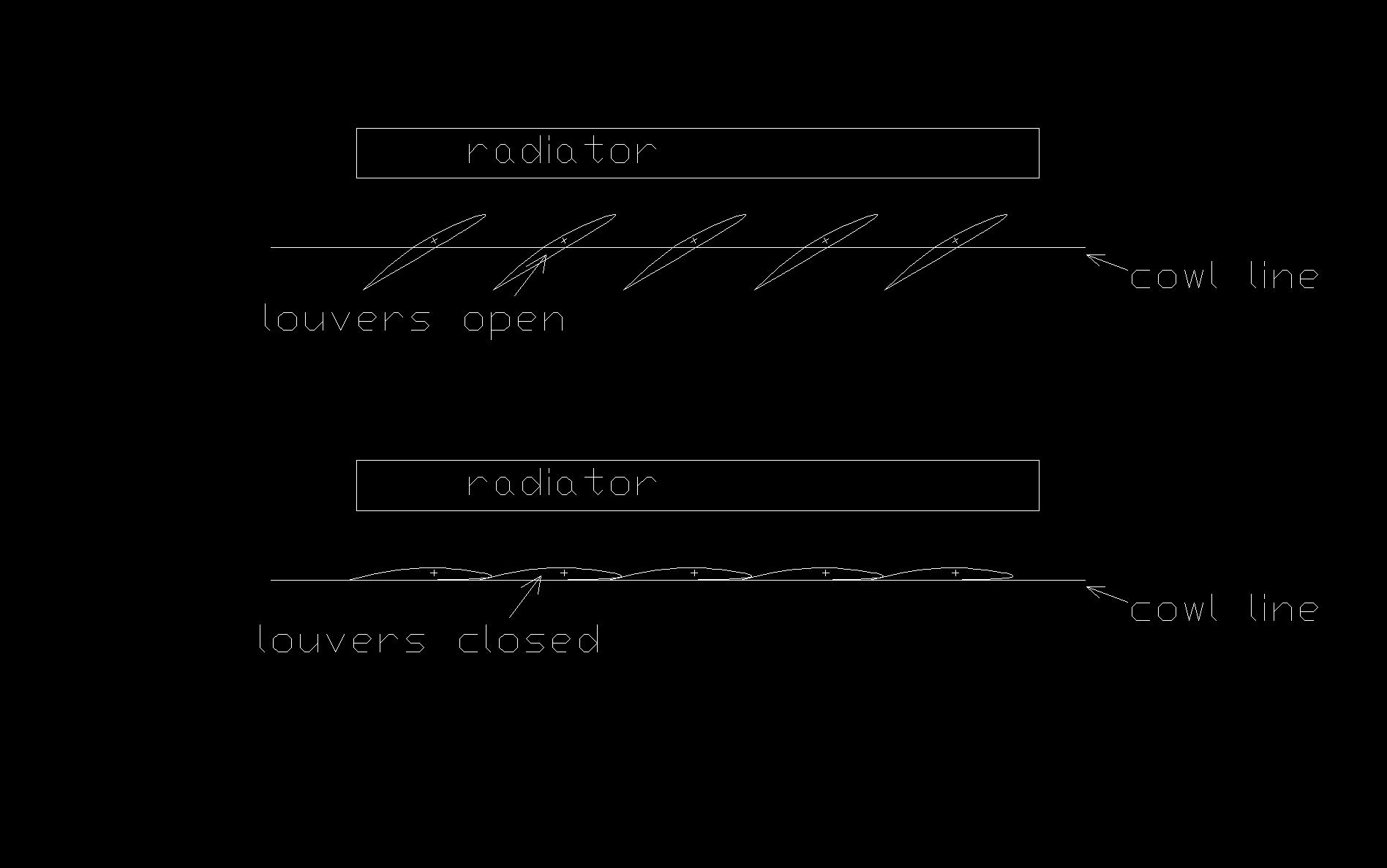
Mike is this what you had in mind?
Great Rhino picture.
In a climb the bottom of the cowl is a bit higher
pressure than static. If you put the flaps in like
the foreground picture and pivot them inward  you might build some
dynamic pressure on their face. This may impede the flow through
the rad. It looks cool but I think it may not cool as
well as the background configuration.
I disagree.  For "venetian openings" 2 thru n-1, the air flow strinking on
the "face" of the blind is exactly the same in both configurations.
Therefore, as the number of openings/blinds increases, the closer in
performance both designs must be.  All that remains is to determine the
effective differences of openings #1 and #n.  Your conclusion would be
correct if this were a conventional single-flap cowl flap.  A single
inward-moving cowl flap would be a disaster!

The inward moving flaps have the mechanical advantage that the edge
receiving the majority of the airflow force is also the edge firmly
affixed to the rigid cowl.  The outward moving flaps would either have to
be narrower or beefier to withstand the same forces (and not collapse).

Russell Kent
OK Russell :-) You decide Mike :-)
Paul,

  In both cases I'd only considered cowl flaps that were hinged with piano
hinge across the bottom of the cowl. Now I've had a different idea. Refer
to the attached (poor quality) cross section view. The venetian blind
sections are rotated about a pivot point anchored at each end to the exit
duct walls. The sections are made from hot-wired blue foam and vacuum
bagged with fiberglass or carbon or whatever. Pretty easy to knock these
out quickly, and with the airfoil shape they are extremely rigid and still
very light. I've made model airplane wings like this for years. What's your
opinion?

Mike Wills
Looks cool. Use carbon fiber as you could see as much as .7 psi on
them at 200 MPH. 12 inch span 5 inch cord 60 square inches
.7 psi ..... 42 pounds each.

Paul Lamar

The AirCraft Rotary Engine NewsLetter.              Powered by Linux.
ACRE NL web site. Copyright 1998-2002 All world wide rights reserved.
http://home.earthlink.net/~rotaryeng/            http://www.linux.org