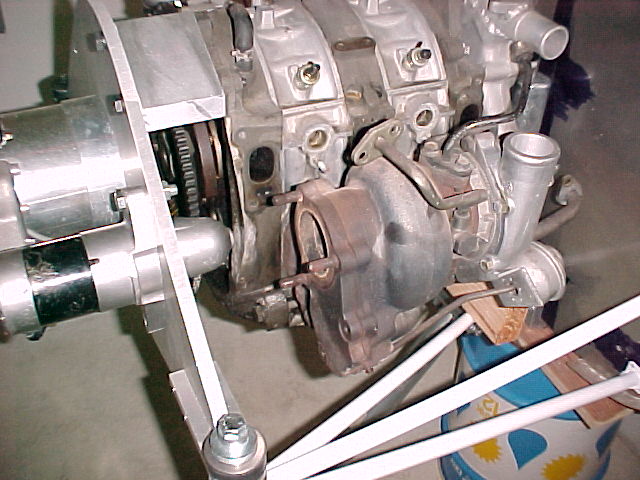
Same as the right side. The motor plate takes all the loads and incorporates
the rubber bushing motor mounts. It also directly takes
the thrust load as well as roughly an 800 ft pound peak torque pulse
applied to the prop from the gear box. I am not exactly sure the exact peak
value as it is mitigated somewhat by the rubber bushings in Tracy's torque
isolator plate. Peak torque is roughly twice average engine torque and average
torque at the prop is up to 400 ft pounds. Two times engine average torque
because of the 2.17:1 gear box. Since the rubber bushing are about three feet
apart they see only a 266 pound vertical pulse. If they were only
one foot apart they would see the full 800 pound vertical pulse and would
need to have roughly three times the travel for the same pulse absorption.

This is the main reason the Questair Venture is one of the smoothest
airplanes flying. I copied that design. It was designed by Jim Griswold
of Piper Malibu fame and Ed McDonald.

IMHO a major breakthrough in aircraft engine motor mounts.


Paul Lamar
Paul,
I'm curious why the bushings are vertical rather than horizontal thru the plate?
...Chrissi
Cozy Mk-IV 13B-turbo
www.CozyGirrrl.com
Chrissi@BlueMountainAvionics.com
Because of the 800 foot pound torque pulse prop reaction is in that direction.

Multiply these torque pulse values by two for a 2:1 gear box.
Note the ten times stiffer rate in the radial direction for the
Barry rubber bushings.

Paul Lamar
Why is there a torque multiplier? Isn't the plate on the
engine side of the gearbox?

Charlie E.
It is the reaction of the prop we are concerned with and that is the torque
out of the gear box is it not? Newton's law. For every action there is
an equal and opposite reaction.

It does not matter on what side of the gear box it is on.
The prop reaction torque must be reacted by the motor mounts regardless
of where they are located. Engine or motor plate. It is a load path issue.
If the plate is on the gear box it is a direct load path to the rubber motor
mounts into the steel tube space frame motor mounts and thence into the
firewall and the rest of the airplane. If the rubber mounts are on the
engine the path is through the gear box spacers into the  engine
and then into the rubber motor mounts and so on. BTW increasing the stress
on the spacers.

Observe an AA fuel dragster when it leaves the line. Notice the twist
in the chassis. The torque is multiplied by the over all gear ratio
between engine and the rear axle. That torque, in the other plane and
multiplied by the final drive ratio, is why funny cars can do wheel stands.

I hate to brag but as a note of interest many automotive tech editors
were trained by me back in the early seventies after they graduated from
engineering school. :-) Csaba Csere managing editor of Car & Driver
Magazine and Don Sherman tech editor at large for Popular Science
are two of the best known. In the early seventies the course cost
$1200 per week per student.

Paul Lamar

The AirCraft Rotary Engine NewsLetter.              Powered by Linux.
ACRE NL web site. Copyright 1998-2002 All world wide rights reserved.
http://home.earthlink.net/~rotaryeng/            http://www.linux.org