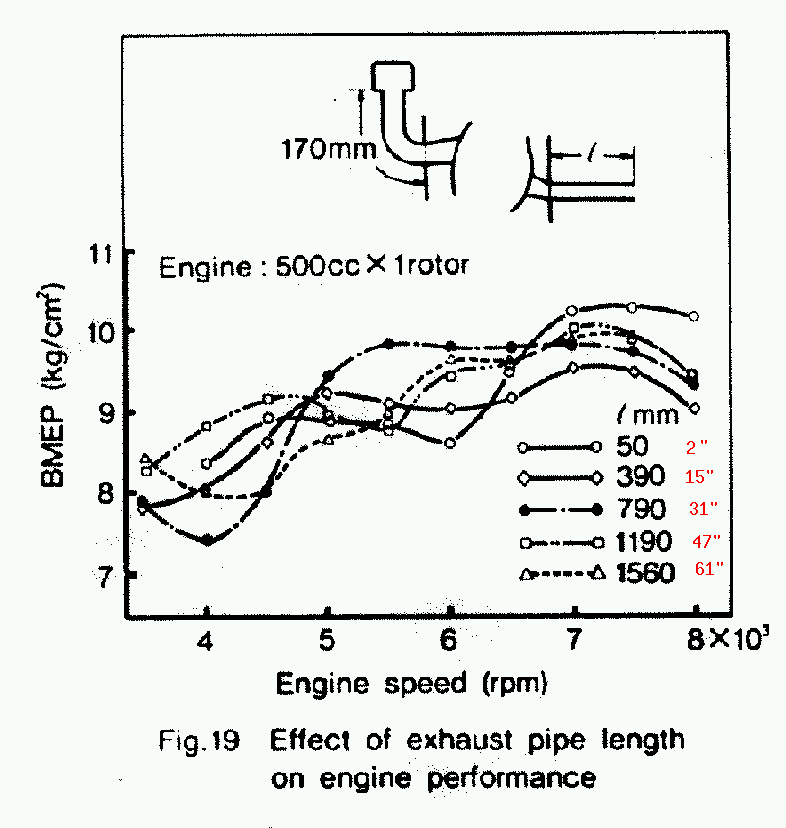
This chart shows BMEP as a function of exhaust pipe length.
You can download, in pdf form, the Mazda tech paper this chart came
from by going to http://www.thecarricos.com/ACRE/

BMEP is the same as torque more or less so you can figure
the HP at the differing RPM's. Looks like the early
tang muff with two or three inch feed pipes gave up about 12%
of the HP around 5000 to 6000 RPM range.

>From this chart the typical untuned tang muff right along side
the engine with two inch long pipes pays about a 22 HP penalty
at the 180 HP level and about 25 HP at the 210 HP level.

In other words 180 HP with 32 inch pipes and 158 HP with the two inch tang
muff. With a P-port 210 HP with 32 inch pipes and 185 HP with the simple tang
muff. So I am not advocating  a simple tang muff. The point is you could be losing
a lot of HP with the wrong pipe lengths.

This jibes with Tracy and other's experience with simple tang muffs.
In Tracy's case he lengthened the pipes and went to a Spintech muffler
under the fuse among other changes and picked up quite a bit of HP.
The problem with under the fuse muff location is aero drag is increased.

BTW the Spintech and the tang muffler work on similar principles.
They both create vortices inside a can.

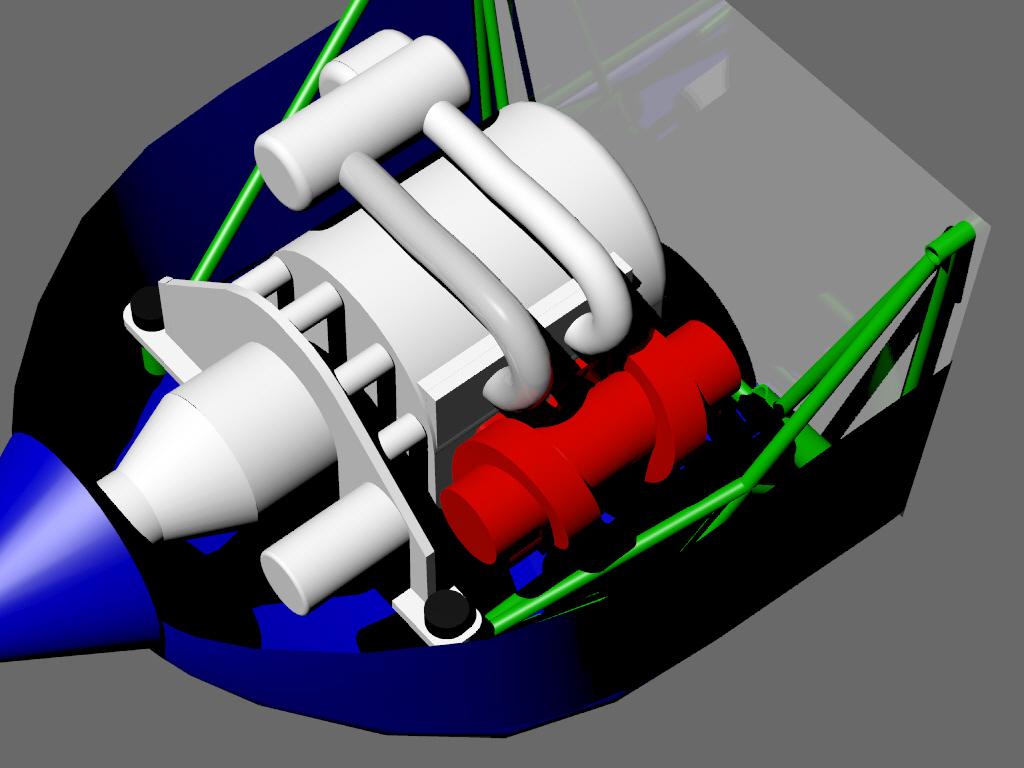
What I am thinking about is a square tube tuned tang muff with rectangular
runners that have the same area as two inch square runners. With a four
inch round can and 2.66 X 1.5 inch runners this should get the overall diameter
down to about seven inches which should fit with 29 inch motor mount bushing center
to center. The trick is to curl the front pipe forward and the back pipe
aft. In some cowls a 5 inch can design should fit.

Shown in the rendering is a four inch can.

Faced with all this a quieting turbo does not look so bad :-)

Paul Lamar

The AirCraft Rotary Engine NewsLetter.              Powered by Linux.
ACRE NL web site. Copyright 1998-2002 All world wide rights reserved.
http://home.earthlink.net/~rotaryeng/            http://www.linux.org