Ah so right Tom!
2 rotor = 80 cu. 3 rotor= 120 cu in (as spec by Mazda...). Mass flow
>from calcs 20B=41.3 lbs min; mass flow from 13 b =27.3 lbs min. So
actually 41.3/27.3=1.5128205
You add more of course than just a rotor, or displacement!
Marc Wiese
Is this 80 cu per rotor, or per rotor face.?
Royce
Now you are getting into a real can of worms :-)
Why do you say that Paul?
Considered as a two cycle it is 1.3 liter but it is not a two cycle.
It is equivalent, as far as the volume of air it pumps, to a 2.6 liter
4 cycle 4 cylinder engine. However the volumetric efficiency is at
least 20% higher than any piston engine. No poppet valves to get in the
way of the intake ports. Therefore in terms of turbo charger
selection I would use about a 3 liter equivalency.

Paul Lamar
So that's 43L per rotor face? And each rotor face being equivelant to a
piston, the 13B would be equ to a six cylinder?
Royce
No. 2.6 L  4 cyl 4 cycle engine. Forget the rotor faces :-)

How the Wankel Works

by Paul Lamar
^MThe wankel rotary consists of a three sided rotor moving in a  modified oval
chamber or rotor housing. There are at least two holes in the walls of one
side of the rotor housing. In the other side of the rotor housing there is
at least one spark plug. One hole is used as an intake port and the other as
an exhaust port. Just like a one cylinder two cycle piston engine. The rotor
rotates around the center of the output shaft while at the same time
rotating around its own axis. This is very similar to the way the earth
rotates around the sun while rotating around its own axis. The rotor rotates
one third as fast about its own axis as it does around the center of the
output shaft. Actually what is happening is the center or CG of the rotor is
moving in a circle around the center of the output shaft while the output
shaft rotates. Very very clever on the part of Felix Wankel to invent and
engine that uses this motion.

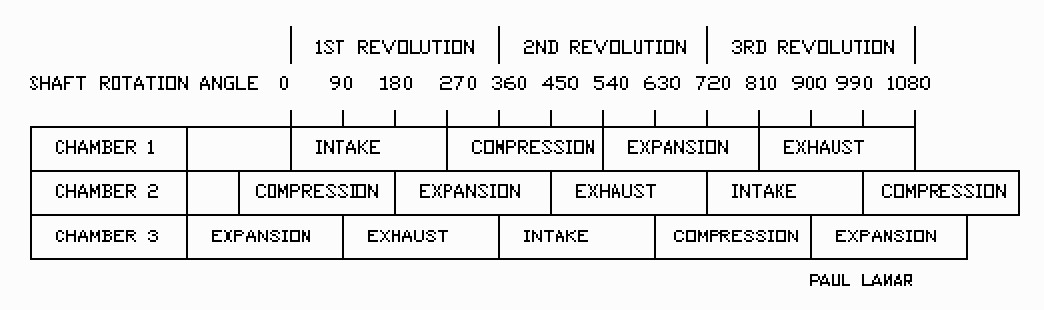
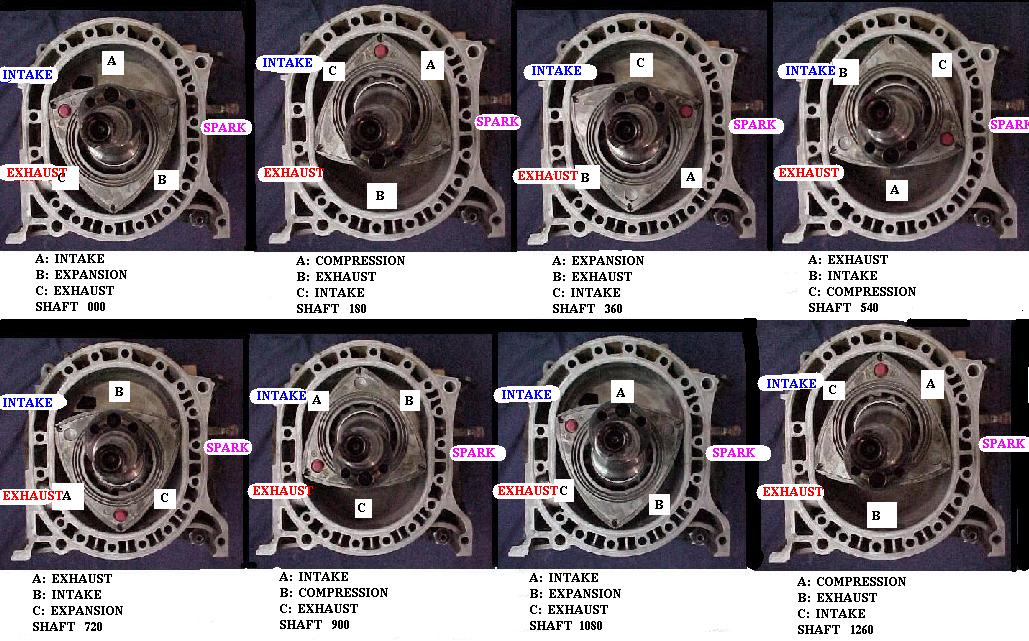
As this motion is taking place the tips of the triangular shaped  rotor are
passing the ports in the housing. As one tip, call it tip A, passes the
intake port in the rotor housing the face behind tip A starts to draw in the
fuel air mixture. Call it face or chamber number 1.  When the next tip call
it tip B passes the intake port the mixture is captured and starts to
compress. As the chamber continues around the housing it encounters the
spark plug and the mixture inside it is fully compressed.  The spark plug
fires and the chamber starts to expand imparting the pressure energy in the
burning mixture to the output shaft. As the rotor continues on around tip A
passes the exhaust port and the burnt mixture starts to leave chamber 1.
This completes the four cycles for chamber one. In the mean time chamber two
and chamber three are completing various cycles of this same sequence
simultaneously.

This three chamber simultaneous action  is the reason the wankel  engine is
so light and compact for the power it is able to generate. Furthermore the
forces in each chamber due to the pressure in each chamber are completely
contained in the one piece cast iron rotor. In a four cycle piston engine
this is not the case. The compression force must pass down a connecting rod,
into the crankshaft and up another connecting rod into another chamber that
is expanding and extracting power from the burning mixture. This makes
piston engine force paths and consequent stresses far far more complicated
than the wankel engine.

Although the wankle has similarities with a two cycle engine,  particularly
in regard with the way the porting mechanism works, it is in no way a two
cycle engine. All four cycles are continuously taking place simultaneously
and those are intake, compression expansion and exhaust.^Z

Paul Lamar

The AirCraft Rotary Engine NewsLetter.              Powered by Linux.
ACRE NL web site. Copyright 1998-2002 All world wide rights reserved.
http://home.earthlink.net/~rotaryeng/            http://www.linux.org