Marc Wiese wrote:
Ah so right Tom!
2 rotor = 80 cu. 3 rotor= 120 cu in (as spec by Mazda...). Mass flow
>from calcs 20B=41.3 lbs min; mass flow from 13 b =27.3 lbs min. So
actually 41.3/27.3=1.5128205
You add more of course than just a rotor, or displacement!
Marc Wiese
Is this 80 cu per rotor, or per rotor face.?
Royce
Now you are getting into a real can of worms :-)
Considered as a two cycle it is 1.3 liter but it is not a two cycle.
It is equivalent, as far as the volume of air it pumps, to a 2.6 liter
4 cycle 4 cylinder engine. However the volumetric efficiency is at
least 20% higher than any piston engine. No poppet valves to get in the
way of the intake ports. Therefore in terms of turbo charger
selection I would use about a 3 liter equivalency.


Paul Lamar
Paul,

Can I clarify the airflow calculation that I uploaded last week in that
spreadsheet? That tried to work out the airflow more analytically.

If you read Corky Bell or Hugh MacInnes, the standard formula for a four
stroke piston engine's airflow is airflow rate = ((cubic inch displacement)
X (rpm) X (volumetric efficiency) X (0.5))/1728. The 1728 divisor converts
cubic inches to cubic feet.

What's the 0.5 in the equation for? Bell writes, "The .5 is due to the fact
that a four-stroke-cycle engine fill sits cylinders only on one-half the
revolutions." (p.27)

That's not true as far as rotary engine airflow is concerned because rotary
rpms have mixture flowing every revolution. So rotary racers who post to the
net leave out the 0.5 when they calculate airflow; they double the airflow,
as you did in suggesting a 2.6 liter piston equivalence.

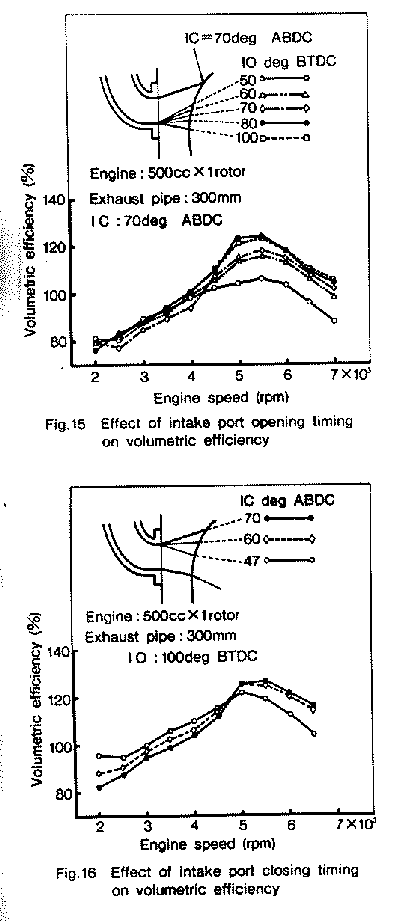
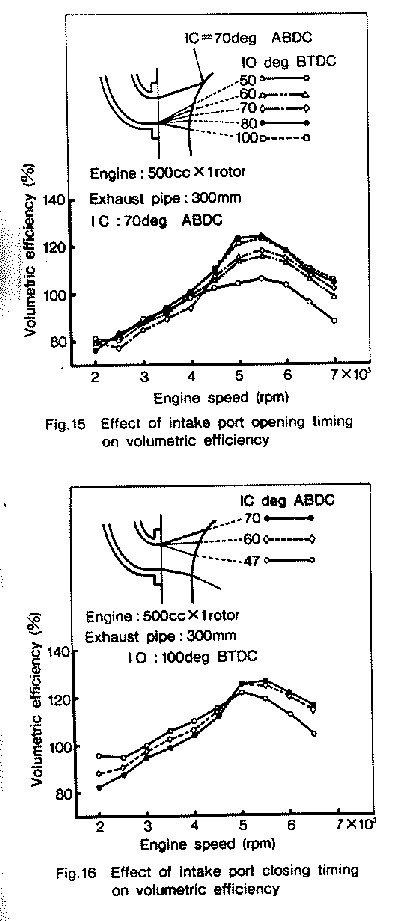
Then the question of volumetric efficiency is another issue. Bell gives a
small-block Ford as an example in one of his problems and uses a volumetric
efficiency coefficient of 0.85. In discussions on this list some time ago,
when Paul Yaw was building up his super-turbo-something for someone, he used
1.07. I'm told that rotary tuner HKS recommends using 1.1 as the volumetric
efficiency coefficient. Some racers on listserve message I've read suggest
1.0. Beats me if there is an exact right number but the bottom line is that
the volumetric efficiency also boosts the airflow. Your estimate of a 20%
better volumetric efficiency is right in there with those other guys.

So, to the best of my ability to tell, knowledgeable people sizing turbos
would use around 278 cubic feet per minute of airflow for naturally
aspirated two rotor 13B engines running at 6000 rpm. I can't imagine doing
anything besides adding 50% when you go to a three-rotor 20B because that's
what you've done to the displacement.

If your comment, Paul, that you'd use a 3 liter piston equivalency was
intended to be your recommendation for a 20B engine, it seems to me that
would be too conservative, though it probably is about right for a 13B.

Of course, if one had a different prop reduction ratio and wanted to
optimize at a different rpm, that would affect your airflow calculation and
turbo sizing.

Barry Gardner
Wheaton, IL
I was referring to a 13B two rotor.

This chart is part of a Mazda tech paper that can be downloaded from:

http://www.thecarricos.com/ACRE/

Paul Lamar

The AirCraft Rotary Engine NewsLetter.              Powered by Linux.
ACRE NL web site. Copyright 1998-2002 All world wide rights reserved.
http://home.earthlink.net/~rotaryeng/            http://www.linux.org