Jerry Hey wrote:
> Paul,
 Has there been any reference data to calculate the necessary volume of the
 swirl tank? How do you decide if you need one? It looks like some
have them and
 some don't.
 Thanks
 Dean
Most automotive systems don't use swirl tanks and they work quite well.
I am going to try it with out and just copy an automotive system exactly.
After all, billions of dollars have gone into developing automotive
cooling systems. If it will work for a 6000 pound truck pulling a
7000 pound load up an 8% grade in So Cal at 65 MPH  on a 100 F
day it will work for an airplane.

People flying use all sorts of different plumbing systems. I cannot at this
time identify why some plumbing systems work well and others don't.
It is buried in too many other factors.

I CAN see why some cooling system don't work for aerodynamic reasons
and that problem  appears to be at the top of the list. In that
category having the back side of the rad too close to an object
seems to be the main reason. Second is not having enough
air outlet area for the cowl. Third is having a poorly shaped
inlet duct. Having a radiator that is too small is way down
the reason list. Most are too large given all the other mistakes.
The exact plumbing system used is probably at the bottom
of the reason list.

We still have not got to the point where we are considering cooling
drag as nobody is yet using cowl flaps to my knowledge.

This is the way I see it now.

Paul Lamar
I think the difference is that automobiles universally have radiators
with one of the tanks above the engine.  If the rad is below the
engine you will need a swirl pot.    Race cars with low radiators
have swirl pots.  Jerry
Certainly won't hurt.
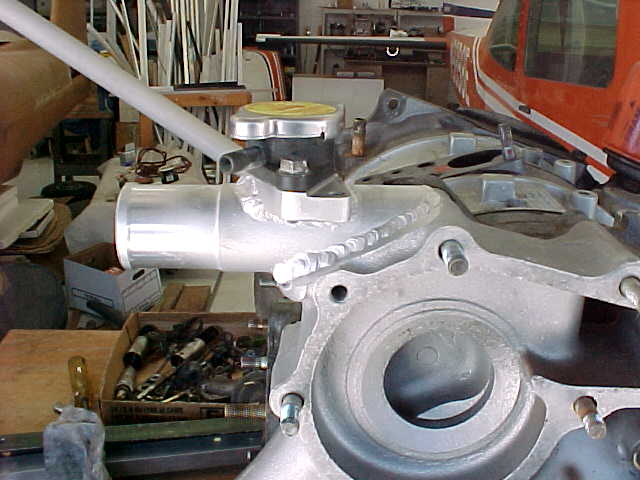
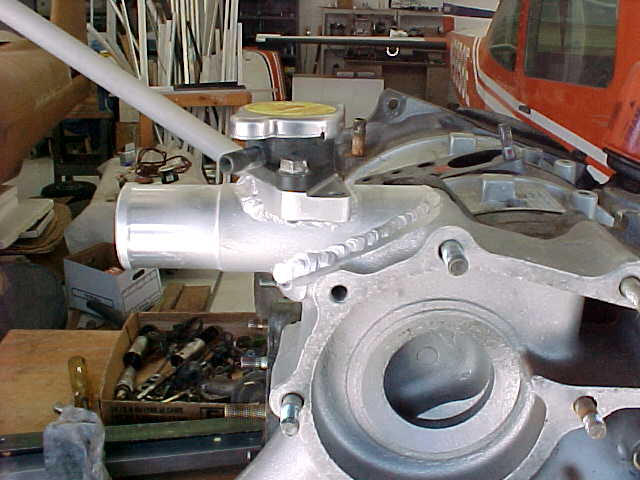
IMHO all you really need is the filler cap being the highest point.
I have mine mounted on the water pump. The rad in the stock
RX7 is below the water pump top where the filler cap is located.
Once the pressure builds up in the system it is all solid
coolant anyway. The air is forced out of the pressure relief valve
located in the cap and into the over flow tank as the coolant
expands when it is heated up. Bubbles float to the top of the
system.  When the engine cools only pure coolant is sucked
back into the engine if the overflow tank is working right.
That is not to say you cannot have air pockets some where in
the system. that is an entirely different problem and can
be solved with vent lines running to the pressure cap.

Paul Lamar

The AirCraft Rotary Engine NewsLetter.  Powered by Linux.
ACRE NL web site. http://home.earthlink.net/~rotaryeng/
Copyright 1998-2002 All world wide rights reserved.