I would
 > like to hear a description of the throttle response of PPorted race
 > cars.   Maybe Lynn, has experience with this.  I would rather have
 > the EC-2 than peripheral ports , if it comes to that, but I really
 > want both.  PP's are the best way to add hp, in my opinion.  It would
 > be a huge boost for the rotary movement if a do it yourself PP design
 > that is compatible with the EC-2 can be developed.
 >   Jerry
     I have one Factory periphery port engine in my old car with two 44mm
venturies
     in a Webber 48 IDA. The runners are the same length as the side port
(bridge
     ported) engine, about 8 inches to the butterflies. There is no throttle
lag in either
     engine, coming off idle. The idle speed is 2,000 RPM. A bit high for
aircraft use.
     I don't think throttle lag would be a problem in any case. More a
function of off
     idle mixture control than runner length. Street car stuff is all off
idle performance.
     We have a bunch of accelerator pump stroke and no problems at all. Most
of the
     time we are at 7,000 RPM or more when we open the throttle. Even if
there was
     some hesitation we couldn't detect it. In the aircraft, the PSRU at
2.17:1 you can
     have the idle at 1,000 RPM without dragging the brakes much on the
ground. So
     the throttle response off idle will be quite good and seldom used in a
way that
     would expose a response problem. On final you could carry quite a few
extra
     RPM without generating a great deal of thrust. So if you need to go
around, just
     roll on the power and go. You already have enough RPM to obscure any
     hesitation. I think the hesitation "problem" is a red herring. I would
mount the
     throttle body at the end of the runners and be done with it.
     Lynn E. Hanover
Hesitation is one thing but idle stability is another.
They are not really related.

Paul Lamar
I agree. Lynn, in a Van's RV-x with a fixed pitch prop, anything over about 700
prop rpm will cause airliner like approaches & hundreds of feet of float in
ground effect. Can a p-port idle under 1500 with no danger of quitting either on
its on or with sudden throttle opening? I would consider *slight* hesitation
acceptable. Someone (was it you?) mentioned cutting the p-port to match the side
port timing. Shouldn't that solve the overlap problem Paul mentioned in a recent
exchange about this issue?

Charlie England
Charlie you are forgetting that Power Sport has been flying p-ports for
years in RV's. Allan Tolle has flown many times coast to coast and
entered several Sun & Fun races. No landing problems as far as
I could tell. Tracy Crook never idled his RV-4 engine below 1800
to 2000 engine RPM  829 to 922 prop RPM for years because the Ross
gear box would rattle mightily. He also does not slip when landing.

The port timing has little to do with the p-port overlap
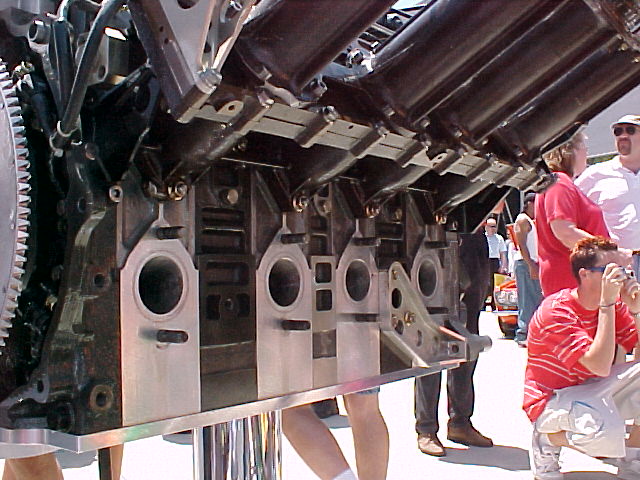
problem. This is mainly due to the pocket in the
face of the rotor. That is the main avenue for the exhaust
gases to enter the fresh mixture area. That path is open from
the moment the apex seal passes the lower floor of the p-port
intake until the next apex seal passes the ceiling
of the p-port exhaust. Then the process soon begins again
with the next cycle. In other words it is open the majority
of the time. P-port intake timing has little to do with it.

When the pressures are the same there is no flow.
This delicate balance of pressures is the main
reason intake and exhaust pipe tuning is so critical
with p-ports. It is quite remarkable that Racing Beat
can build a turbocharged 3 rotor p-port engine developing
over 300 HP per rotor on gasoline.  One would think the
turbo charger would blow all the fresh mixture down
the passage in the face of the rotor and out the
exhaust port. This does happen to a certain extent
but the saving grace is the pressure in the exhaust
is only slightly lower than the pressure in the intake.

Never the less  p-ports have the HP per rotor record for
normally aspirated wankel engines as far as I know.
Perhaps there is bridge port engine out there that generates
more. Bridge ports are half peripheral port and half
side port.

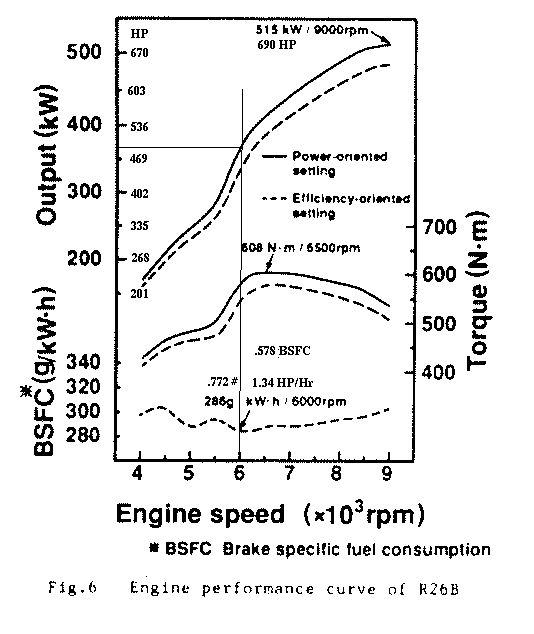
The p-port Lemans engine generated 120 HP per rotor
at 6000 RPM and 172 HP per rotor at 9000 RPM. Even the side
exhaust port RX8 engine generates only 280 HP at 9000 RPM
or 140 HP per rotor in its best stage of tune. The street
version will be lower HP. This in spite of the fact the
side ports are roughly 20% larger than the old 3rd gen
side intake and peripheral exhaust ports. I digress.

In a side port the passage is much more restricted. The ultimate
reduction in overlap and improvement in idling stability, according
to Mazda engineering, is achieved by both side intake and
exhaust ports with zero overlap.

Idle misfire and the resulting unburned fuel in the exhaust is the
main reason Mazda went to the side exhaust port. Unburned fuel
in the exhaust during idle is another way of saying high
hydrocarbon emissions.

I highly recommend downloading those tech papers from:
http://www.thecarricos.com/ACRE/


Paul Lamar

The AirCraft Rotary Engine NewsLetter.  Powered by Linux.
ACRE NL web site. http://home.earthlink.net/~rotaryeng/
Copyright 1998-2002 All world wide rights reserved.