> > >Jerry Hey wrote:
         > >>
         > >>  >  > Paul, The nsu engine looks like the perfect arguement
 for the
         > >>  >variable intake timing you had laid
         > >>  >>  out some time ago. Some of the last versions of two
 cycle engines
         > >>  >>used variable timing in the
         > >>  >>  intake and exhaust to improve drivability, even on the
 GP bikes
         > >>  >>making 400 hp/l ! The comments
         > >>  >>  about the rotary I.C.E. still being a relative baby do
 ring true.
         > >>  >>A version of the variable inlet
         > >>  >>  seems a perfect fit. Any plans to persue or too many
 irons already
         > >>  >>in the fire? I know I would
         > >>  >>  like to help.
         > >>  >>  Bill Jepson
         > >
         > >
         > >>  >Ken was going to build up an engine with them but then he
 got
         > >>  >shipped off to South East Asia. Are you back yet Ken?
         > >>  >
         > >>  >Other than the idle I think it has few advantage for an
 aircraft
         > >>  >engine as they mostly run from 5000 to 7500 RPM. A simple
 P-port
         > >>  >would give the same or better power.
         > >>  >
         > >>  >Paul Lamar
         > >>
         > >>  Paul/Bill,  Ken shipped the variable intakes to me, hoping
 I would do
         > >>  something with them.  Would  you like to have them?
 Jerry
         > >
         > >Good idea Jerry. Bill Jepson may have more time.
         > >
         > >BTW guys I think it best if we run them upside down from the
 way
         > >I show them in the drawing. That seems to be the way NSU and
         > >Mazda time the engine for low power and better idle.
         > >
         > >Paul Lamar
         >
         > Bill,  send me your shipping address
         >
         > >  Jerry
         >
         > --
         >
         > J-Wind Designs
         > Motor Mount Plates,  Engine mounts
         > j-winddesigns@thegrid.net
         > 831-385-0908

         Also Bill this arrangement will be better for low and medium
 power.
         Timing is more favorable over the HP range.

         Paul Lamar


         Paul, Jerry, Bill, and Other Interested PP Parties,
         Our recent discussion of PP has caused me to think a little more
 about this whole concept of variable port timing, especially since we
 all agree that we are really only interested in idle, cruise, and WOT.
 Throttle response and midrange torque are not really relevant to our
 environment.  Our objectives are:
         1.  smoother, lower speed idle  (important for short fields in a
 fixed pitch relatively slick airplane like a RV)
         2.  More power due to more radical porting (much more overlap)
 and much larger ports
 >         3.  better fuel economy
 >              (wow, how is that for a conflict of goals!!!!)
 >
 >         The main objections to PP are the perceived problems with: (Lynn
 > has me wondering about how much of a problem any of this really is
 though)
         1.  rough/no idle
         2.  very poor fuel economy
         3.  shorter life span of engine components due to higher RPM's

         Over the past couple of years a couple of guys have suggested
 using PP and the stock side ports.   The common answer has been is that
 you could but the benefits and added complexity would probably not be
 worth the effort.  Well, maybe this idea has merit after all.  Why not
 have 2 separate intake tracts - one PP and one side port.  Use separate
 throttles, cables and quadrants like Tracy used for his carb setup.  In
 idle situations (taxi and takeoff) use the sideport intake (PP intake
 closed); use BOTH for everything else.   Paul showed us a picture of a
 NSU RS80 yesterday that had a small PP port above the primary PP port -
 he said that this engine idled well.  Also, didn't Suzuki use both a
 large and a small PP on their street bike circa 1975/1976?  ( I was in
> grad school at the time and working part time as a Suzuki mechanic - I
 remember these bikes quite well but the owner loved them and always
 worked on them himself.)  As an alternative to using the side ports, we
 could also use this proposed setup in the same manner as Suzuki and NSU
 with both a small and large PP port, but with manual control of the
 throttles rather than staging.

         Here are the concerns as I see them:
         1.   the BIG PP will still allow exhaust gas dilution of the
 intake charge.  Is this a show stopper???  Is it an issue at all?
         2.  the complexity and weight of 2 separate intake systems - I
 thought that I would only plumb the outside/upper side ports and not
 deal with those pesky inner ports but maybe a single throttle feeding
 both center ports would be better (this worked OK for Tracy with his
 carb setup but no doubt cost considerable HP but we are only interested
 in the idle qualities)
> Ken Powell
   Ken you may have ingeniously  solved a problem that does not exist.
The PowerSport  idles  nicely. If they can do it, so can we.  Based
on what I saw at Seven Stock and Lynn's comments,  I don't believe
there is a throttle response problem.  Aside from the  power, the
thing that attracts me about P Ports is their simplicity and light
weight.  You have to decide how much power you want and what you are
willing to give up to get it.  220 hp at 6000  rpm  is just about
free.  Probably you could get 240hp  with the 2.85 gear box.  I'm
guessing  that is  near the limit.   If you need still more power,
kiss the simplicity, light weight, smooth idle  and fuel economy good
by. Not having space for those big runners might be the show stopper.
Jerry
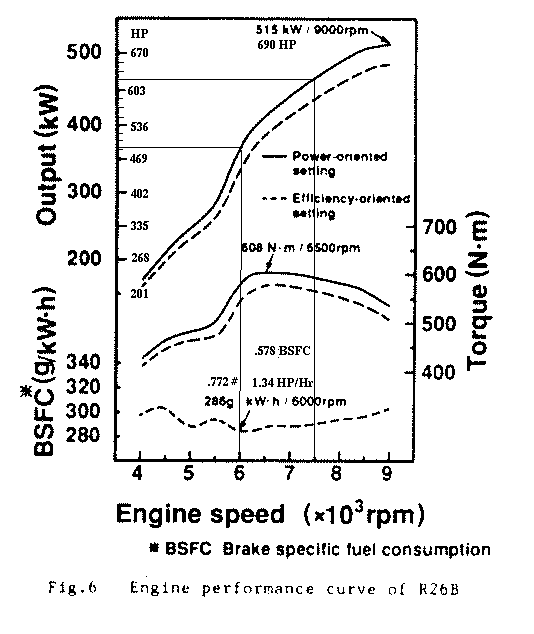
You can get 240 at 6000 RPM Jerry if you are willing to copy
the Leman engine P-porting and pipe tuning exactly. You need
to divide the HP numbers on this 4 rotor chart by 2 to get
two rotor HP numbers.

At 7500 RPM you would have 310 HP with shorter pipes.
Note; there is very little difference in 6000 to 7500 RPM.

Paul Lamar

The AirCraft Rotary Engine NewsLetter.  Powered by Linux.
ACRE NL web site. http://home.earthlink.net/~rotaryeng/
Copyright 1998-2002 All world wide rights reserved.