OK, Paul, so maybe I'm just a little bit (lot?) dumb, but-I have seen the
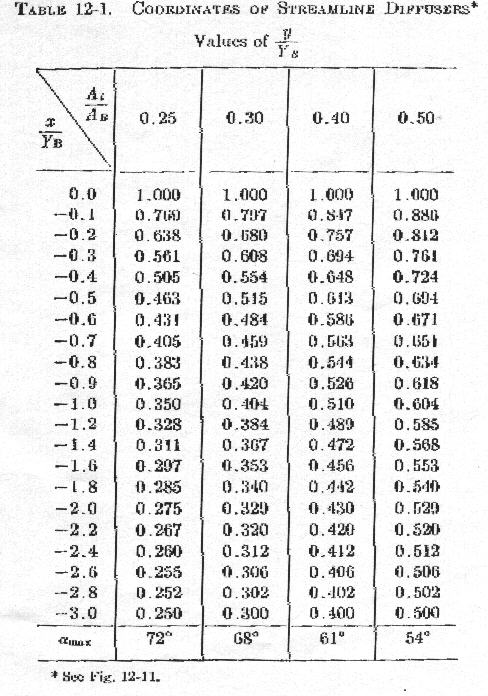
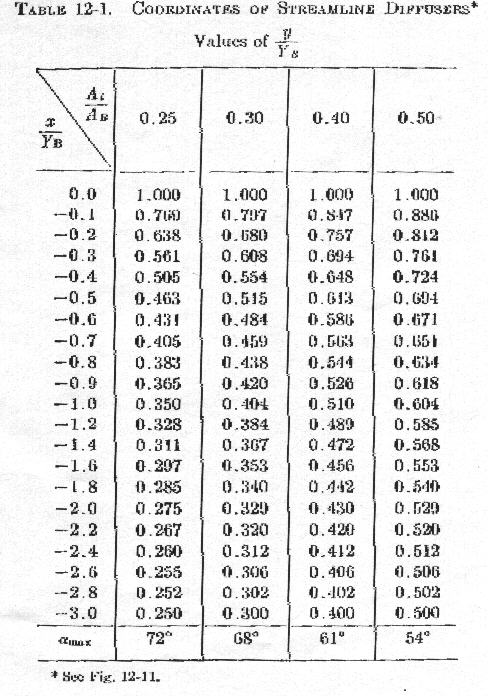
Table 12-1 figure labled "Coordinates of Streamline Diffusers" many times,
but I still don't understand it.  How about a simple X Y set of points that
I MIGHT be able to understand and transfer to paper.

Bob Darrah
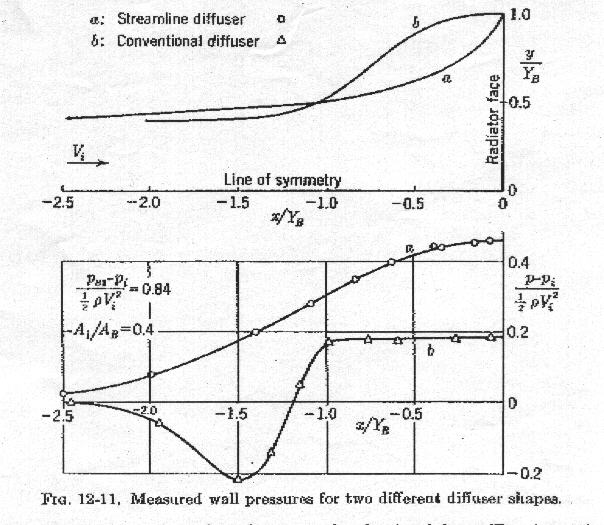
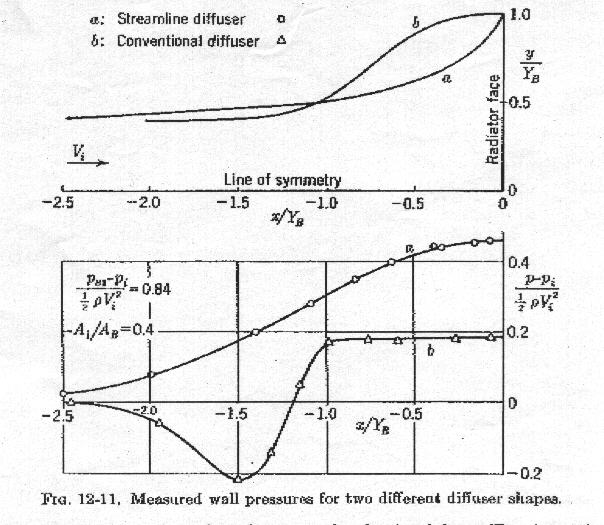
Both illustrations are needed to plot a duct.
Lets us assume for the moment the rad is a perfect square.
The line of symmetry is the center line of the duct.

YB is half the height of the rad.

y is the height of the duct anywhere along its length.

When y/YB = 1 you are at the top of the rad core.

As you move along the line of symmetry (along x) towards to opening
y gets smaller and smaller.

There are four sets of coordinates.
Ai/AB is the ratio of the area of the opening to that of
the rad it self. First set (Ai/AB) is 25% second set is 30% and so on.

The length of the duct (x max) in all cases is three times half the height
of the rad (YB). If the rad is 18 inches square the length of duct
required is 27 inches. Obviously a very space consuming situation
and hardly suitable for our water rads but could be used
for an oil cooler.

Lets say for the moment we had a rad 18 by 18 by 2 that worked.
The volume would be 648 cubic inches. If we reduce the height and width
to 13 inches and the thickness to 4 inches we could maintain the
same volume. According to this theory the duct length could then
be reduced to 3 times 13/2 or about 20 inches.

Would the short duct and thicker rad provide
the same cooling? I doubt it. The rule of thumb is the first half
of the rad thickness does 3/4 of the cooling as the air warms up
as it passes through the thickness of the rad. The actual
rate of heat transfer is proportional to the difference in temperature
between air and the metal rad. Also my guess is less total mass of air
would flow through the thicker rad as well. Modern heat exchangers
are getting thinner and thinner.

Therefore this scheme is unsuitable for our water rad  purposes
and we must look elsewhere for a solution.

The answer was developed in a paper by London, Klopfer and Wolf
called oblique Flow Headers for Heat Exchangers. ASME vol 90,
p 271, 1968 wherein they measures the air flow with the rad mounted
90 degrees to the direction of the airflow. This paper
can be downloaded in pdf format from http://thecarricos.com/ACRE/
BTW London, Klopfer and Wolf used the term headers instead of ducts.

Both London, Klopfer & Wolf and Kuchemann & Weber discovered that
obstructions behind the rad reduced the flow of air.
Kuchemann & Weber's rule of thumb is anything closer than half
the height of the rad starts to reduce the flow of air. That
is why I suggest placing the rad close to the inside surface of
the cowl and using louvers to allow the air to escape to the
atmosphere. This effect is more pronounced as the rad gets
thinner and thinner and the exit air velocity gets higher and higher.

This is because the impact pressure builds up on the front
of the obstruction, is reflected back towards the rad and
reduces the flow through the rad.  A 18 by 18 inch rad placed
in front of the firewall should be at least 9 inches away.
With a 20 inch long two rotor and a 14 inch long
PSRU in a 39 inch long cowl gives only 5 inches behind the
e-shaft pulley. We would need 9 inches plus the thickness
of the rad (probably another two inches) or 11 inches total.
The cowl itself would then be the inlet duct which would
cause Kuchemann & Weber to roll over in their graves.
We don't want that now do we? :-)

There is also an additional loss because the air must exit at a 90
degree angle behind the rad.

Any attempt to dump the heated air into the cowl against the
engine with these sorts of restrictions is not practical as that
too would require too much space.

The bottom line is we can eventually use smaller rads and
smaller cowl openings with less drag after we build some completely
successful cooling systems with these facts and principles
in mind.

Paul Lamar

The AirCraft Rotary Engine NewsLetter.  Powered by Linux.
ACRE NL web site. http://home.earthlink.net/~rotaryeng/
Copyright 1998-2002 All world wide rights reserved.