Dearest Chrissi,
    I agree with you about the wastegate.  I plan to use Greg's idea and put
an adjustable blow off valve on the intake manifold side and block off my
HKS wastegate port.  A larger exhaust A/R will allow my boost to come in at
higher rpm's with the blow off valve only opening at the top end.  A smaller
A/R will cause the boost to come in at low rpm and open the blow off valve
sooner........I think.  How about the GT35 with a larger exhaust A/R??
Where's the turbo experts when you need them? :)
Ernesto
Not sure but it all sounds good since I really don't know much about this subject. I am having the
vendor's "experts" evaluate and compare to our ideal TO4E-50 scenario. Should hear something by
early next week.

...Chrissi

Cozy Mk-IV 13B Turbo
www.CozyGirrrl.com
Chrissi@BlueMountainAvionics.com
Who is the vendor Chrissi?

Here are some basic turbo things IMHO. The bigger the turbine the slower
the turbo RPM, the less turbo HP, the less back pressure on the engine
and the less heat on the blades. Longer lasting.

The bigger the compressor section the more the boost. So if you want a self
limiting turbocharger use a large turbine and a small compressor.

If the compressor is too small the engine looks too much like
a restriction on the compressor and you move left on the map.
This then will be limited by the HP coming out of the turbine section.
Also you will move out of the high efficiency area of the map
and the intake charge temp will increase tending to reduce engine
HP.

If the compressor is too large the engine is too less of a restriction
and you move right on the map. Assuming of course there is plenty
of HP coming out of the turbine section to drive the compressor.
Also you will move out of the high efficiency area of the map
and the intake charge temp will increase tending to reduce
the increase in engine HP.

As altitude increases the turbine tends to speed up as there is less
back pressure on the turbine. You move up on the map. This tends to
increase the compressor speed and compressor ratio. However starting
air density is lower so too is starting air temp  so engine HP
may not increase. It might stay the same or it might decrease.
Consequently the HP coming out of the turbine may also be limited.

The rate of change for all of these variables must be plotted
to see what the turbo engine is going to do as the altitude
is increased. This is also a chicken and egg situation so
to solve all this mathematically will take an interation
type program or a "solver" type spread sheet program.
The compressor map could be entered into the program as a
look up table. So too the turbine HP characteristics.
You would also need the intercooler characteristics.
Here is Jeff Spitzer's spread sheet on the problem.

I think they ought to plot the turbo HP required to drive the
compressor on the compressor maps and the HP generated by
the turbine as a function of air flow, temp and turbine RPM.

Might make it simpler to understand what is going on.

Paul Lamar
Here is another spread sheet Chrissi. Tell me which
one you like the best.

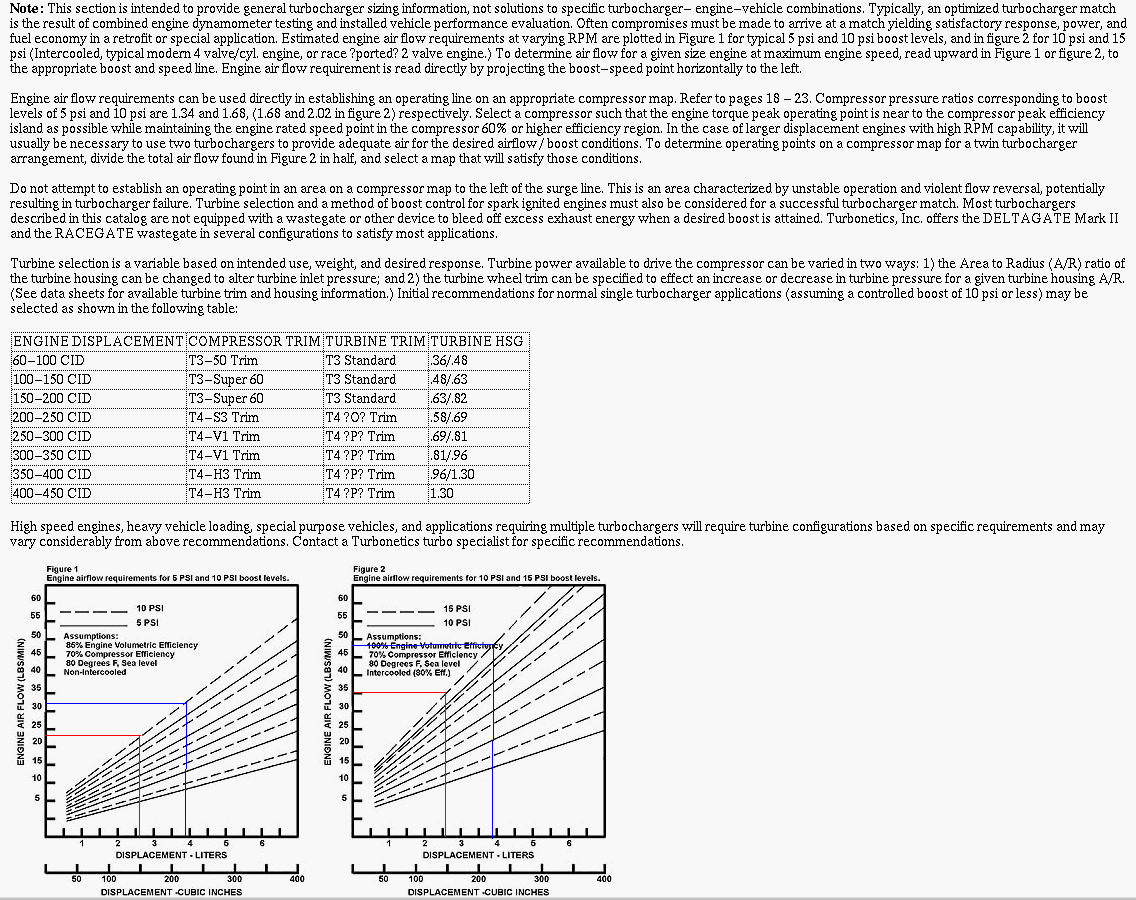
Also an excerpt from the old Turbonetics catalog.


Paul Lamar

The AirCraft Rotary Engine NewsLetter.  Powered by Linux.
ACRE NL web site. http://home.earthlink.net/~rotaryeng/
Copyright 1998-2002 All world wide rights reserved.