>OK That means of course you are going to need a space
 >above the rad core at its leading edge of (235 *.3) /13 or
 >5.4 inches. Do you have room under the oil pan for that?
 >
 >If you mounted it sideways you would only need 235 * .3 /18
 >or 3.9 inches.
 >
 >Still want to mount it long ways?   Paul Lamar
 If I were starting over I would set the radiator sideways, however,
 that is no longer an option.  No, I cannot  achieve the optimum
 opening at the leading edge of the core.  The maximum available is
 4.75 inches.  At the leading edge of the rad header tank, the plenum
 opening is 5.188 inches.   May not be optimum but it is very good.
 I suspect that a MUCH smaller opening will prove to be adequate as
 > long as a good pressure drop through the radiator is achieved.  If
 > the louvers are efficient, no problem.  If they are not, then no
 > intake plenum regardless of size or shape will make a damn bit of
 difference.  Just an uneducated opinion, mind ya.    Can the test box
 be made so that different size intakes can be tried?

 Jerry
OK we will build the box with 4.75" by 18" opening and see
what we get in the way of airflow. There may be a way of cheating
when you do an actual 3D duct.

Drawing later.


Paul Lamar
The opening should be 4.75" x 13". Jerry
  Paul,

  Your suggested inlet opening is approx .3 times the frontal area of the
core. I've seen you use this number repeatedly recently and have let it go,
but I've gotta ask - where does this come from? Is there documented data
that indicates this is required? Or is this based on the experience of
others who are currently flying?

  I ask because this is contrary to the analysis that Fred Moreno did for
me several years ago. Fred provided 3 different configurations of
radiator/inlet/outlet size and as the rad size increased the inlet and
outlet requirements decreased. Intuitively this makes sense to me. For a
constant heat load as radiator size increases airflow requirements should
decrease. It could be that one of those combinations did in fact follow the
.3 "rule" but clearly not all 3 of them did.

  Now it could be that for Jerry's configuration an inlet of 70 sq in is
appropriate for his chosen radiator and anticipated heat load. But if this
is in fact true, then presumably he could get away with less inlet area
(and therefore potentially less cooling drag) if he could squeeze in more
radiator. This was the point of Fred's analysis and is contrary to the .3
"rule" that you've been applying.

Mike Wills
As I recall I had a GM engineer mention it to me about
30 to 35 years ago.

This rule of thumb has been around for years and K&M used
.25 to .50 in their duct coordinates back in 1953. Just recently
I did a BTU analysis at 80, 100 and 120 MPH and for air
temp increases in the range of 50 to 60  F the .3 rule
showed up again. When I did road testing on the box I got
excellent flow through the rad at .3 indicating most of the
max amount of air available was coming in the duct and was
flowing through the rad despite having to turn almost
90 degrees to do so. Duct area times forward velocity (volume1)
equals core area times core flow velocity (volume2). If
the duct area had been too small or too large  this equality
would not hold. We will get another chance to verify this
when we test Jerry's rad. I encourage anybody to build
a test rig and verify these numbers. I am hoping Tracy
will make some measurements on his airplane.

The ratio can be smaller if the speed is higher. It is optimum
only at one speed and one rad thickness. When you use cowl flaps
and close them down in effect you are making the hole smaller.
External diffusion then takes over and most of the air flows
around the opening.

As I recall Fred said nothing about take off and climb.

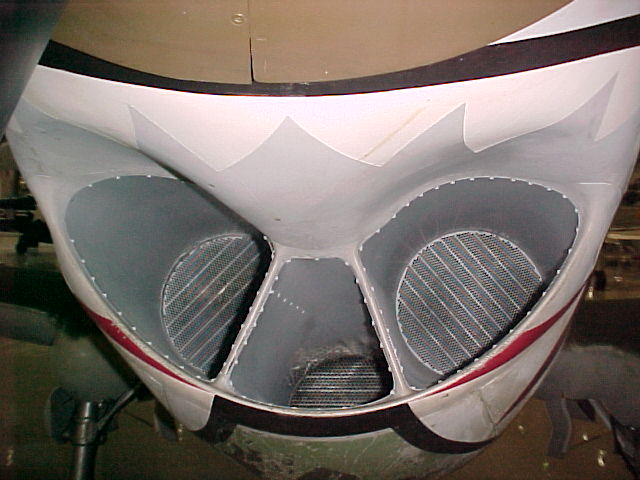
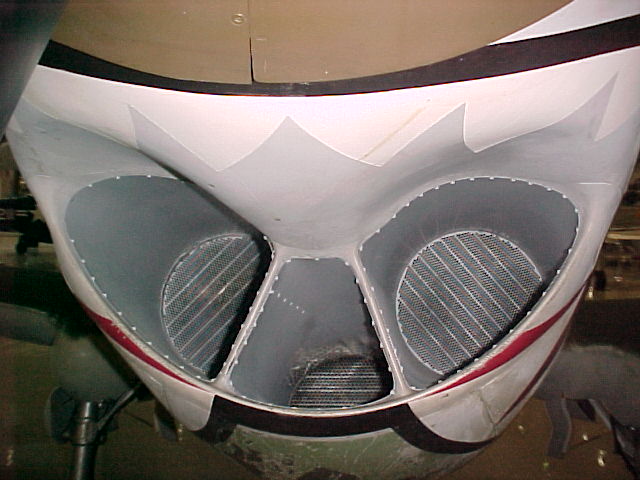
BTW here is a pic of a P40 with the duct opening area equaling
the area of the rads.

Paul Lamar

The AirCraft Rotary Engine NewsLetter.  Powered by Linux.
ACRE NL web site. http://home.earthlink.net/~rotaryeng/
Copyright 1998-2002 All world wide rights reserved.