The side port engine that Jim described is typical of the engines a
lot
of us have. 4 port housings with n.a. high compression rotors and street
porting. That's what Bruce Turrentine built for me and that's what Tracy
is
currently flying. I think Tracy estimates his HP at about 185 - 190 and
thats what I hope to get from mine as well.

  As I've mentioned in years past, Racing Beat has built a 4 port
aircraft
engine. A member of my EAA chapter had it built to his specifications
and
hopes someday to market it. I've sent pictures to the list in the past.
Jerry, if you'd like to see some pics or want further info let me know
and
I'll email you off list. BTW, there was extensive dyno testing done on
this
engine and the result was 190HP @ 5900 RPM as I recall.

The first year I attended the Copperstate fly-in (I think 95) Everett
Hatch
did a presentation on the Powersport engine. The gist of the
presentation
was that much experimentation and dyno time was expended in coming up
with
port timing, runner size, port size and shape, and runner length in
order
to optimize the engine which at the time was rated at 210HP. I dont
remember the details but the timing requirements were considerably
different from the typical PP timing used by the racing crowd. And as
Jim
mentioned to you the optimum runner size (and port size) was also
smaller
than is typically seen on PP race engines. Keep in mind Paul that I'm
just
the messenger but my recall of Everett's presentation is that bigger is
better definitely did not apply in his testing. There were significant
benefits in optimizing port size, runner size, and particularly port
timing.
In addition to HP potential, it seems to me the real advantage of the
PP
is the simplification (and decreased weight) of the intake manifold. As
with many things I suspect its not as simple to arrive at an optimized
set
up as it appears on the surface. Jerry, I hope the homebrewed PP engine
works out for you. It's an upgrade I'd be interested in pursuing in the
future.
Mike Wills
Everett Hatch was not entirely infallible. Look at his incorrect position
on the torsional vibration issue. Neither is Jim Mederer.
Compared to the engineering resources of Mazda they are fleas on
the back of an elephant.

It always amazes me how people are in complete denial on the Lemans
engine. It is a big mystery to me. Do you think Mazda was lying
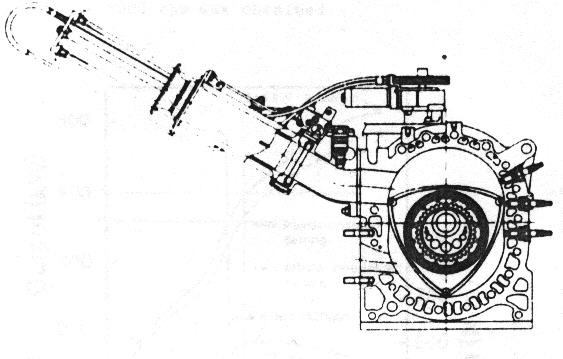
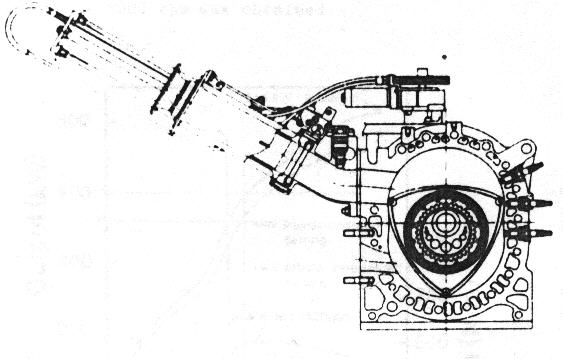
about 240 HP at 6000 RPM? Do you think the drawing Mazda published
in the SAE paper showing the P-port to be at least two inches in diameter
to be a cartoon? Have you read what I wrote and looked at all the pictures
of the Lemans engine? Do you not believe that the 3rd gen ports are larger
than the 2nd gen ports and that the RX8 ports are larger than the 3rd gen
ports by 20%? Do you not believe the bigger the pipe the more the flow
at the same velocity? What's up? I don't get it. Am I to be completely
discounted? Are you people being contrary just be contrary and create
a controversy? :-) As my wife is found of saying; "what does logic and
reason have to do with it"?

I'll tell you what is probably fooling more than one  cottage industry
rotary engine tuner. And that is this. The diameter of the pipe also
affects
the tuned length. Surprise! Have you been to church lately and seen an
organ?
If you are not trying all combinations of pipe
length and diameter on your dyno you are fooling yourself. See
the chart below. Lets say you want to try only 3 different diameters
and 3 different pipe lengths and 3 different timings. That is 27 different
combinations and dyno runs. Did Everett or Jim do this? I don't think
so. OK lets say you make three different pipe diameter variable length
tuned
intake manifolds. Or start small and tear the engine
down each time you increase the size of the p-port.
You will also need six sacrificial rotor housings with different
p-port timings. Did Everett or Jim do that? I don't think so.
This sort of  trial and error applied research is economically
beyond the average cottage industry or shade tree rotary engine tuner.

Just copy the Leman engine for *&^%$#@ sakes!

Paul Lamar
Okay, Paul. Suppose I want to copy the Lemans engine. I've copied the
diagrams and pictures you've posted before. But Lynn Hanover had suggested a
specific and practical way of working out the port timing.

I've looked in my archives and found a diagram marked Fig. 4.26 that plotted
mean effective pressures for both the side port and peripheral port engines.
It documented that at Wide Open Throttle, the side intake port opened at 32
degrees after TDC and closed  40 degrees after Bottom Dead Center. The
peripheral intake port was said to open at 90 degrees before TDC and close
at the same 40 degrees after BDC.

Is that the timing curve you say we should copy? And...dumb question...how
does one determine the TDC or BDC equivalent on an engine without a piston?

Barry Gardner
Wheaton, IL
Print this jpg. Take it to Kinko's and have them blow it
up to full size. Measure the drawing and put the ports in exactly
the same place and size.

TDC is when the face of a rotor is vertical next to the spark
plugs. BTC is when it is vertical next to the ports.

Paul Lamar

The AirCraft Rotary Engine NewsLetter.  Powered by Linux.
ACRE NL web site. http://home.earthlink.net/~rotaryeng/
Copyright 1998-2002 All world wide rights reserved.