Tracy Crook wrote:
     >
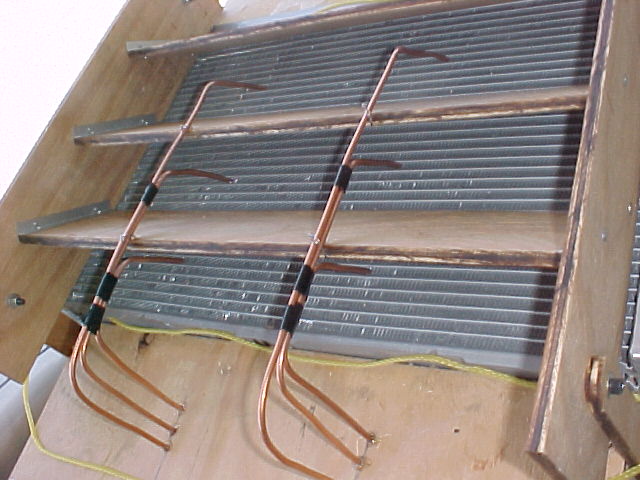
     > Here's some progress shots of Bernie Kerr's RV-9A project.  Amazing how that
     > Griffin rad fits in the cowl .
     >
     > Tracy Crook
     > tcrook@rotaryaviation.com

     Yes it fits but the back side is not unobstructed enough
     and the exhaust will transfer a whole lot of heat to the
     back side of the rad. Good luck Burnie :-)

     What does he have against putting it under the engine?

     Paul Lamar
     It's all a matter of flow area.  The air exiting the back of the rad is moving
     relatively slowly, and I wouldn't expect it has much problem moving around objects that
     might be there.
I thought the same thing going into my rad test. I was rather
surprised to find that the air speed coming out of the back of this
rad was 40% of the forward velocity despite having to turn 90 degrees.
I would not call that relatively slowly. If that air impinged on
something it would develop around 25% of dynamic pressure. Of course
that does not happen as the back pressure slows the speed
of the air going through the rad. The end result is less airflow and
less cooling. As Kuchemann & Weber stated the configuration of the
duct behind the rad is extremely important.
As long as the total area available for the air to move away is larger
     than the rad exit, shouldn't affect the flow.  It would be good to shield the exhaust,
     but I'd guess the radiant heat transfer to the rad is very small compared compared to
     the convection transfer of the air blowing through there.  Probably the bigger issue is
     going to be to get an effective diffuser section on the inlet side.

     Al
The only possible diffuser for such a configuration would be the wedge
diffuser. There is not enough room for a K&M type bell shaped diffuser.

I highly recommend doing some full scale testing, as I have, on any duct
configuration before you commit yourself to a particularly arrangement.

As far as radiant heat is concerned:
Get a 100 watt infrared heat lamp and shine it on a surface ten inches away.
Gets very hot right?  It will burn your hand lickity split.

Now think of a wildly optimistic 33% efficient, 200 net HP rotary engine.
600 HP total heat in the fuel burned. 100%
400 HP total waste heat. 66%
132 HP out the water cooling system. 22%
68 HP out the oil cooling system. 11%
200 HP out the exhaust. 33%

One HP is 746 watts. 200 HP x 746 = 149,200 watts. Lets say only one
tenth of that exhaust heat is radiant energy from the exhaust pipes.
149,200 x .1 = 14,920  watts. Now think of an 14,920 watt infrared
heat lamp ten inches away from a surface. How hot do you think
that would be?

Paul Lamar

The AirCraft Rotary Engine NewsLetter.  Powered by Linux.
ACRE NL web site. http://home.earthlink.net/~rotaryeng/
Copyright 1998-2002 All world wide rights reserved.