Marc Wiese wrote:
 > Just to reiterate here are some pertinent graphs from Kuchemann &
Weber
yet again. Placing a large rad within ten to fifteen inches from the
block,
intake manifold, exhaust manifold (no matter how cool) or firewall is
a
no no if you want it to work well. It is particularly important
with a two inch thin or thinner rad (what we are dealing with here) as
the flow velocity is higher than about 40% of the forward velocity.

This causes an impact pressure build up on the obstructions
which in turn reduces the flow through the rad. If you want your
airplane to cool make absolutely sure the back of the rad is
totally unobstructed.
Paul,
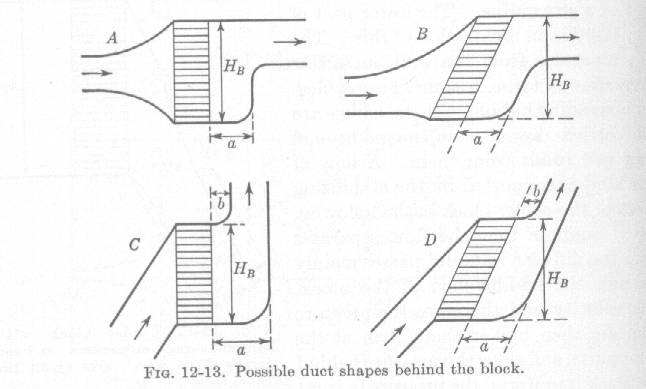
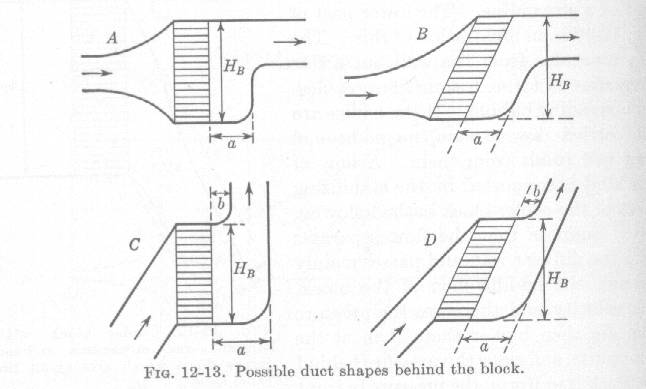
Would you mind sending out how to calculate the values of the a and b
letters on the diagram attached?
Marc Wiese
Hb is the height of the rad assuming a square rad.
a is the distance to an obstruction behind the rad.
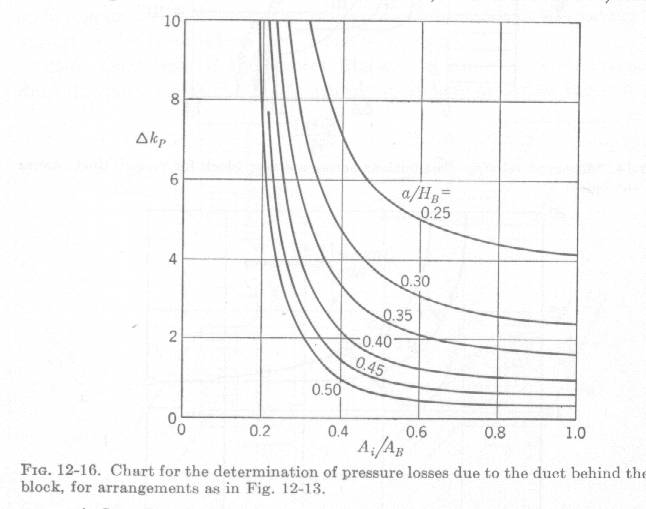
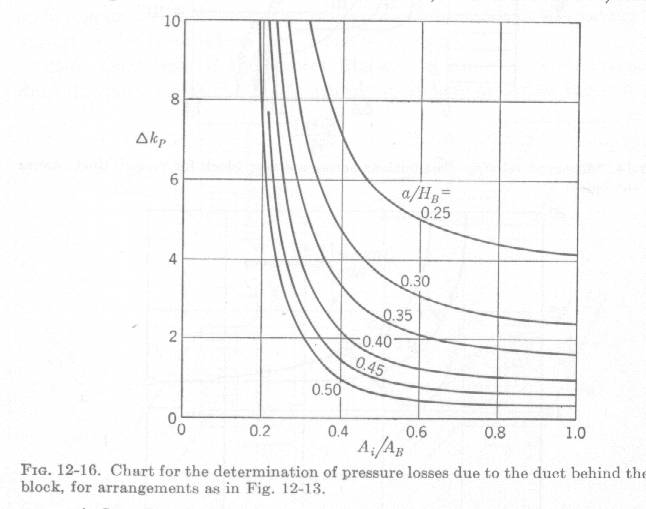
Hb  If Hb is 20 inches the obstruction must
be .5 times Hb or ten inches or more according to fig 12-16
or a large flow penalty will be paid.
Ai/AB is the ratio of the inlet hole area to
the area of the core. In K&M speak referred to as the cooling
block. 0.4 means the inlet hole area is 40% of the core area.
Delta Kp is the overall pressure loss in the system.
Lower numbers are better.
Notice making the hole bigger and bigger does not help
much if the obstruction is too close to the back of the
rad. Power Sport and tracy Crook have both experienced
this phenomenon.

Interesting thing about this chart is that the 30% rule of
thumb appears yet again.

Paul Lamar

The AirCraft Rotary Engine NewsLetter.  Powered by Linux.
ACRE NL web site. http://home.earthlink.net/~rotaryeng/
Copyright 1998-2002 All world wide rights reserved.