Ed Anderson wrote:
Paul, I took my spreadsheet routine and with a gasoline BTU of 20891
BTU/LbMass and 11:1 rich fuel mixture caluculated that with 100% Ve that
a
two rotor 13B size engine can produce 240HP at 6000 rpm with a NA
intake.
So looks like the Mazda engineers just may have been telling the truth
on
the Lemans engine {:>).

Air Fuel Mixture Ratio(Air Part)      11.00
Initial Engine RPM                          6000
RPM Step                                      100
% Throttle Opening (Enter Percentage)      100%
MSL Altitude in feet                          0
Enter Air Temperature (Select 15F - 160F, in 5 Degree  Increments)
59
Enter Boost (psi Gauge)  Calculations Compensate for Altitude      0

  Prop RPM Horse Power Fuel Rate Gallon/Hour
 RPM    HP        Fuel Rate    Radiator   Oil Cooler (Heat
rejection -BTU/Min)
6000      239         19.35         6768     3384
6100      243         19.68         6881     3440

So our 160-170 HP rotaries at 6000 rpm are producing approx 33% - 25%
less
power.  Does that imply our intakes are at a Ve of approx 75%?  The only
thing I don't have is whether their compression ratio was similar - but
that
would not account for more than a few percent of the difference in any
case.
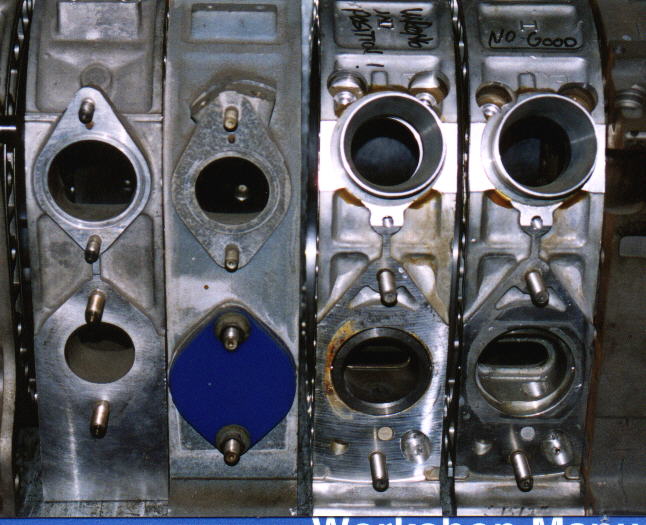
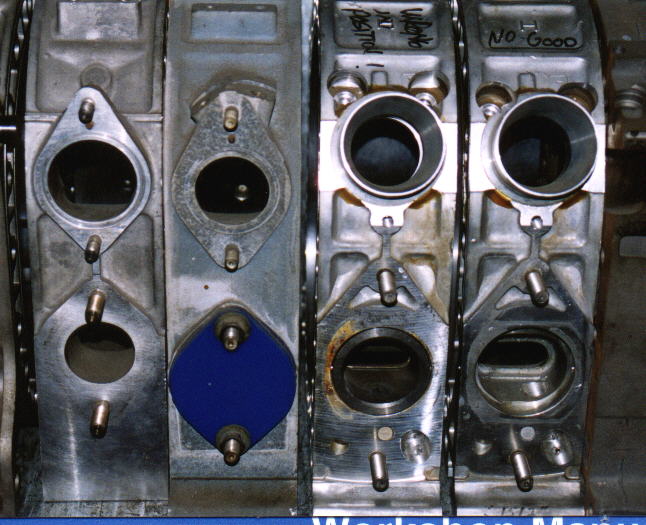
So, your/their  view that large diameter intakeswith no turns into a PP
combustion chamber gets more air/fuel into the mixture certainly looks
possible . Even though I had larger dia pipes on my initial 86NA engine
and
they gave me 300 rpm less at static than my current smaller pipes, it
may be
that the smaller ports into the NA engine simply could not benefit from
the
larger dia intake I then had. Perhaps if I put the original intake back
on
the engine I would see a futher increase.  But, that will have to wait.

Anyhow, just thought you might find it interesting if not surprising.

Ed Anderson

Ed Anderson
Matthews, NC
RV-6A N494BW
eanderson@carolina.rr.com
I don't expect they would lie :-) There are ten thousand automotive
engineers around the world looking over their shoulder.

The volumetric efficiency of P-ports is well over 100% over a wide
range. That is the beauty of a wankel. Straight shot into the housing
with no silly poppet valves to wiggle around. (I expect I will hear
from Vance shortly :-))
Paul Lamar
Your darn betcha !! Vance is going to chime in on this.
First just look at the laws of physics - NO positve displacement engine,
regardless of port
or valve size, shape, nor timing, is going to produce over 100% volumetric
efficiency,
unless the average port/valve inlet pressure is over ambient during the open
period.
Other than this is called "super" charging. This can be accomplished to a
limited
amount by resonant conditions, for which Chrysler Corp dubbed "Ram
charging".
The Lemans rotary did this in spades with the trombone inlets, and
undoubtedly
produced the horsepower they stated. However thinking you can reproduce
these results just by tracing a brochure drawing is pretty darned
optomistic.
I always thought SAE papers were designed to sell cars but
calling it a "brochure drawing" is a bit over the line Vance :-)
It is so much like what I have seen and the pictures of the engine
that I have no doubts it is accurate.
I do suspect Mazda of "jobbing" the volumeteric efficiency, probably related
to the displacement ploy they are using to defraud (in my opinion) the
Japanese government out of taxes.

Volumetric efficiency is generally measured by measuring inlet air flow
on the dynomometer, and comparing that to the mechanical measure of
pumped displacement of the engine. For example a 350 chevvy at 4000rpm
would theoretically pump 350 times 4000/2 cubic inches per minute
(divide by two because a 4 stroke only "pumps" on the intake and
exhaust stroke). Easy, and straight forward. However a "1.3 liter"
13B at 6000 rpm is not so straight forward. If you assume it is a 4 stroke
1.3 liter at 6000-rpm it would "pump" 1.3 times 6000/2 liters per minute.
Gee - how much power would that entitle you to get?
Well 6000X1.3/2 is 3900 liters p/min - with hanbook number back
to English units that is 631.8 pounds of air per hour. We were using
an 11 to one air fuel ratio so that is 57.4 pounds of fuel per hour.
even if we think we can get .4 bsfc that is only 143Hp Gee! maybe
the rotary is not a 6000 rpm 1.3Liter engine.
If you call it 1.3 liters you must consider it a two cycle.
It is 2.6 liters working as it does as a four cycle.
If we put our air measuring barrel on top, we find that we are using a lot
more air than that, Over 100% Ve - I dont think so! The real pumping
element is the rotor which is turning 2000 rpm. Each turn is sweeping
all three faces through all four "strokes" of the 4 stroke cycle. We have
filled and emptied each of the .65 liter cavities on both rotors in one
turn 2000 times 3 chambers time 2 rotors times .65 is 7800liters per
minute, so our true volumetric efficiency is more like 60 to 80
percent like a typical garden variety piston engine.
Vance J
You are forgetting that piston engines have valves that get in
the way of airflow into the engine.
I need to let you drive my RX7 Vance.

It puts out two power pulses per rev just like a four cylinder four cycle
engine so it must complete all four cycles twice per rev regardless
of what the rotor is doing or not doing. That is the bottom line.

Regardless of these academic considerations the bottom line of any
aircraft engine is the power to weight ratio and durability  and in
this regard the rotary is outstanding. In that case you can say
it has any displacement you like. Call it ten liters if you wish :-)

Paul Lamar

The AirCraft Rotary Engine NewsLetter.  Powered by Linux.
ACRE NL web site. http://home.earthlink.net/~rotaryeng/
Copyright 1998-2002 All world wide rights reserved.