"Michael D. Lilja" wrote:
Hi all,
As I am new to the rotary world I have a few basic questions about
rotaries.  I understand the basic operating priciples of a rotary
engine, but I would like to know more about their operating
characteristics.  What is the torque output of a rotary like?
Why do you want to know?  It don't got no stinking torque :-)
What do you need torque for?
HP = torque x RPM /5252
Therefore torque = (HP x 5252)/RPM
Lets say the engine HP is 200 at 6000 RPM.
The engine torque is  then 175 foot pounds at 6000 RPM.
The prop torque is 2.85 x 175 or 498.75 foot pounds.
Exercise for the reader. What is the prop HP?
The
recipricating engine still seems to be the most fuel efficient, what
is
the reason for the rotaries relative inefficiency?
Sounds like a hit and run question.
No longer true. In fact Jan Car & Driver says the RX8 gets 19-20 mpg
city
and 28-30 highway. EPA estimate. That is better than the vast majority
of 250 HP four passenger 2900 pound and above four place cars.
The rotary will run 100 degrees lean of peak unlike a piston engine.
We think this is because the the combustion chamber is rotating
forcing
the fuel out towards the spark plugs providing a natural stratified
charge
situation. Naturally there are no exhaust valves to fail so
you don't have to worry about that. Tracy Crook claims he can cruise
along side a lycoming and get the same fuel burn.
BTW C&D claims the RX8 does zero to 60 in 6.3 seconds and
the 1/4 mile in 14.9 at 95 MPH not bad for a car with no torque.
Apparently the test drivers at Car & Driver know how to drive
a rotary better than the test drivers at Motor Trend.
C&D also compl
ains the turbo exhaust is too cool to trigger
the cat converter.
Is the horse power
output because of the RPM's attainable?
Yes of course. They are real Percheron draft horse's. See picture
below.
 From a conveience standpoint,
(fuel available at the airport) what is the possibility of using
100LL?
 Thanks for the help and the newsletter.
Michael D. Lilja
100 LL is a bit hard on the plugs but a tank or two of no lead
auto gas seems to clean them up. We are working on a solution.
Probably multiple spark discharge ignition systems will do the
trick.
Merry Christmas.
Paul Lamar
"Michael D. Lilja" wrote:
Okay, so my initial questions were a little simplistic, but I got a few
of you talking. It is my
desire to understand this engine better and see if it is what I want to
use. As I am an A&P I am
familar with the current aircraft piston technology and am not the least
bit impressed with the
perfomance vs. displacement or the reliabilty of some of it (due mostly
to quality control
issues.) The fuel efficiency question was not in the least a hit and
run. The comparison listed
in one of the letters from a previous day actually showed the RX8 with
the worst milage of the 250
horse comparison.

So, now to share some of my (mis) understandings of the internal
combustion engine. An
intercooler is used (at least in recips) for two reasons. The first was
already mentioned,
detonation. As the air is compressed in the turbocharger/supercharger
it is heated. If the
incoming charge is too warm, along with the additional compression in
the chamber, it will cause
the fuel to detonate (burn at not only at the wrong time but not
uniformly as well.) The other
reason an intercooler is used is to produce a denser charge. Again, the
air is heated as it is
compressed in the turbo and becomes less dense than if cool at the same
pressure, allowing for
less fuel to be used and not getting as much power as possible.

Turbo normalizing means no more than sea level density is mainted
throughout the altitude changes,
usually about 30" of manifold pressure. The thing about turbo
normalizing is, higher compression
ratios can be maintained without fear of detonation and the engine
efficiency can be maintained.
It is when you get into boosted (above 29.92" Hg and in aircraft
parlance refered to as
supercharging) manifold pressure that detonation is a problem . Most
engine manufactures then use
a lower compression ratio in order to prevent detonation. Even though
more power is produced
(more fuel and air) in the boosted engine it is done at the sacrifice of
efficiency, or a higher
sfc per horsepower produced. So a boosted (supercharged) engine has a
higer effective compression
ration from a detonation standpoint because of the denser charge, but as
was also pointed out, not
a higher effective compression ratio from an expansion or power output
standpoint.
So, sorry about the disertation, but this what I am trying to find out
about the rotary engine in
terms of its efficiency relating to fuel consumption. Does it have a
relatively high or low
(normaly aspirated) compression ratio? And besides running lean of peak
what is being done to
improve its fuel consumption numbers? Even though I can trade engine
weight for fuel weight, I
still don't want to buy anymore gas than necessary or lug it to the
field! That brings up another
question. Has vapor lock been a problem using auto gas? Do you forsee
any problems using this
engine and auto gas at high altitudes?

I am asking about torque because it does have some bearing on the
overall engine/aircraft
performance as well as P-factor on take-off and other high power setting
attitudes.
Thanks for the forum. The discussions have been quite entertaining and
improving my understanding
of this engine.

Mike Lilja
Your concern about torque characteristics is very real with fixed pitch
props on high
performance airplanes. low end torque is sacrificed with any type of engine
when it is
timed (ported) for high output at high RPM. I feel that the Wankel is
particularly
sensitive to this effect. With controllable props, this is of course, a non
issue,
and absolute horsepower rules - Vance J
I am surprised at you Vance :-)
What happened to prop HP is proportional to the
square of RPM? Did that law of physics go away when
I was not looking? A fixed angle of attack wing (prop) will
increase its drag proportional to the square of velocity.
Is that not true?  Therefor prop HP requirements go
up with the square of RPM well below mach one tips speeds
while the very worst case scenario for a rotary is HP increase
DIRECTLY with RPM in a linear manner. (At mach one tip speeds
everything runs into a brick wall.)

For this not to be true the rotary
would have to have a concave HP curve and I have yet to
see that short of turbo charged rotary.

The fact of the
matter is NA rotaries and aircraft engines have almost identical
straight line HP curves because of the low RPM red line of
the aircraft engine. The red line is low because of structural
limitations of the large displacement  per cylinder air cooled
piston engine. This happens long before the AC engine runs out
of breathing. That is why it is so easy to get a lot more HP
out of an aircraft engine if you are willing to destroy it by
running it at 3500 RPM or more. The structural limitations
and the RPM red line are there to keep the weight down
and the life up.

The car piston engine on the other hand has a very convex
HP curve as breathing drops off drastically as RPM
approaches twice the red line due to the smaller displacement
per cylinder. Half as much as an aircraft engine typically
suffers under. After all there are plenty of 360 cubic inch V8's
around while 360 cubic inch four cylinder aircraft engines
are the norm.

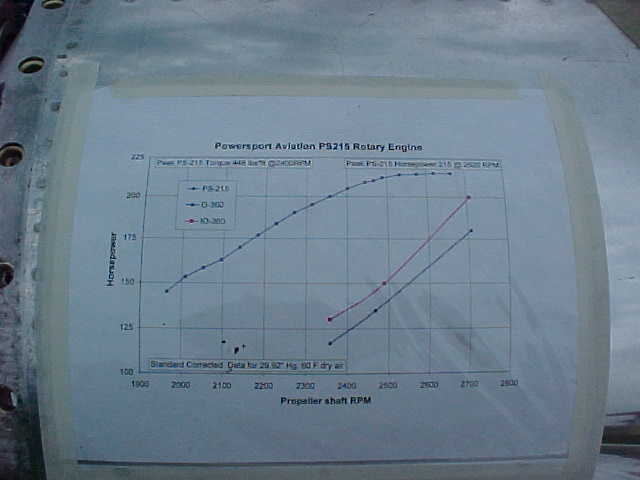
Here is a very good chart that illustrates the difference.
The top curve is the full load HP curve of a Power Sport
NA peripheral port engine on a dyno plotted according to
prop RPM. Note the prop HP load curve of a Lycoming
compared to the geared rotary. Now tell me the rotary
lacks the necessary torque to stall the prop.

Just about any geared rotary can stall just about any prop
at less than top speed. Ask the men flying them.

Paul Lamar

The AirCraft Rotary Engine NewsLetter.  Powered by Linux.
ACRE NL web site. http://home.earthlink.net/~rotaryeng/
Copyright 1998-2002 All world wide rights reserved.