Your concern about torque characteristics is very real with fixed
pitch
props on high
performance airplanes. low end torque is sacrificed with any type of
engine
when it is
timed (ported) for high output at high RPM. I feel that the Wankel
is
particularly
sensitive to this effect. With controllable props, this is of
course, a non
issue,
and absolute horsepower rules - Vance J
I am surprised at you Vance :-)
What happened to prop HP is proportional to the
square of RPM? Did that law of physics go away when
I was not looking? A fixed angle of attack wing (prop) will
increase its drag proportional to the square of velocity.
Is that not true?  Therefor prop HP requirements go
up with the square of RPM well below mach one tips speeds
while the very worst case scenario for a rotary is HP increase
DIRECTLY with RPM in a linear manner. (At mach one tip speeds
everything runs into a brick wall.)

For this not to be true the rotary
would have to have a concave HP curve and I have yet to
see that short of turbo charged rotary.

The fact of the
matter is NA rotaries and aircraft engines have almost identical
straight line HP curves because of the low RPM red line of
the aircraft engine. The red line is low because of structural
limitations of the large displacement  per cylinder air cooled
piston engine. This happens long before the AC engine runs out
of breathing. That is why it is so easy to get a lot more HP
out of an aircraft engine if you are willing to destroy it by
running it at 3500 RPM or more. The structural limitations
and the RPM red line are there to keep the weight down
and the life up.

The car piston engine on the other hand has a very convex
HP curve as breathing drops off drastically as RPM
approaches twice the red line due to the smaller displacement
per cylinder. Half as much as an aircraft engine typically
suffers under. After all there are plenty of 360 cubic inch V8's
around while 360 cubic inch four cylinder aircraft engines
are the norm.

Here is a very good chart that illustrates the difference.
The top curve is the full load HP curve of a Power Sport
NA peripheral port engine on a dyno plotted according to
prop RPM. Note the prop HP load curve of a Lycoming
compared to the geared rotary. Now tell me the rotary
lacks the necessary torque to stall the prop.

Just about any geared rotary can stall just about any prop
at less than top speed. Ask the men flying them.

Paul Lamar
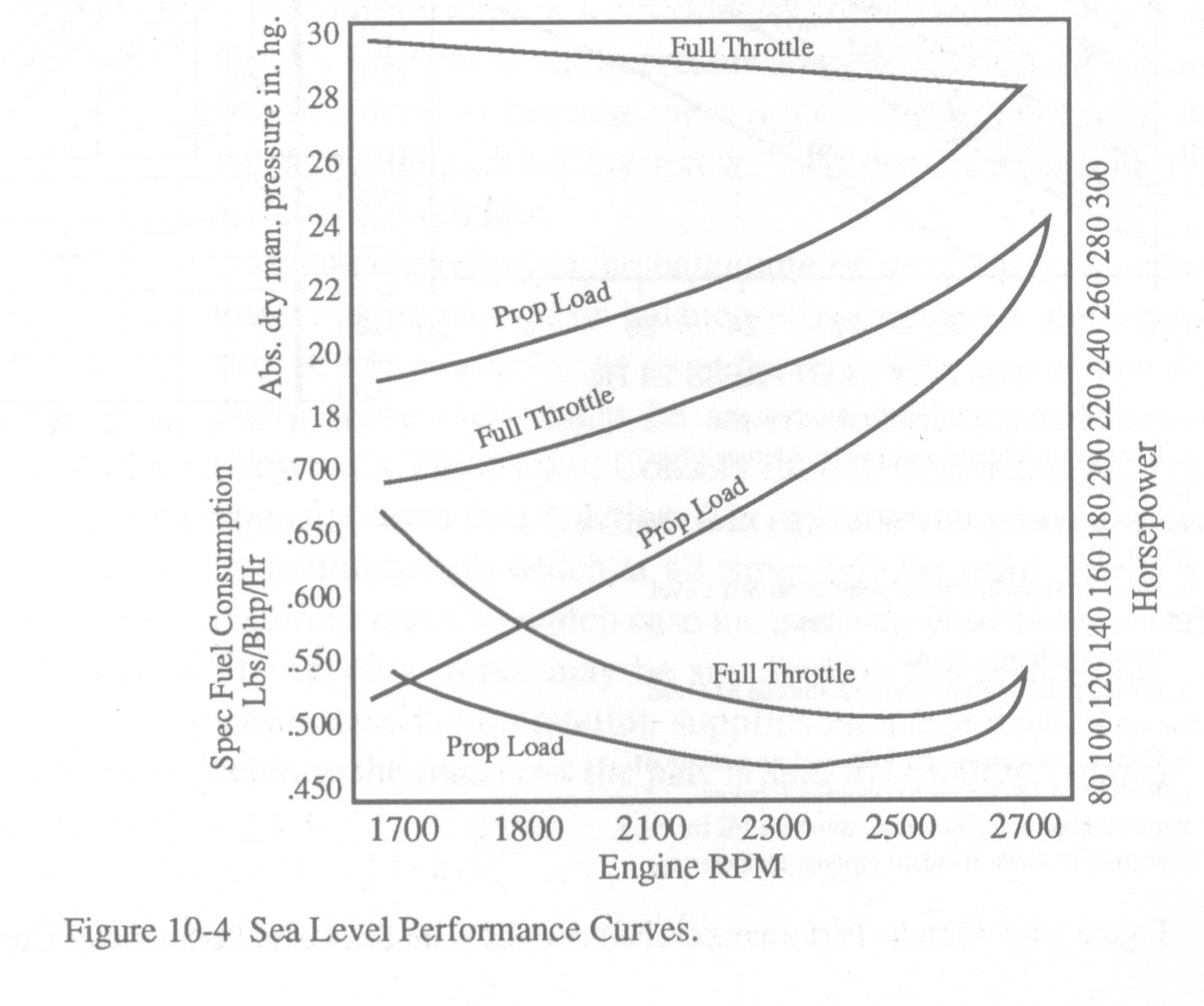
Here is a chart from the Sky Ranch engineering manual that
illustrates my points precisely. Note the full throttle
HP curve is convex. Much worse than the peripheral port
13B rotary from Power Sport. Compare this full throttle
curve with the previous full throttle curve for the
Power Sport engine.

Paul Lamar
Opps! That should be:

"Note the full throttle  HP curve is concave."

Paul Lamar
Most of the curves you posted were not full throttle power curves
and few of them really were scaled to show the very real torque
fall off as you go below the max torque rpm. The Powersport curve
is (deliberatly?) misleading in that it shows prop power load
curves for the Lycoming, not full throttle power curves.
Yes I think I said that. But the Sky Ranch Lyc dyno curve IS full throttle.
It says so right on the curve. Here it is again in case you missed it. PL
At any given
forward speed, a prop load is a cubic function, and differs for
each selected speed. The load at static (in spite of stalled blade
sections) is highest, which is why at static you may get less than
2000 rpm at full throttle.
All practical displacement type combustion engines show a fall off at rpm
below max torque, and non will exhibit your suggested, straight line
power curve extrapolated to zero (they hit zero torque and
power a long time before zero rpm) .
I never claimed it was extrapolated to zero. I was referring
the practical RPM ranges. PL
Ths fall off is caused
by several things - ie pumping and friction losses become
greater than available power and the engine slows and stalls. Also
valve timing and especially overlap are based on flow
inertia  at speeds near design pont, and incomplete scavenging,
filling, and charge dilution become major factors, especially
in peripheral ported Wankels. All power curves are basically
convex. with the drop off at low rpm as described, and
fall off at high rpm with breathing limitations, resonant
flow, and variable valve timing , can put dips and bumps
in the torque curve that can locally disrupt this concave shape,
but the overall effect cannot be eliminated.
All power curves for the engines found in cars are convex
but if you take an engine, like an  aircraft engine, that breaths
well and you artificially limit the RPM red line to a point will below
the breathing fall off then... in the RPM range of interest.. it IS
nearly a straight line... just like a Wankel. The reason the
Wankel power curve is a straight line is it breaths well up to the
RPM imposed by the prop tips hitting the super sonic wall.
Currently with the common 2.17: gear box that is around
6500 RPM. Almost the same situation as the aircraft engine
with a red line of 2700 RPM.

The difference is the aircraft engine is direct drive
while the Wankel is geared. This means the RPM of the
Wankel and the prop can be divorced from each other
unlike the direct drive aircraft engine. The RPM
red line of the Wankel can be set purely on structural
limitations alone. This is not to say there is any structural
margin left in an aircraft engine beyond its red line. All
excess structural strength  is designed out of aircraft engines
to save weight.

With a gear box the wankel breaths well to RPMs well over
twice the RPM of the aircraft engine and well above the RPM
of your average piston engine.  Unlike an aircraft
engine, or any piston engine for that matter, the Wankel
still has a lot more RPM available without comprising
the structural integrity. More RPM more HP. That is why I
am pushing for the 2.85:1 gear box. PL
Paul, I am suprised at you! I am sure you know this if you
thought about it, - Vance J
Ops. I forgot the sky Ranch dyno curve.

Paul Lamar

The AirCraft Rotary Engine NewsLetter.  Powered by Linux.
ACRE NL web site. http://home.earthlink.net/~rotaryeng/
Copyright 1998-2002 All world wide rights reserved.