At the airport today I met a fellow devloping a water cooled lycoming
0-360.
The discussion included the rotary and he liked it for its future
potential saying as others have
that it makes a better aircraft engine than auto engine.
His biggest criticism was poor cooling due to the constant focused heat
with only "one" combustion
chamber, unlike recip's.
Has this consideration been solved ? overheating.

bd
Never was a real problem. Partly because the "combustion chamber"
is rotating around inside the rotor housing.

Paul Lamar
I do think this is the limiting factor in how much continuous power you can
make with the rotary.  With the stock water pump,  around 200 HP is probably
close to the limit for a two rotor.  Grooving the water jacket helps.
Nucleate boiling is taking place at this level and if you go much higher,
the localized boiling turns to an isolating film on the CC walls and
temperatures start skyrocketing.

This problem can be overcome with brute force water pumps like Racing Beat
is doing with the 900 HP 3 rotor, but this is way beyond what most
recreational aircraft builders are prepared to do.

Tracy Crook
tcrook@rotaryaviation.com
www.rotaryaviation.com
Nobody really knows because nobody has placed a thermocouple next
the combustion chamber and correlated the temperature data with
the continuos power generated. Not Racing Beat not Power Sport.
Not even Tracy Crook :) What the water does or does not do
temperature wise has absolutely nothing to do with it.

I suspect this particular urban myth got started when oil
used to coke on on  the rotor housings long before synthetic
oil was available. Old oil coked around 250 to 300 degrees F.
I have never, ever, in 30 years, seen a rotor housing damaged
by this kind of heat. I suspect that no car racer has seen it
either. I have seen collapsed cast iron rotors from a turbo
charged engine but that was probably caused by a plugged
oil squirter. The water pump on a Lemans four rotor is
no larger than the water pump on a 13B and that engine
developed up to 175 HP per rotor. 350 HP for a two rotor
...for the arithmetic  challenged.

I'll believe it when I see the temperature data. It is one
of the things I am going to do with our new temperature data
acquisition system.

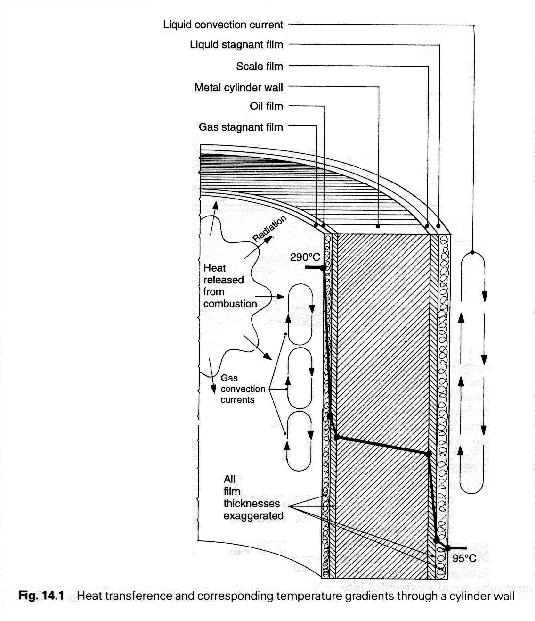
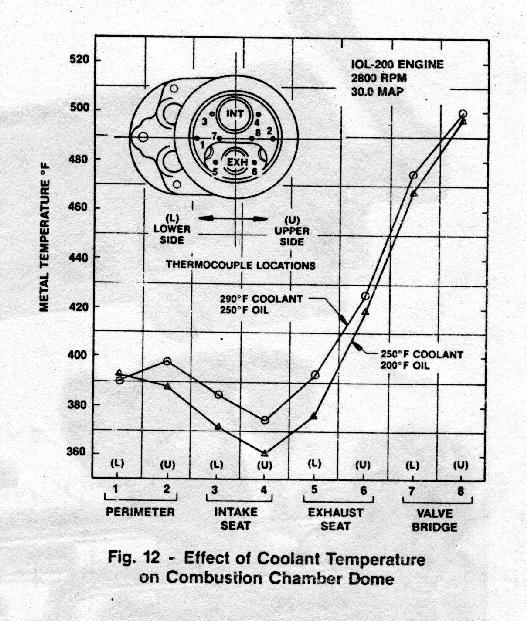
I do have a bunch of data on the Continental water cooled aircraft
engines. Continental did do the homework and instrument this part
of the cylinder head. They found the temperature reached 500 degrees
within 1 mm of the combustion chamber and felt that was the upper
limit for aluminum. The Mazda rotor housing is lined with steel
and there is a lot more surface area not to mention the combustion
chamber moves dissipating the heat over one third of the rotor
housing inner surface.

Paul Lamar

The AirCraft Rotary Engine NewsLetter.  Powered by Linux.
ACRE NL web site. http://home.earthlink.net/~rotaryeng/
Copyright 1998-2002 All world wide rights reserved.