Keith's email indicates there were about 20 hours of run time on
the
installation, 4 of which were flight hours and the other 16 hours
were
ground run. If it were your plane would you consider 16 hours of
ground
test time sufficient to prove the installation prior to beginning
flight
testing? How much ground test time is sufficient? 20 hours? 100
hours?
Or
do you just test until something breaks and then you know how long
to
expect that particular part to last? If it were my airplane I would
have
considered 16 hours of ground test time sufficient to prove the
installation. Its always easier to be the quarterback on Monday
morning.
Someone else pointed out that during the initial flight test phase
it
makes sense to stay within a glide of the airport. I totally agree.
Also,
it seems possible to me that this was not a sudden catastrophic
failure
(though thats not certain). Could be that there were indications of
impending failure that might have been found through inspection
prior to
the last flight. All of the heat shielding around the exhaust may
have
hindered or precluded those inspections. The fiberglass wrap around
the
exhaust system makes routine inspection virtually impossible.

Mike Wills
I agree Mike.
They may have run it 16 hours on the ground but obviously they did
not inspect it adequately. Something like that does not just happen
all at once. It starts with a small crack.

Paul Lamar
Why in God's name he used exhaust wrap I will never fathom. It HIDES any
weaknesses and cracks, promotes corrosion, etc. Not worth it. ss shields
are much better and you can visually inspect the pipes EACH time. If he
test ran it with that stuff on it I can see why this happened! He might
have discovered the cracks before failure, found a potential weakness,
fixed it and keep on going without the heartache and $ he is into now.
That stuff is junk on aircraft. Don't use it.
Marc Wiese
It seems to me that if you are trying to:
1) keep the exhaust system heat under control, and
2) impart less stress on the exhaust system itself,
the ceramic coatings that are readily available (Jet Hot, Performance
Coatings, et al) are the ticket.

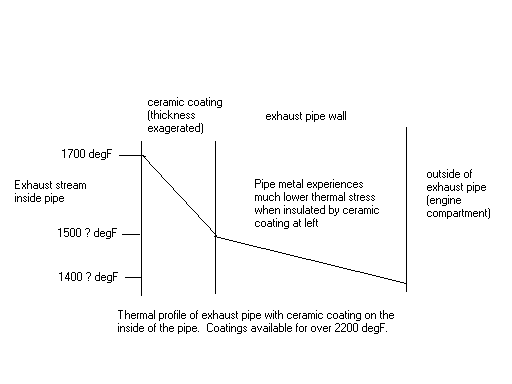
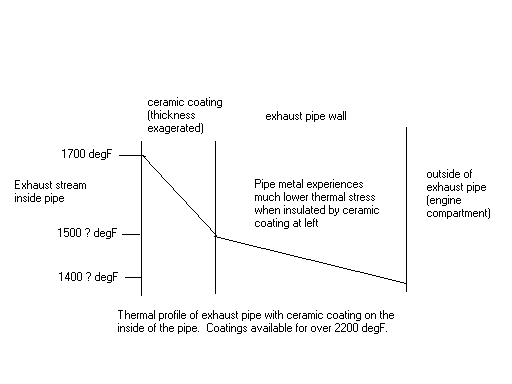
Ceramic coatings are available that are rated to 2200 degF and can be
applied to the INSIDE of the pipes.  This help keep the heat in the exhaust
stream and the inside of the pipe, not inside the engine compartment.  This
acts as an insulation barrier and reduces the thermal flux in the pipe
itself and thereby helping maintain the structural integrity of the
system.  I don't think I would even coat the outside of the pipe as that
would create a barrier for the heat to get out of the metal (except of
course it looks nice).  This of course will push the thermal load
downstream into the muffler or turbo if you have one.  The treatment may be
necessary through the entire system.  The inconel turbine wheels should
still handle the heat and the added energy should actually give an <almost
measurable> improvement in turbo efficiency.

Of course I have not got this built and proven yet, but, do you see the
logic here?

Mike McGee, RV-4 N996RV, O320-E2G, Hillsboro, OR
13B in gestation mode
The AirCraft Rotary Engine NewsLetter.  Powered by Linux.
ACRE NL web site. http://home.earthlink.net/~rotaryeng/
Copyright 1998-2002 All world wide rights reserved.