Paul wrote>
I wonder when the IC engine manufacturing world is going to wake up to the
potential
of the turbo compound? Ideal for the rotary has it has no exhaust valves
to fail and take out the turbine. That was the achilles heel of the
R3350TC.
Paul Lamar
Mark Wrathall wrote:
Paul, I thought we worked through this. The low mass flow is the show
stopper for compounding a 200HP engine. Small flow means small turbine which
needs very high rpm to get efficiency, which then leads to a very differcult
gearbox problem. How do you build a gearbox to convert 15hp from an
overslung turbine at 100,000+ rpm to 6000 rpm with a clutching or damping
mechanism. Likely not unsolvable, but not a feasible path for producing a
"free" 15HP, or 10% SFC. Technical interesting, and we would all love to see
someone do it, but a huge challenge.
What do you mean "we" white man? :) I just agreed that a large diameter
slow turbine was not the way to go. The 15 HP recovery figure is too low. 3800HP/2800HP is 135% more
or 70 HP at a 200 HP level.
At a turbo 300 HP level it would be about 107 HP or 407 HP
net.

BTW no increase in cooling system requirements over the base
300 HP turbo engine. In other words turbo compounding
does not add to the waste cooling heat.

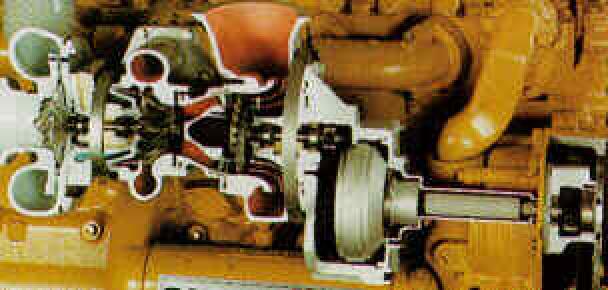
I would now use a oversize turbo charger turbine and
remove the power from the turbocharger shaft out through the
compressor inlet. Same as the Caterpillar TC diesel engine does it.
Yes it will need a gear reduction but only to 8000 RPM from 100,000
or 12.5 to one which can be done in two very small planetary stages.
Yes we will also need some sort of small friction clutch or fluid
coupling to decouple the turbine from the output shaft.
I think the BSFC improvement can be more like 20% and considering
current world wide hysteria over fuel consumption can be
economically viable. Certain cheaper than a silly hybrid car
not to mention way less weight.
Compounding an R-3350 was much simpler from an aero perspective because of
the resonable (in turbine terms) mass air flow; from the mechanical
perspective due to the resulting lower turbine RPM; and from a business
perspective because it was was pretty easy to sell any technical idea to the
US government in the forties and fifties :)

Mark Wrathall
The main use of the R3350TC was not military. The main use was
in the Connie and the Douglas DC7 Seven Seas. It was not until the
R3350TC that routine transatlantic non-stop NY to London and Paris
flight became possible. In fact there was a 24 hour TWA Connie
polar flight from San Francisco to London non stop. It took years
for jets to equal that range. I think the B747 was the first. The R3350TC
was used by the Navy in Lockheed P2Vs. One of which flew non-stop
un-refueled from Australia to Ohio. That range record held until
the Rutan Voyager went around the world.

Paul Lamar

The AirCraft Rotary Engine NewsLetter.  Powered by Linux.
ACRE NL web site. http://home.earthlink.net/~rotaryeng/
Copyright 1998-2002 All world wide rights reserved.