George Lendich wrote:

Paul,
Have a look at the attached GIF.

Firstly I'm unable to get the Bearings you selected on your PSRU drawing,  in Australia, but have
been able to ID a replacement but their not LL's (lighter than light) or even L's because their
far too expensive. The replacement is a little larger and out of a Volvo Diff- the data is being
sent to me from Timken (some extra weight).

Now , as we don't have Chrome Molly readily available here, in any form (everything is sent from
the USA) - I thought I'd investigate Tracy's molded strategy, and no worries I can get parts made
inexpensively enough. I can get all the parts made from the same material (C.M.) - harden the
Flange and drive end of the shaft and leave the prop shaft annealed.
BTW is 8 x 6mm bolts enough to hold the prop shaft on !?

But as you can see the bolts now line up with the locating section of the flange-Ahhh !!!!!!

Now with all this research I can now appreciate Tracy's and Don's approach - with the shaft and
flange being one piece, molded with a solid shaft. Much simpler, cheaper, easier to machine
(possibly stronger), smaller and lighter bearings.

I discussed, with the local foundry, on possible problems with the thin aluminium PSRU housing.
The main concern with thin casting is the distance the aluminium has to travel and having  enough
access points to minimize this. Have you had any feed Bach from your contact on the feasibility of
your one piece PSRU housing.
George (down under)
I forgot to answer that last question. American International foundry
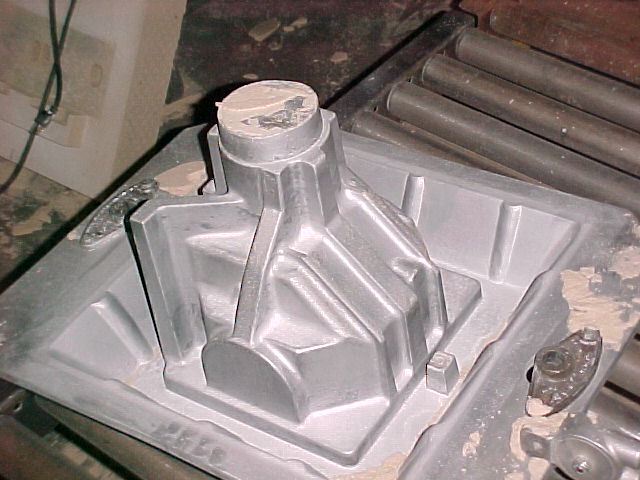
in San Fernando CA specializes in thin wall sand castings. I showed
them the rendering and they said no problem with .140 wall everywhere.
They use a new technique that not every foundry in the world uses.
There is stuff called green sand and dry sand. Dry sand is mixed with
water glass and as I recall that is sodium silicate. It is then hardened
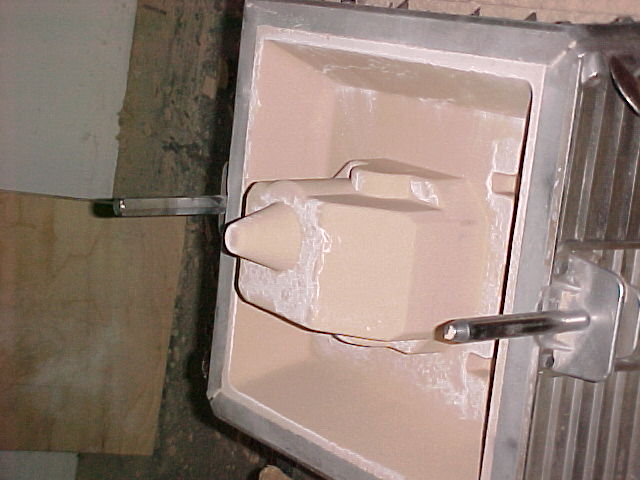
with CO2. This is used world wide for cores. In AI's case the pattern
itself is sort of a core box. The mold is made directly using the pattern
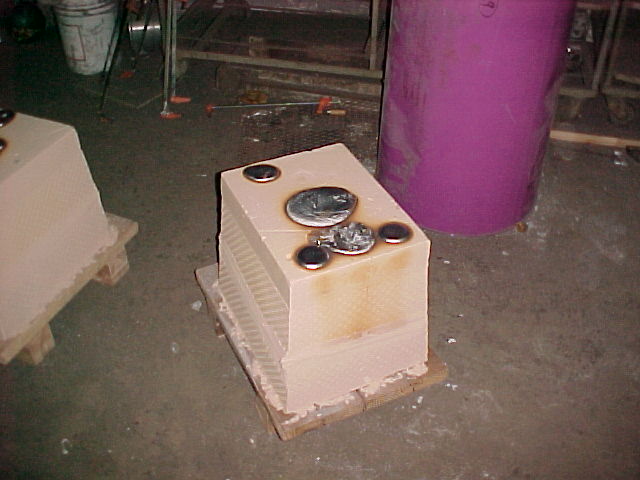
box with no cope, drag or flask used. When done the mold looks like a
big block of dry sand. It is strong enough in thin sections to hold the molten
aluminum with out a surrounding flask. The advantage is finer details can be
accommodated than when the traditional green sand molds are used.
Green sand is just water and sand.

Paul Lamar

The AirCraft Rotary Engine NewsLetter.  Powered by Linux.
ACRE NL web site. http://home.earthlink.net/~rotaryeng/
Copyright 1998-2002 All world wide rights reserved.