The Wankel rotary is ideal for turbo compounding.
The big thing is not so much the additional HP possible but
the fuel burn can be reduced up to 20 to 30% at
the same HP. I am surprised that the auto makers have
not jumped on turbo compounding given the current
fuel consumption hysteria.

Here is a short article on the Allison Turbo compound.
This engine preceded the R3350TC.


This is from http://enginehistory.org/

PL
***********************************************************************************
The Mightiest V-1710 Was a Turbo-Compound

                                     By John Leonard

The first V-1710 produced 750 hp. By the beginning of World War 11 it was
producing 1050 hp, then 1125, then 1325, and late model P38's got 1475. But
engineers recognized that there was a lot of energy going out the exhaust
pipes.

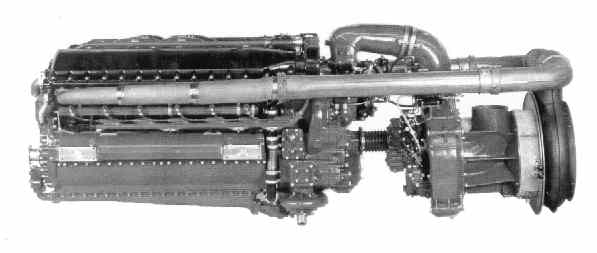
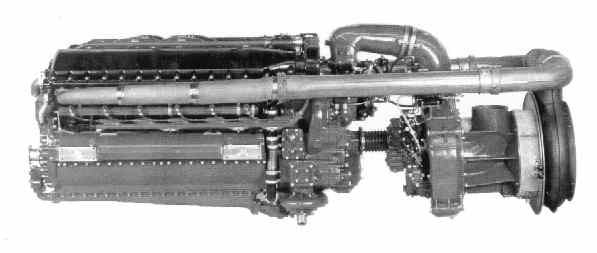
 An attempt to recover some of this energy resulted in the turbocompound
V1710 shown at the bottom of the page. It was identified as the V1710-E22 by
Allison, and as the V1710-127 by the government. A turbocompound engine
collects all of the exhaust gasses and runs them through a turbine, with all
of the power generated going back into the crankshaft and ultimately to the
propeller. It differs from a turbosupercharged engine, which uses exhaust
gas energy to increase the pressure of incoming air. Work on this engine
began in about 1944 and continued until 1946, when Allison asked that it be
cancelled because turbine engines had greater promise. It was the first
successful turbocompound engine, and probably one of only three to ever be
built. This engine was designed to power the XP63H, which, as it turned out,
never flew. The V1710-E22 had a military rating of 2320 hp, and a War
Emergency Rating with water/alcohol injection of 3090 hp.

The most successful turbocompound engine was a version of the air-cooled,
18-cylinder, three-row [Wrong. It was a two row] radial Curtiss Wright R3350.
This engine had three
turbines, each fed by 6 cylinders, that were geared to the crankshaft. The
normal version produced 2700 hp and weighed 2850 lbs. The turbocompounded
version produced 3500 hp and weighted 3440 lb. This engine was used on the
Douglas DC-7 and some versions of the Lockheed Constellation. The other
turbocoupound engine is the Napier Nomad, which was built in England. It was
a 12-cylinder, horizontally opposed, liquid cooled, valveless, 2-stroke
cycle Diesel engine with a 3-stage turbine. It reached flight test but not
production.

 The Allison engine collected the exhaust gas from all 12 cylinders and
routed it to the turbine at the rear of the engine through two exhaust
tubes. The shaft from the turbine ran through the center of the first stage
supercharger impeller, back to the engine and put its power directly into
the crankshaft. The turbine could not be connected to the supercharger
impeller because the supercharger was driven by a variable speed
transmission, which did not run at a fixed speed ratio with respect to
either the crankshaft or the turbine. Since this engine was to power a P63,
it used an extension shaft and a remote gearbox attached to the crankshaft
at the front of the engine at lower left in the picture below. This engine
represented quite an advancement over the original 750 hp engine.

****************************************************************************


The AirCraft Rotary Engine NewsLetter.  Powered by Linux.
ACRE NL web site. http://home.earthlink.net/~rotaryeng/
Copyright 1998-2002 All world wide rights reserved.