Has anyone read the article in the latest Custom Planes on
flutter
starring our first design?

Chris
microcosman.com
Vance W Jaqua wrote:
Chris- I finally backed up to the Jan issue and read the report. I was
probably one of the people that he mentioned talking to, and I suggested
raising the frequancy with a stiffening bulkhead in the tail. His more
direct approach of cutting off some vert mass apparently did the job.
An intersting side to this that others on the site might find
interesting
is the fact that this is another demonstration that composite planes
appear to be one of the few configurations where you can fly home
to tell about your experience after flutter. Actually the Piper that
he mentioned seeing the video, also flew home. The flutter almost
instantly broke the spar in the horizontal, and this shifted the
frequency. The skins were still intact, and provided enough
structure for a gingerly return to field. Vance
Can somebody scan that article for me?
Or Xerox it? Are we talking torsional flutter of the entire tail?
How about a few layers of diagonal carbon uni inside the aft fuse?

Paul Lamar
Paul - here is the article, it is really rather light, but reminds one of
the devil waiting behind the tree - Vance
Thanks Vance here is the first page only as they are too big to
upload all at once.

I talked to Ron Caraway about putting a 13B in this and he laughed and said
he would never make it from Apple Valley to Copper State on the fuel it
could carry. Typical of the misinformation on the rotary out there.

We need to have more people fly longer distances to air shows to overcome
this prejudice. I don't fully understand this. Perhaps people are embarrassed
by what they don't understand and they hide their befuddlement by bad mouthing
the subject of their befuddlement. They tend to seize on a particular criticism
and repeat it over and over again as the gospel truth.

Paul Lamar
BTW What Ron did not do in his article was attempt to explain why balancing
the control surface eliminates flutter.

When you break the problem down it is quite simple.

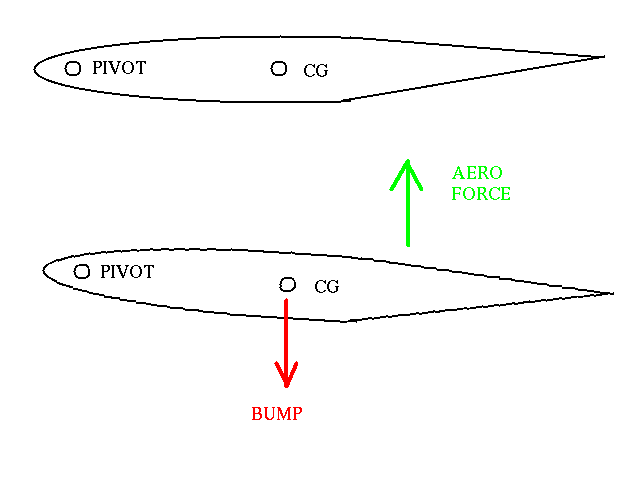
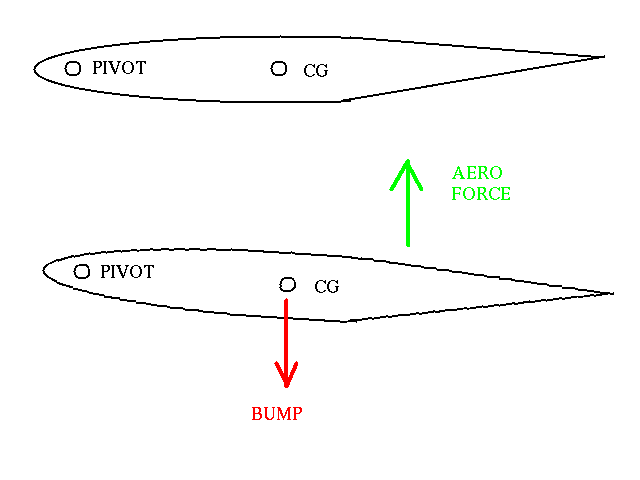
See the diagram below. When a surface is not balanced by a counter weight
the CG of the surface is well aft of the pivot. If the airplane hits an up  bump
the CG of surface tends to stay were it was while the pivot moves upward. "Objects
at rest tend to stay at rest" (I. Newton long time ago). This also generates a large
aerodynamic force that tends to accelerate the surface upwards. At first this
force tends to raise the tail magnifying the effects of the bump. The surface starts
to accelerate and move up towards the trail position. As it passes the neutral trail
position its velocity upwards is a maximum and it over shoots the trail position. "Objects in
motion tend to remain in motion" (I. Newton long time ago). As it deflects further
upward the aero force changes direction tending to force the tail and the control
surface downward. Since the tail and the pivot are now moving downward the inertial
force on the CG of the control surface is upwards. This happens over and over
again. If the frequency of these actions coincide with the natural pendulum
frequency of the tail the motion is amplified and you get flutter.

The aerodynamic force the control surface experiences in this situation varies with
the square of velocity. Change the velocity... change the aero force and that changes the
frequency out of the range of the natural resonant frequency of the tail.

Change the natural resonant frequency of the tail system by stiffening
it or adding or subtracting mass and that changes the speed where flutter occurs.
This is what Ron did by cutting off part of the vertical surface. Reducing
the mass ups the frequency and raises the speed.

Balance the control surface around the pivot and this situation does not happen
as the entire control surface moves up in conjunction with the pivot when the airplane
hits a bump.

Back in 1966, while I was at Chaparral Cars, when we first applied a variable angle of
attack  wing to a racing car we mounted it on the wheel hubs and not the body. This
had advantages as the aero down force did not compress the suspension springs at high
speeds and use up the precious suspension travel. The pivot point was near the center of
aerodynamic pressure which is always located about the 1/4 cord point. This was done
to reduce the force required to vary the angle of attack, the down force and the
drag. However the CG of an unbalanced wing is always located near the 1/2 cord point.
Consequently we had to balance the wing about its  1/4 cord pivot point to prevent flutter.


Paul Lamar

The AirCraft Rotary Engine NewsLetter.  Powered by Linux.
ACRE NL web site. http://home.earthlink.net/~rotaryeng/
Copyright 1998-2002 All world wide rights reserved.