Al Gietzen wrote:
Here is the results of the Mazda work with the rotary again. It does indeed
respond to wave tuning or these curves would be straight lines as no
collector was used. According to this chart one could lose 10% in power
at 6000 RPM if for example you used 15 inch pipe instead of a 31 inch pipe.

I am not saying collectors don't work. I think
you will get more power if you also pay attention to the position
of the collector on the pipe. In other words wave tuning
as well as inertial or momentutuning.

It is interesting that 11 inches shows up in some race car experience.
That is an integral multiple of 33 inches. 3 x 11 = 33.
So too 22 inches. 2 x 11 = 22. I suspect the following numbers might
work at 6000 RPM; 11, 22, 33, 44, 55, and 66. The 61 number does well
in the Mazda work. For example; if the collector is located at 33 inches
and the muffler is located 11 inches beyond that then you MIGHT have a
very sharply tuned system at 6000 RPM.

Only your dyno operator will know for sure :)

Paul Lamar

I think it is interesting that the curves all kind of bunch together at
around our cruise rpm of 5000, suggesting that anything from 2" to 47" would
probably be OK.

Al
Any one of the tested numbers; 2, 15, 31, 47, and 61. I would not
necessarily assume other numbers would work as well at 5000 RPM.
There still is an 8% difference between the best and the worst.
BMEP (torque) is also down 10% meaning HP is way way down at 5000 RPM.

Another minor point to consider is; this is at WOT at sea level. At less
than full sea level power things might be different. The back
pressure on the pipes ends is less at altitude of course.

I also might add a 10% difference in BMEP may not affect the fuel
burn to the same percentage.

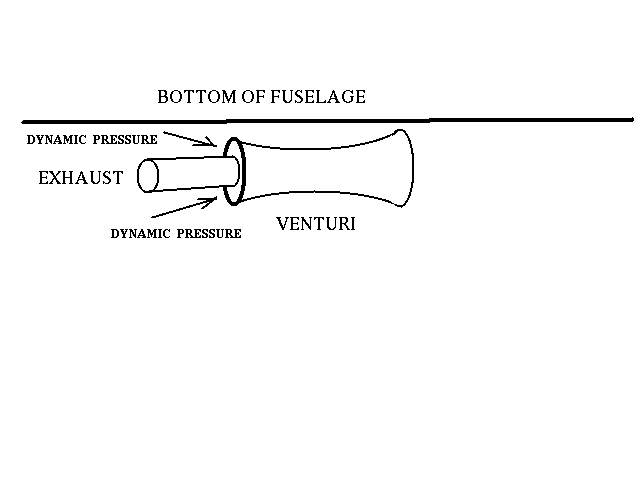
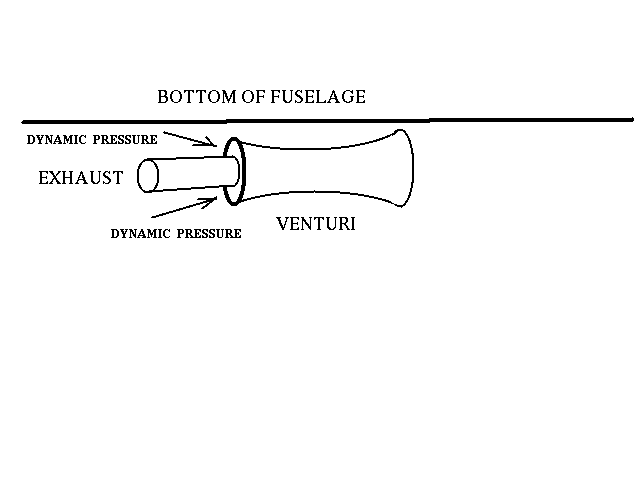
BTW speaking of lower pressure  here is another idea I just had for the
ends of the exhaust pipes. Kind of like a reverse exhaust augmentor
that uses the forward velocity of the aircraft to lower the
pressure in the exhaust system increasing the power.
I am not sure the additional drag of the venturi would out weigh
the slight additional power gained. Probably not.
I also think the exhaust gas velocity in the exhaust pipe is on the
order of 200 (136 MPH) to 300 feet per second (200 MPH)  so I am not
sure that this would even work :)

On the other hand it might provide additional jet thrust :)

Paul Lamar

The AirCraft Rotary Engine NewsLetter.  Powered by Linux.
ACRE NL web site. http://home.earthlink.net/~rotaryeng/
Copyright 1998-2002 All world wide rights reserved.