> >Page 83 Scientific Design for Exhaust & Intake Systems book
 > >by Smith & Morrison Robert Bentley ISBN 0-8376-0309-9.
 > >
 > >Max torque for a four cylinder engine at 6000 RPM is a pipe
 > >length of 34 inches. Sound familiar for the rotary? Mazda
 > >concurs with their dyno tuning as did Everett Hatch.
 > >
 > >Makes sense as wave tuning depends on the speed of sound in the pipe
 > >alone. In this case they claim 1700 foot per second for the wave
 > >speed. Twice my initial guess. They go on to say it has been
 > >measured at 1300 feet per second in other experiments.
 > >
 > >A very simple formula from the book for a tuned intake pipe is:
 > >
 > >L = (72 X C)/N
 > >
 > >L = length of the pipe in inches.
 > >N = RPM
 > >C = the velocity of sound in feet per second.
 > >Varies from 1100 to 1700 take your pick depending on temp.
 > >The lower the temp the lower the speed.
 > >
 > >Plugging our numbers in gives 72 x 1100 / 6000 = 13.2 inches.
 > >
 > >This is the formula used by Chrysler with their ram tuned
 > >V8 engines which were quite successful.
 > >
 > >I highly recommend this book and I think 32 to 34 inches is
 > >the right place for the exhaust collector.
 > >
 > >One of the things I would like to do with the dyno is measure the
pressure
 > >along the length of an exhaust pipe in real time. Low on the priority
 > >list right at the moment but us nerds have to have fun too :)
 > >
 > >Paul Lamar
 >
 > Questions:  at any particular RPM is the exhaust temp constant and
 > predictable?  It seems like the exhaust pipe length would have to
 > vary with the mixture.  Tracy is operating his engine one or two
 > hundred degrees below peak and most of  us want to do likewise.  How
 > does this reality interface with the ideal exhaust pipe length?  If
 > you tune you engine for 6000 rpm, is it then out of tune at 5500 rpm
 > or 6500 rpm?   Does a pipe become gradually more in tune as it
 > approaches the ideal length or is it suddenly in or out of tune.
 > Example,  I was trying to attain 32inch pipe length but had to settle
 > for 28 inches.  Does this mean that to have a tuned engine all I
 > would have to do is operate it at a higher rpm where 28 inches was
 > the perfect length?        Should the engine be tuned for max
 > performance at 6000 rpm or should it be tuned for best cruise
 > performance?    And so on.......Jerry
 >

 True but it does not seem to be that critical. +/- 500 RPM
 will not make that much of a difference.

 Take your pick. If you tune for cruise you might be able
 to reduce the fuel burn.

 Paul Lamar
Without going to school for 4 years, what should a system look like that
would work well? I can give you some ideas from stealing everything I can
from the people that go faster than my car. Some apparent truisms. There are
a number of lengths that work just fine. So long as the primary pipes are as
close to the same length and enter the collector at the same angle, you
almost cannot go wrong.
The Formula Mazdas have a very limited space from the
side of the engine to the tub. So the primary pipes are very short. Perhaps
11 inches total with a short collector. They are very close to stock 13Bs and
produce over 170 HP with very effective mufflers in place on a short run of
pipe after the collector. When racing starts again I will measure on of these
systems and post some pictures for you. A short collector tends to be
slightly more peaky and a long collector tends to be less peaky. Primary
tubes entering a collector at a shallow angle tend to be less peaky. Primary
tubes entering the collector at a steep angle tend to be more peaky.
Some
years back the National champion had very short primaries on a system that
looked much like the current Formula Mazda system. So the very short
primaries say 10 to 11 inches are best for 8 to 10 thousand revs. It works
fine everywhere but has its very best performance very high up the band. So a
short system for 6 to 6.5 thousand would be around 16 to 18 inches. It would
perform its best at 6 thousand or higher but would be good everywhere.
Because the tubes are exactly the same length and enter the collector at
exactly the same angle. The short system is lighter (less tubing) leaves more
space for shields and the like, and with a slip joint before the collector
the system will be far less likely to crack anywhere. Then the collector and
down tube can be one piece with a slip joint at the muffler.
Mount the
muffler soft in hangers with spring loaded straps and the engine can flop
around in the mounts with out stressing any of the system. The long system is
just a bit better for peak power and has better power over a broader band,
but it is only a few HP and the extra weight, may not in the end, be worth
the trouble.
I have 22" primaries on the race car. It is the long system but
is good above 9,000 RPM. The short system would be as close to 10" as
possible but you end up with rather steep angles into the collector so there
goes the broad power band down the drain.
The primary tubes need to be the
same as or just slightly bigger than the ID of the port liners. Big primaries
mean higher peak power but narrower band. Smaller primaries mean broader
power band but less peak power.
Almost everything about the rotary exhaust
system works the same as a piston engine. So the rules are about the same.
Instead of a poppit valve slowly opening and closing the end of a tube that
is closed most of the time, the rotary engine's end of the tube is always
open to the inside of the engine. I am not convinced that the sonic tuning
part of the equation can be calculated to any good use. Since the exhaust
port opens in near zero time, and the exhaust gas leaves at supersonic speed,
and at first isn't the leading edge of the pulse the sound? And it is already
going faster than it is possible for sound to travel? So the nearly solid
slugs of gas at hypersonic velocity are dragging empty (lower pressure)
spaces between them that will be used in the collector to help blend the
slugs from the other primary and then into the down pipe, still supersonic
and into the muffler to be homogenized to the extent possible and slowed to
subsonic speeds. I have a vivid full color imagination.
I cannot imagine reversing sound waves traveling back up the system and doing
anything like what some books say is going on. Like shouting into a
supersonic wind. Where would the sound go? There may be a series of standing
shock waves (like the shock balls in a jet exhaust in afterburner) doing this
or that in there but I think to attempt to gain anything like useful power
from any of that is just beyond the scope of anything but fully equipped lab.
And even then there would have to be as different study for each installation
because every one is going to be different.
So, keep it loose (slip joints).
Keep it simple, keep the primaries exactly the same length and you will have
more power than you can use. And if you get to the point that you want more
power than that. Go to bridge ports and add more rudder offset.

Lynn E. Hanover
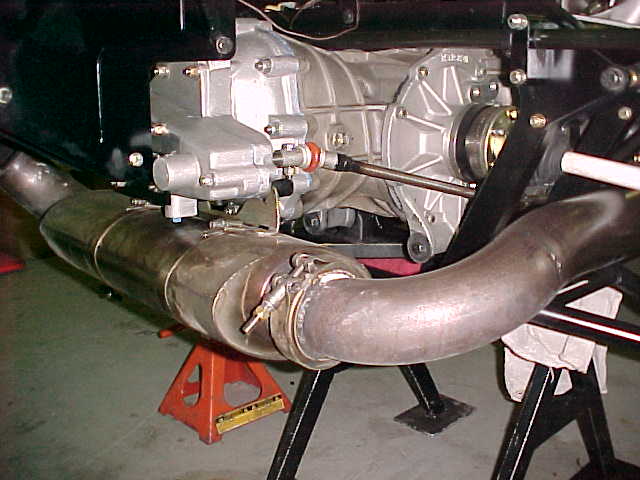
Here are some pictures of the Star Mazda spec cars Lynn mentioned.
Note the three inch diameter down pipe.
Remember however race cars need high torque over a fairly wide
RPM band. We on the other hand only need peak torque for take off RPM.
A wide band system will sacrifice peak power but might reduce
the fuel burn slightly at cruise RPM.

Much of the Scientific Design for Exhaust & Intake Systems book deals
with the shape of the pulse after it leaves the poppet valve. There is much
experimental pressure data as a function of time in the book. A large part
of the book deals with high speed methods of measuring the pulse shape
and pressure profile as a function of time.

Even piston engines have exhaust pulse leading edges that are initially
supersonic. The wave soon slows down however to the speed of sound in the
pipe given the temperature of the gases. Even though the pipe is always
open at the engine  more or less there is still only one pulse per rev
per rotor coming out of the exhaust.

Here is the results of the Mazda work with the rotary again. It does indeed
respond to wave tuning or these curves would be straight lines as no
collector was used. According to this chart one could lose 10% in power
at 6000 RPM if for example you used 15 inch pipe instead of a 31 inch pipe.

I am not saying collectors don't work. I think
you will get more power if you also pay attention to the position
of the collector on the pipe. In other words wave tuning
as well as inertial or momentutuning.

It is interesting that 11 inches shows up in some race car experience.
That is an integral multiple of 33 inches. 3 x 11 = 33.
So too 22 inches. 2 x 11 = 22. I suspect the following numbers might
work at 6000 RPM; 11, 22, 33, 44, 55, and 66. The 61 number does well
in the Mazda work. For example; if the collector is located at 33 inches
and the muffler is located 11 inches beyond that then you MIGHT have a
very sharply tuned system at 6000 RPM.

Only your dyno operator will know for sure :)

Paul Lamar

The AirCraft Rotary Engine NewsLetter.  Powered by Linux.
ACRE NL web site. http://home.earthlink.net/~rotaryeng/
Copyright 1998-2002 All world wide rights reserved.