Dan Ruggirello wrote:
Hi folks,
I am making great progress on the Bushcaddy fuselage.  I seem to have
the
rotary on my mind alot during the building process though.  Probably has
something to do with the great newsletter traffic ;-)  Lately, I have
been
thinking alot about turbos, so I have a few questions.

1.  Has anyone thought out a method to control boost for a stock 2nd gen
turbo?  Looks like it is electronically controlled for stock?

2.  I will only require about 230HP from a 13B TII engine, so I suspect
the
boost will be rather low.  (Any estimates what boost pressure to develop
230HP?) Would it be difficult to control the stock turbo this low (if it
is
low)?

3.  Any ideas how to enable/disable the stock turbo for intermittent
use?
(Take-off and high altitude cruise) Would a mechanical system be
feasible?
Would a muffler be required?

4.  How is Greg Richter controlling boost for his Cozy (not sure the
current
status of it)?  Is it controlled to 8 psi only by the full time TO4
turbine-compressor design?  I saw that he was using an HKS 12psi BOV in
the
intake, but this appears to be for safety.

Dan Ruggirello
My guess is 8 psi on the boost for 230HP. Stock is 5 psi 205 HP with
a muffler. More without. The stock gate is controlled by a pneumatic servo
sensing the intake manifold pressure. It is possible to control
the stock waste gate with a push pull control cable instead.

I don't plan to run a muffler as IMHO the turbo does a pretty good job.

Paul Lamar
Dan Ruggirello wrote:
Hi Paul,
So, is the 89-92 a fully mechanically controlled wastegate?  I read that pre
89 were solely mechanical and 89 and on are electrically controlled.  Could
it be possible that the pressure through the pneumatic servo was controlled
by an electric valve somewhere?
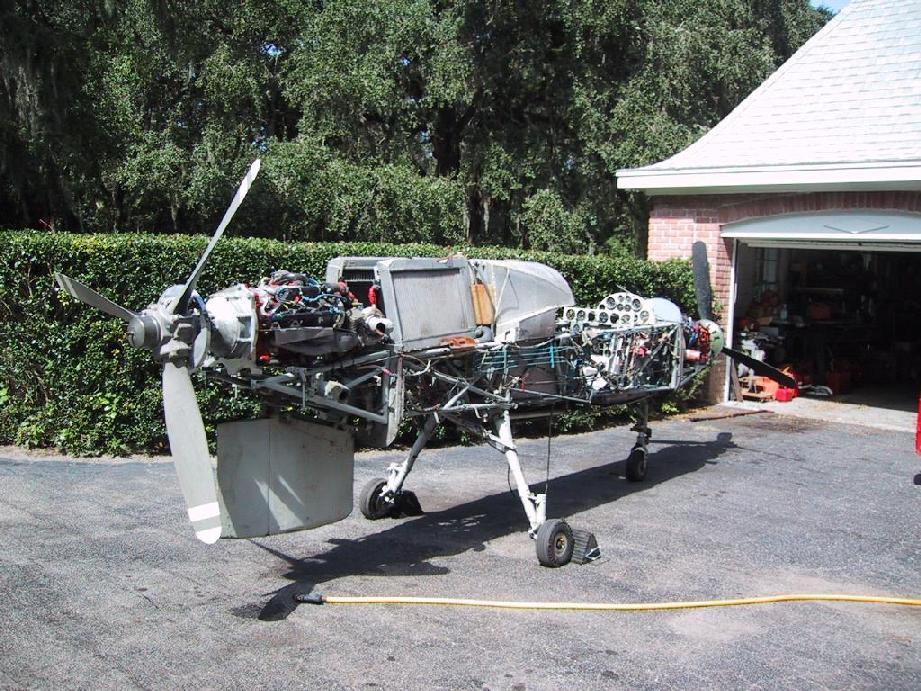
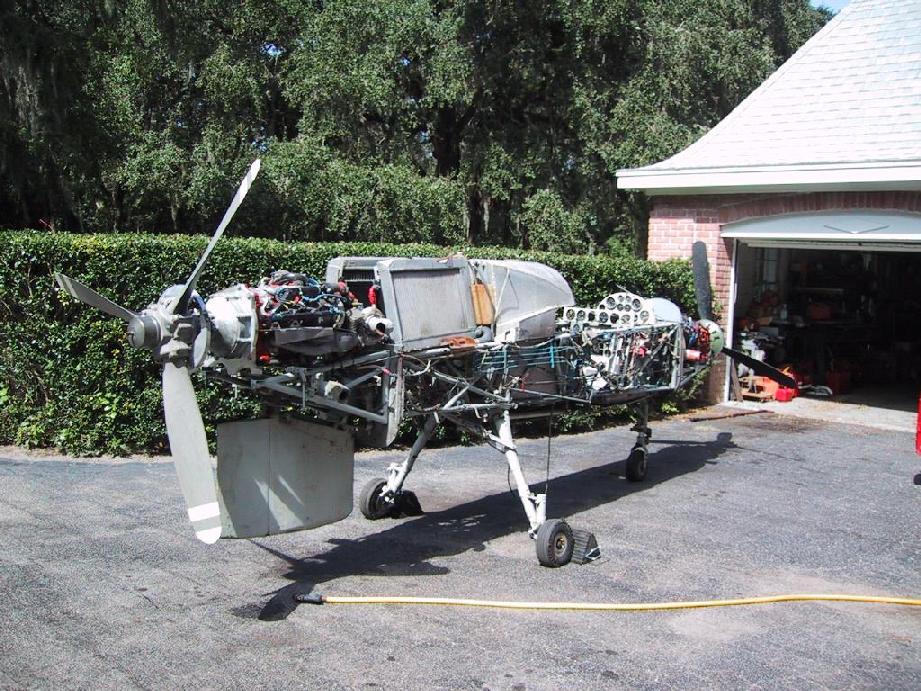
Hang on I'll check the shop manual. Ah so there is a T in the pressure
sense line that goes to a solenoid valve. The answer is therefore yes.
I suppose the computer senses knock and closes a bleed line fully applying
manifold pressure to the servo and opening the waste gate. At least that
is my guess on how it works. I could be way wrong. I suppose you
could use a manual needle valve and do the same thing.
Thanks for the pics!  Wouldn't the engine be loud when opening the
wastegate?
I suspect it would be louder :) Probably not as noisy as a Cessna P210
or AT6 in fine pitch during takeoff.
It appears that using the stock turbo will be an easier set-up
than non-stock since the wastegate is built-in which doesn't require
bringing the bypass gas back into the exhaust downstream.  I am concerned
though that fuel efficiency will suffer if I cruise with the wastegate open
since there are so many turns in the bypass exhaust system as opposed to NA.
It would help sans muffler though.

So as far as turbo fuel consumption goes, let me get this right.  In an
earlier post it was mentioned that the BSFC actually goes down, right?
Seems like another good reason to turbocharge.
Well I am not completely sure about that with a fixed pitch prop.
Engine friction is a big parasitic consumer of fuel so if you can run
the engine at a lower RPM with a high pitch prop and some turbo boost
it should be more economical.
Someone mentioned that the turbo would increase the heat load in the engine
compartment.  Do you have an estimate on what heat this would add?  Wouldn't
most of this be radiation and reduced with proper shielding?

Dan
Compared to what? Compared to an under the cowl muffler probably not
a whole lot more. Certainly more than an under the fuse muffler.
Shielding is definitely called for. Rig a blast tube to feed cooling
air to the space between shielding and the turbo.

BTW I forgot to answer your question on how Greg Richter controls
his boost. He flies the boost gage with the throttle. No waste gate.

The rotary is not like a turbo charged aircraft piston engine.
Over boost an aircraft piston engine and you can blow a cylinder
head right out through the side of the cowl. The rotary will withstand
an enormous amount of over boost up until the engine detonates and cracks
an apex seal. Other than a fractured seal nothing else happens.
A two rotor will generate up to 800 HP with a pile of boost if
you can prevent detonation with the proper mixture and a cool enough
intake charge. Structurally speaking the rotary is nearly indestructible.

The two piece 3 mm steel apex seals from Hurley engineering are highly
recommended for turbo engines as they are much more robust and less
prone to fracture than the three piece 2 mm cast iron factory apex seals.

I ran Dave Garbers dual turbo 12A engines at Sun & Fun last year
at 45 inches of mercury at only 4500 RPM. His engines
will generate 56 inches of mercury at about 5500 to 6000 static
RPM if you run them WOT. No waste gates. No inter coolers. The
PSRU is three to one. Take a look at the large  diameter and high
fixed pitch of those huge three bladed props!!!!

BTW this airplane is still up for sale.
Now there is a worth while community goal Butch.

Paul Lamar

The AirCraft Rotary Engine NewsLetter.  Powered by Linux.
ACRE NL web site. http://home.earthlink.net/~rotaryeng/
Copyright 1998-2002 All world wide rights reserved.