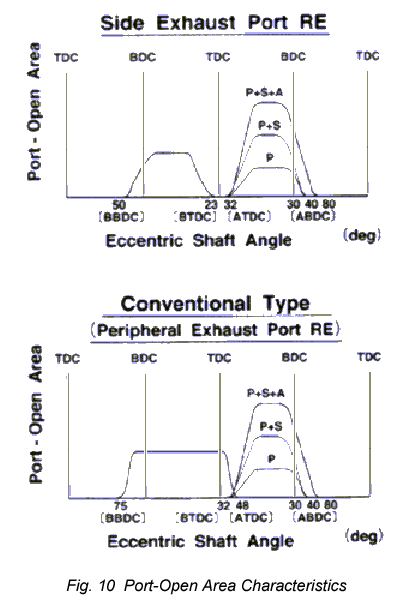
Here is the one pulse scan.
The left side of the graph is the opening of the exhaust
port and the right side is the closing of the exhaust
port. In a rotary this takes 180 degrees of e-shaft rotation.
The BDC and TDC numbers in this graph is for a piston
engine so ignore those numbers.
...
Paul Lamar
Paul -

As I understand it, the peripheral exhaust port:
"OPENS" when the apex seal passes the port bottom
"CLOSES" when the following apex seal passes the port top

Assuming the exhaust port is a single point on the peripheral housing
(really small), then the minimum e-shaft rotation is 360 degrees (not
180).  The ROTOR completes 1/3 rotation (120 degrees), but the E-SHAFT
completes a full rotation (360 degrees).

Of course, the peripheral exhaust port isn't a single point, but covers
a finite area on the peripheral housing, requiring additional "degrees
of travel".  Therefore, for peripheral ports (exhaust or intake), the
MINIMUM opening time is 360 degrees - and that's for infinitely thin
ports.

It follows that peripheral port "timing" must OVERLAP between one
"chamber" and the next (exhaust or intake).  They MUST be more than 360
degrees.    This makes sense when you look at it.  When the apex seal is
OVER the peripheral port, the leading chamber is STILL CLOSING, and the
following chamber has ALREADY OPENED ... overlap.

*****

I'm hoping that the port "timing" and total area options provided by the
Renesis side housing ports will really help us out here.

- Vince Orton
Right! My mistake 360 degrees. Once per e-shaft revolution.
thanks for catching that. That could cause a brief exhaust gas flow
into the leading chamber that is beginning the intake phase.

On the other hand that could also mean there might be some suction
due to the inertial effect of the sudden rapid escape of exhaust gases.
Suction that is on the leading side of the apex seal that is beginning
the intake stroke.  Hard to say with out some sort of high speed pressure
or flow instrumentation.

The exact situation would then be a strong function of RPM and pipe
length. Suck at some specific RPM's.. back flow at other specific RPM's.

With turbo engines it is well known that the pressure in the intake
manifold can be higher than the pressure in the exhaust pipe with a
consequently loss of mixture down the exhaust pipe during the overlap
period. Far more pronounced when you turbo a peripheral intake port engine.

Here is the overlap diagram for the RX8 engine compared to the
current exhaust peripheral port engine.

Paul Lamar

The AirCraft Rotary Engine NewsLetter.  Powered by Linux.
ACRE NL web site. http://home.earthlink.net/~rotaryeng/
Copyright 1998-2002 All world wide rights reserved.