-Dan Ruggirello wrote:
No problem.  Just want to contribute to the group however I can. And I am
learning a bunch about cooling issues too.

It is curious having a low inlet pressure.  The attached pic shows a
decreasing pressure towards the inlet....... but pressures still greater
than the exit.   I am inclined to believe the problem lies in too high an
exit pressure as Paul said.  Does the duct have its own exit, or does it
dump into the pressurized engine compartment?

Dan
That one is real strange Dan. Too bad the weather is so bad. I would take
my water manometer up and help Perry measure some pressures. Perry,
how about a RS232 module data acq system. Do you have a note book computer?
Do you have a digital camera to take some pictures of the water manometer
mounted in the back seat over your shoulder? I can ship you
the water manometer and a bunch of tubing.

Paul Lamar
I don't have a notebook but could maybe borrow one. I don't have a
digital camera either.  I'm in the process of modifying the top cowl. I
flew yesterday morning, it looks like I didn't gain back the power I
lost with the new intake manifold, RPMs were the same, but I think I
gained 5-7 knots, up to around 137 knots.

I thought that upper cowl surface between the strake and the fan would
be a low pressure area, but if it's high pressure like Charlie England
says that might be why I've had so much trouble with the oil cooler in
the area on the left side of the engine. The inside of my cowl is not
pressurized, it is in a partial vacuum because of suction from the fan.
The best oil cooling I got was with the upper cowl closed up over the
oil cooler, with a big hole in the back of the cowl in front of the fan,
putting the exit side of the oil cooler and the whole engine compartment
under low pressure.  That was the only way I could make it work last
summer and even then it was marginal, basically couldn't fly above 80F.
With the exit side ducted to the top of the cowl like I have it now (as
you did the simulations) it is not cooling as well as it was then and
will be trouble this summer.

Perry
That is a huge improvement!! Congratulations. There is hope for this
direct drive configuration after all :)
That means the prop is more efficient due to cleaner air. You may still
have more power at the same RPM without realizing it. More prop load
around the hub would explain that.

It is very unlikely the top aft of the strake is high pressure if it
were not for the duct and fan. The fan could be dragging air around
in front of it and impacting the top of the strake right in the
vicinity of the oil cooler air out let. Looking at it from
the front the engine rotates clockwise. That means there could be
a vortex in front of the prop also rotating clockwise. This vortex
could be impacting the top of the aft strake on the right side
(looking from the front) near where the oil cooler is. Something
really difficult to simulate with out a full blown 3D CFD program.
Just a theory.

You need to do a bunch more pressure measurements. Or build something
like Dan suggested in this simulation gif. This would shield the
outlet from the vortex vertical component (if it is there)
and allow the suction of the fan to work.

On the data acq you could buy a cheap cardboard box camera and send me the photos.
I can scan them. I'd like to see some pictures of the new manifold as well.
Also the new air outlet for the oil rad.

BTW How are the post 93 thrust bearings holding up?

Paul Lamar
I used to have a big hole in the left side rear of the cowl (looking
from rear) as an exit for oil cooler.  This was the closest point to the
fan.  When I closed that up and moved the cowl trailing edge forward
about an inch I gained 100 RPM. I thought maybe I would gain RPM with
the bumps removed from the upper cowl, but no difference.  I'm guessing
they were too far forward to have a power-robbing effect on the fan.
 But the path for the air to get to the fan certainly is much improved.

Your idea of the CCW fan (viewed from the rear) pushing air toward the
upper left side cowl makes sense. I'm making cowl mods now so I intend
to put that shield in front of the oil cooler exit and try that.
 Everything is very rough right now, when I get it cleaned up in a
couple weeks maybe Mike McGee can come over and take some pictures.

About 230 hours on the new engine now, haven't noticed any change in the
end-play so can only assume the thrust bearings are ok.

Perry
When you moved the trailing edge forward one inch and gained 100 RPM
that is evidence for the vortex theory.

Try moving it forward five inches :)

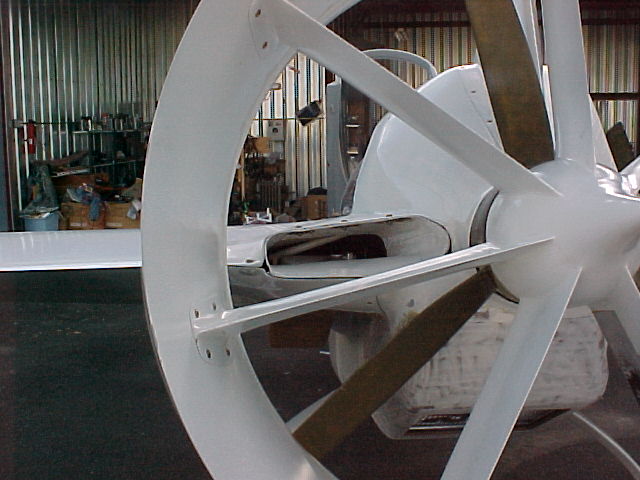
Old picture of Perry's duct.

Paul Lamar

The AirCraft Rotary Engine NewsLetter.  Powered by Linux.
ACRE NL web site. http://home.earthlink.net/~rotaryeng/
Copyright 1998-2002 All world wide rights reserved.