Dan Ruggirello wrote:
Why not. Lets have a go at it! But, I don't understand what you
mean,
Paul, by a straight section prior to turning the flow. Do you mean
that the
outlet duct narrows to the left of the heat exchanger?
Yes he does.
How about an exit like this instead? I think what Russell is after is
to turn
the radiator more head on into the flow, right?
Correct.
If so, it seems like the heat exchanger would offer less resistance to
flow in
this configuration.
That's what I'm speculating about. Specifically the type of pressure
wave
reflection resistance that having the exit wall too close to the
backside of the
radiator (as Paul pointed out). I'm wondering if the nearly right angle
turn of
the airflow to pass through the radiator is setting up "micro scale"
reflections
within the air passages of the radiator itself.
I spoke with the developers and compilations for unix and linux should
be easy
to do. And of course the nt executable is already compiled. The
software was
not written for parallel processing and he said it would be difficult
to
implement for their algorithm. Bummer.
Yeah. I've got a 2 CPU box at the house running Win2K.
I have been looking into other cfd codes. There is one written under
nasa/dod
grants called NPARC WIND and is free and I believe is capable of
parallel
processing and 3D. The only problem is that access to it for
individual
experimenters like myself is a bit difficult. Apparently it is only
available
to "U.S. owned companies, public and private universities, and
government
agencies" and you need to get an export control number for
non-government
agencies. It does piss me off that I pay for the development, then I
can't use
it. (Just like stinger missiles - I payed for them, so I should be
able to
purchase one for fun, right ? ;-) I don't have a company set up, I
guess that
would be my next step.
Paul Lamar responded:
K&M did some work and they came up with this graph.

Russell Might be able to get that code through his employer.
Dan, send me infor on both the CFD package you have now as well as the
NASA NPARC
WIND stuff.  I'll see what I can do.

Now that Paul and Al have pointed out the flaws in my Microsoft Paint
drawing
(yeah, yeah, it's a poor craftsman who blames his tools...), I've
re-drawn it.
This better?

Of course this is all a moot issue if Perry is unable to turn the oil
cooler.
Russell Kent
Do you want me to tell you what is going to happen? :)

Paul Lamar
Dan Ruggirello wrote:
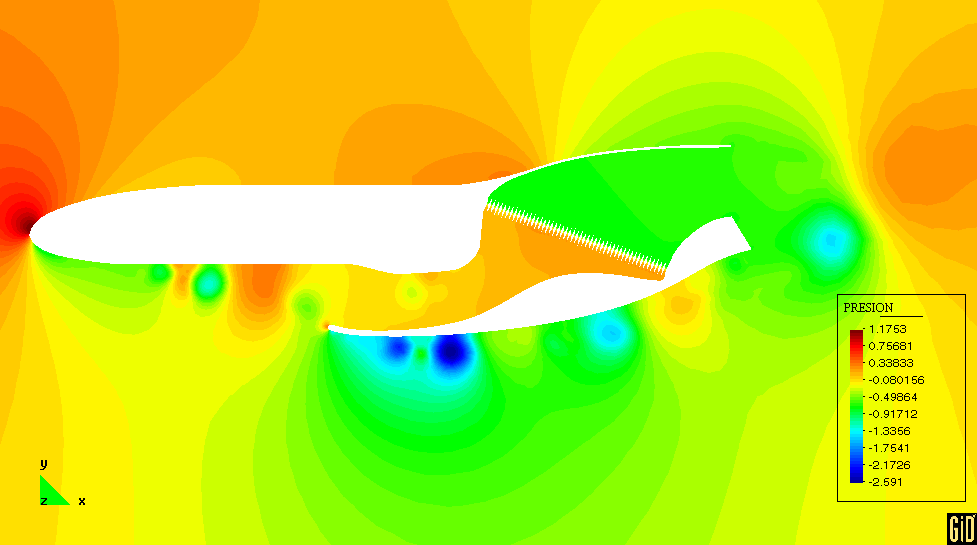
Here are some results..............when animated, you can see the low
pressure eddy's from BL separation continuously rolling into the duct, then
dissipating.  It appears that this run has full on BL separation.   I
probably should allow one of the other sims to run longer to verify if they
too would have full on BL separtion.

Hmmmmm........inlet pressures through the duct seems lower than other runs.

Dan
What a mess. Sucking in the boundary layer is a no no.

Paul Lamar

The AirCraft Rotary Engine NewsLetter.  Powered by Linux.
ACRE NL web site. http://home.earthlink.net/~rotaryeng/
Copyright 1998-2002 All world wide rights reserved.