Dan, If you don't mind run one of these configurations for us.
It will give us an idea of how well the CFD correlates with
the work done by K&M, Kays & London and Hoerner.


Paul Lamar
-Dan Ruggirello wrote:
Paul,
Here is a model I ran for correlation.  The inlet coordinates are
directly
from table 12-1.  I eyeballed the exit geometry as close as I could to
figure 12-17.

cfd_corr_1_1.gif - wall pressure of inlet.  Values directly from model.
cfd_corr_1_2.gif - wall pressure of inlet.  Values from model offset to
match figure 12-11.

Reynolds number was 8E5.  Model velocity and pressure are non-dimenional
as
usual.  Ai/Ar = 0.40

Dan-
Very very interesting Dan. Thanks. Seems to correlate well with what K&M
did
years before CFD was available. That Me109 configuration would also
be interesting. The one with the bullet in the exhaust duct.

Paul Lamar
Dan Ruggirello wrote:
Paul,
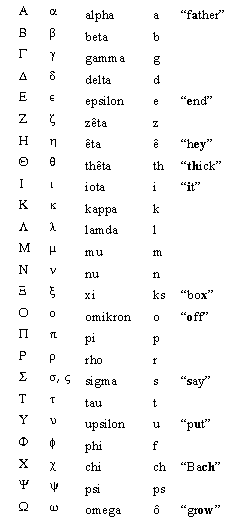
What are all the variables shown in the graph area of figure 5 of the Me109?

Dan
Its from page 9-5 in Hoerner's book Fluid Dynamic Drag.

Efficiency is on the left y axis.  A formula is give for the efficiency
to define it I think. The funny looking vertical squiggle line is
called the pressure loss coef. In this example the curve is plotted using
a pressure loss coef. of 3.2 I suspect. The measured data is plotted around
that curve.   w/V is the ratio of input velocity
in the duct at the face of the core (w) over the forward velocity of the
aircraft (V) and is the x axis.

c is the cord of the wing.

S is area. So S sub block / S sub i is the rad area over the inlet
area I think. Inverted over the way K&M defines it.
It is 6 so that is about 16% I think.

Here too is another interesting Hoerner graph on this subject.

To really get a handle on what he is talking about you will have
to read the whole book. Or at least chapter 9.  He kind of builds
up on everything right from the start of the book. I get the impression,
from my limited knowledge of aerodynamic theory, that he generates his
own nomenclature. Each book I have on this subject
uses different nomenclature. Kays and London call diffusers
"headers". A major head ache when trying to decipher this stuff :)

If there were two of me one of us could scan it in and convert that
chapter (Chapter IX - Drag Due to Internal Flow Systems) to a pdf file.

Peter G might be able to enlighten us on this subject. I am sure Peter
has the book.

Paul Lamar
Here is some more Hoerner stuff Dan. The first one is very interesting.
It compares wing rad stuff from NACA 743 with stuff the Germans did on
the Me109 full scale.

Paul Lamar
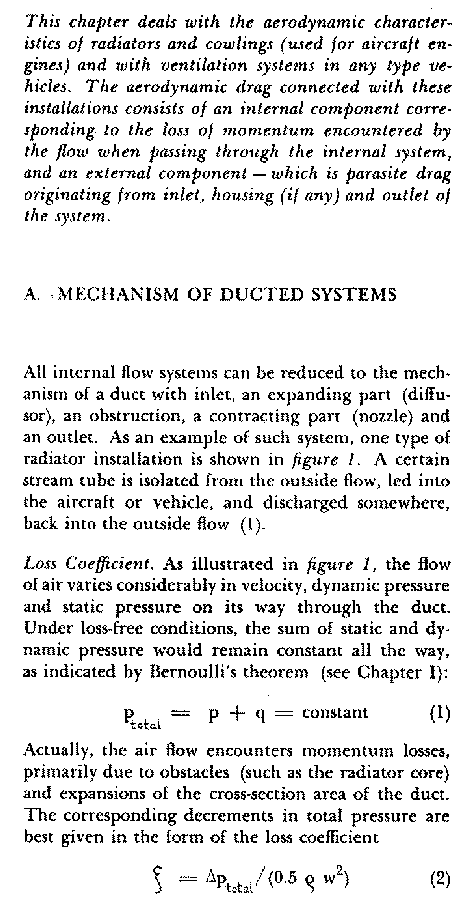
Here is the first half of the first page in Chapter 9

Paul Lamar

The AirCraft Rotary Engine NewsLetter.  Powered by Linux.
ACRE NL web site. http://home.earthlink.net/~rotaryeng/
Copyright 1998-2002 All world wide rights reserved.